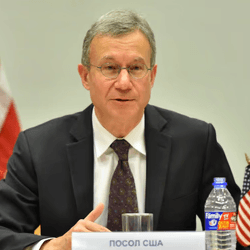
Daniel Rosenblum
AFL-CIO Free Trade Institute U.S. State Department, Retired, Former US Ambassador
Biography
This interview includes three separate videos and transcripts. The additional interviews can be accessed through the links below.
(1): AFL-CIO Free Trade Institute, working with independent Russian labor unions
(2): U.S. State Department, Coordinator of U.S. Assistance to Europe, Eurasia, and Central Asia
Ambassador Rosenblum’s interest in the Soviet Union started as a child through his father, who helped establish the American movement to save Soviet Jews from religious persecution,growing up immersed in Cold War politics. This led him to study Russian history and language at Yale. After a four years advising U.S. Senator Carl Levin (D-MI) on foreign affairs and international trade, he earned a Master’s degree in Soviet Studies from Johns Hopkins School of Advanced International Studies.
Following grad school, he worked for the AFL-CIO’s Free Trade Union Institute, an NGO that supported independent labor unions in the former Soviet Union.
Joining the State Department in 1997, the first part of his diplomatic career was spent administering U.S. foreign aid programs supporting the sovereignty and stability of Eurasia and the Western Balkans. He then served as Coordinator of U.S. Assistance to Europe, Eurasia and Central Asia from 2008-2014, including oversight of US aid programs in Russia.
During his last decade at State, he focused on the five Central Asian states as Deputy Assistant Secretary of State for Central Asia (2014-19). Subsequently, he served as U.S. Ambassador to Uzbekistan and then to Kazakhstan. Ambassador Rosenblum retired from the State Department in March 2025.
Summary of Main Topics Covered
Interview Summary
Daniel Rosenblum’s interview offers a detailed insider account of U.S. assistance policy toward Russia and the former Soviet states during the 1990s and early 2000s, illuminating both the ambition and the limits of America’s largest post–Cold War engagement effort. Moving from work with the AFL-CIO’s Free Trade Union Institute into the State Department’s Office of the Coordinator of U.S. Assistance to the New Independent States (S/NIS/C), Rosenblum explains how the 1992 FREEDOM Support Act created a new framework for coordinating billions of dollars in aid—approximately $6.3 billion during the 1990s alone—aimed at fostering market economies and democratic governance .
The interview highlights the mechanics and politics of that effort: vertical and horizontal coordination across agencies including USAID, Treasury, Commerce, USDA, and Defense; oversight of enterprise funds such as the U.S.-Russia Investment Fund (TUSRIF); and the experimentation that defined the period, from American Business Centers and BISNIS to the Eurasia Foundation and large-scale exchange programs. Rosenblum describes his leadership of the Regional Investment Initiative under the Gore-Chernomyrdin Commission, focusing assistance on Novgorod, Samara, Tomsk, and the Russian Far East—regions selected for reformist governors and investment potential. He recounts both early optimism and the growing suspicion that followed, as centralization under Vladimir Putin, media attacks, and concerns about foreign-funded NGOs led ultimately to the closure of USAID’s presence in Russia in 2012.
Spanning humanitarian airlifts, food aid controversies, people-to-people partnerships, and the evolution toward locally implemented grants, Rosenblum’s reflections capture the scale, experimentation, and ideological confidence that characterized U.S.–Russian engagement in the post-Soviet decade. His account provides essential historical perspective on how American policymakers believed transition could be guided—and why that belief ultimately collided with political realities inside Russia—making this interview a vital record of the largest sustained interaction between Americans and Russians in modern history.
Daniel Satinsky: Okay, so it’s good to see you again, and we’re going to do a little addendum to the interviews that we kind of pulled to a formal end, but this is too important a topic to leave out, and it’s something that you bought up, and I think it’s really germane to this whole period about the impact of U.S. politics on U.S. policy and objectives during this period. So, I know you had some things you wanted to say about that, so please.
Daniel Rosenblum: Yeah. No, absolutely. I did think it was important to talk a little more about this. You know, I think the first time I became aware of the impact politics was having on our assistance and on policy towards Russia was when I heard the story of how my boss became the head of the coordinator’s office. So, Richard Morningstar, who I had mentioned earlier, who was a political appointee, he was very close to Hillary Clinton, as I recall. Maybe they went to school together or something. And I will say, you know, some people have the image that political appointees are just cronies, or they’re only in the position because they made a big contribution. He was actually a very well qualified person. He was a businessman, but he had a lot of executive experience, and incredibly smart, and I can’t say enough about what a capable steward of American taxpayer money he was, and also just a very creative and dynamic boss.
But he took over that job in 1995, which was two years before I started, because as you’ll recall, I started in ’97. But apparently the first coordinator was a guy named Tom Simons, who was a diplomat, a foreign service diplomat, had been an ambassador, I believe. And I don’t think it was really his own fault, but he got caught up in a lot of political, I don’t know, criticism, and a firestorm on the Hill about the way the money was being spent that had been appropriated by Congress in 1992 and ’93.
The first appropriations made under the FREEDOM Support Act were very big. There was a front-loading of the money. I want to say it was like $1.5 billion the first year and maybe another half a billion the second year, a lot of money upfront. And as I think I mentioned in earlier discussions, I don’t think anyone had a very good idea of how to spend it all usefully. This is a common problem in American foreign policy, or it used to be when we had a lot of foreign aid, which is that the money all flows to the biggest problem, the biggest headline of the moment, and it’s always too much to absorb. And then when it’s not absorbed, or some of it is spent poorly, because there’s just too much of it, then the criticism starts, and everyone starts chipping away at how you could have done this.
And that’s what happened here, too. And so especially—most of that initial money was going for Russia, not the rest of the region, and I think by the mid ‘90s there was this sense that we were probably…people in Congress, many of them thought that we were either wasting the money, not spending it fast enough, or making foolish decisions. There was also, around that time, this big scandal broke about the Harvard Institute for International Development and its work in Russia, and some potential conflicts of interest on the part of the people who were leading it, so this all, this was a perfect storm that led to Tom Simons losing that position, and it being given to Dick Morningstar who, as I recall, was seen as someone who had better political instincts, would be able to sort of ride through this period because he was well connected with the White House and he understood the political temperature, so to speak. So, that was in ’95.
And by ’97, when I joined the office, some of that firestorm about money being wasted or not being spent fast enough had subsided, and the budgets were lower, but still significant. But when I was there what we started seeing happening in ’97, ’98, and especially ’99 and 2000 was an intensification of investigations, congressional hearings, GAO studies—that’s the General Accounting Office, which Congress empowers to sort of do audits of government programming and government spending—of the Russia assistance in particular.
Daniel Satinsky: And do you have any idea what caused that upsurge of hearings and investigations?
Daniel Rosenblum: I mean, I think it was—and I haven’t done a deep study of it and looked at the documents from the period—I’m pretty sure it was largely political in the sense that I think that at that point Republicans controlled both houses of Congress, you had the Clinton administration in office, and the Republicans controlled Congress, and clearly were using it as a springboard to criticize the Clinton administration. Obviously this pales in comparison to the Monica Lewinsky scandal and the impeachment attempts with Clinton and everything. Obviously, that was the big headline stuff, with Congress using its power, the Republicans in Congress using the power to really go after the Clinton presidency. But as a kind of sideshow the Russia aid was a big thing, too.
I remember there was a congressional committee or commission that was formed called the Cox Commission, which was headed by Christopher Cox, who was a Republican congressman, maybe from Connecticut—I can’t remember what state, maybe New York. But it was all about: a. have we wasted a tremendous amount of this aid, you know, has it been spent for foolish things, or misguided things, and is it all being accounted for, does anyone know where it all is; and b. has the Clinton administration been too cozy with Boris Yeltsin, and ignoring things that they shouldn’t have been ignoring in terms of corruption. And we talked earlier about the oligarchs emerging and all that. So, it all added up to there’s something that doesn’t look right here, and we’re going to get to the bottom of it.
And so the Cox Commission issued a report, I remember, that was scathing in its criticism of the Russia program. And throughout this period, when these hearings were happening, the Cox Commission, GAO reports, our office was the frontline responder to a lot of that, because we were tasked within State with responding to congressional letters, to GAO—GAO always gives the agency being investigated a chance to comment, so we would prepare the comments. And I would also say I think the White House and the NSC in particular looked to us to come up with the right narrative and explanation of what our strategy was in Russia, and what we were trying to do with the funds.
And I’ll add here, going back to something I said earlier, that this was part of what drove Morningstar to, I believe, come up with a different way of explaining what we were trying to do in Russia—and not just Russia, the whole former Soviet space—with this thing called the Partnership for Freedom, which I mentioned earlier. He came up with this concept that we’re going to spend a lot of money in this effort to partner Americans, American organizations, businesspeople, scientists, experts in a variety of things with counterparts in Russia and the other countries, and that that’s what’s going to drive forward transition to market economy, transition to democracy. And I think that was a way of recasting our approach to make it, I don’t know, maybe more palatable or just more attractive to people in Congress.
And I’m not sure that did anything. I don’t think it did anything to lessen the political pressure that was coming from Republicans in Congress because I think they saw they had—they felt they had an issue that was resonating somewhat with the public, or certainly with the media, and that put the Clinton administration in a bad light.
And as Al Gore emerged as the likely nominee for the 2000 election—and I don’t remember my political history well enough to know exactly when it was clear that Gore was going to be the choice—but certainly in 2000, if not even in 1999 it was already, a lot of this was used as a way to attack Gore by the other candidates. I’m not sure it came up in the primary from Democrats, probably not, but certainly once the Republicans had their candidate, George Bush, he was using it as a way of attacking Gore for a foreign policy that put Boris Yeltsin first instead of putting America first.
Daniel Satinsky: It’s interesting, given his father’s relationship with Yeltsin.
Daniel Rosenblum: Gore’s father, you mean?
Daniel Satinsky: No, Bush’s.
Daniel Rosenblum: Oh, Bush’s father. Oh, yes, of course.
Daniel Satinsky: No, not Gore’s father, Bush’s father.
Daniel Rosenblum: Bush’s father, yes, yes.
Daniel Satinsky: I mean, you know, when I’ve seen accounts of the meeting in the…where…the woods—I’m blanking on the name—where the decision was taken by Belarus and Ukraine and Russia to dissolve the Soviet Union—
Daniel Rosenblum: Oh, yeah. Yes.
Daniel Satinsky: —Yeltsin’s first call was not to Gorbachev, but it was to Bush. And again, this is the account I’ve seen. And that Bush was quite solicitous of Yeltsin—Bush the elder. Anyway, I just find it quite interesting.
Daniel Rosenblum: Yeah. Well, actually, so the denouement of this story actually brings it full circle in terms of Bush the younger, because after he was elected—and frankly, I don’t think that the attacks on Gore over Russia or the Republican investigations were the difference in the 2000 election. I doubt very much anyone’s vote was directly affected. Maybe it had some marginal effect. But clearly the Republicans thought at the time it was a successful political strategy.
But once Bush became president—well, two things happened. First, early on in the new Bush administration they ordered a top to bottom review of our Russia policy. It was a priority item for the National Security Council to re-look at everything we had done. Which, to their credit, that was consistent with Bush’s campaign message, that there was something deeply flawed about our approach to Russia. And part of that was a review of the assistance. So, our office, the coordinator’s office, as usually happened, were tasked with conducting this review. And since I was the Russia guy, more or less, that was my main responsibility at the time, I led the review.
And we took it very seriously. We had a series of interagency meetings, probably eight or ten different ones, thematic, so one looking at economic support, another looking at humanitarian, one probably looking at exchanges and public diplomacy, you know, the whole range. And we produced a report of our findings to the NSC and made some recommendations. And basically, I think the—to be honest, the changes that were made were not radical, in the end. Maybe this is typical of the way bureaucracies work and can absorb the blows of a change of administration and keep going. But we, again, I think we did take it seriously. We looked at what kind of impact we had been having, and what was successful and what wasn’t.
And I think the main change we made is that we decided we needed to emphasize less on aid to the government, and particularly the federal government, more on assistance that would help the private sector, especially small and medium enterprises, more on support for civil society and media, and probably more exchanges. I think we looked for more people-to-people kinds of programs. That’s my recollection now of what we concluded.
Daniel Satinsky: Roughly, how did you measure success? What did success mean? I mean, you know, it’s kind of central to this whole evaluation and back and forth, right?
Daniel Rosenblum: Yeah, yeah. No, it’s a great question because, you know, you would hope that there was some objective measure that you could, you know, indicators you could point to and say yes, this had impact, or this didn’t have impact. Unfortunately, the nature of a lot of these programs, the impact is hard to measure. When you’re talking about foreign assistance, health programs are the easiest to measure, right, because you can look at health outcomes—did less people die of TB or something like that, and therefore you were a success. Or I suppose if you have a program aimed at export promotion you look at did you increase the quantity of exports, and by X amount.
But when you’re talking about—well, even something like support for small and medium enterprise, there were some objective indicators, but a lot of what you’re doing is just creating a better environment for them to operate in, and it may be unfair to say that in a year or two years you’re going to see the impact of that. You need a longer time frame. And even then, there’s so many different variables that measuring it can be tricky. And of course, in some ways the hardest of all is the democracy stuff that you’re doing where you’re trying to build democratic institutions.
Anyway, the point is that we had experts at USAID, some in State and other agencies on monitoring and evaluation, or M&E, as we called it. And these people were creative at coming up with the measurements, the indicators they were going to look for. So, in the case of this review of the Russia program, I vaguely recall, and I’m pretty sure that what we did was we kind of collected all the evaluations that had been done by these M&E specialists from like 1995 until 2001, and kind of tried to draw some conclusions based on what they found.
Some of it was probably anecdotal as well. We were just collecting stories, impressions. And we did, as I recall, also interview people outside the U.S. government who had some sense of what was happening in Russia and got their impressions, like what was more or less effective. So, it was a variety of different ways. But certainly unscientific, unfortunately.
Daniel Satinsky: And this was around 2000?
Daniel Rosenblum: Well, no, the review was in 2001. It was when the new Bush administration took office. They ordered this. And we probably completed it by the summer or early fall of 2001. And then the other—so that was one thing that was interesting about the change to the Bush administration and reflecting on what you were saying about Bush’s attitude versus his father’s, perhaps.
However, then in June of 2001—and I just looked this up to verify that I had the facts right—there was the famous summit between George W. Bush and Putin that took place in Ljubljana, in Slovenia. And that was the one where he, according to—well, according to the statements he said afterwards, he looked into the eyes of Vladimir Putin, and he saw his soul, and he concluded that this guy is straightforward, and he’s trustworthy, and I can deal with him, like he tells it like it is. When you look back at what Bush actually said, it wasn’t crazy or unreasonable. I think later people parodied it a little bit and said that Bush looked into Putin’s soul, and he saw a spiritual man or something. He didn’t quite say that, although he did use the word “soul.” Some people question whether there is a soul there in Vladimir Putin, but…
But what happened after that—and I think this was accentuated after 9/11, because it’s hard to remember now, but after 9/11 Russia came out strongly supporting the United States, and Putin was one of the first world leaders to call Bush and offer support, and Russia was supporting our…essentially supporting our incursion into Afghanistan, right, to get al Qaeda out, and facilitating. And even for years after that the Russians were allowing shipments to go through Russia of supplies for the troops, etc.
So, in 2001, later in 2001—and I remember this moment very clearly—so we’re getting all of this messaging about we need, you know, at the beginning of the administration we need to re-look at our policy, and it has to be hard-nosed, pragmatic, U.S. interests first, and that’s not what the Clinton folks were doing. They were soft on Yeltsin, they were giving away gifts to the Russians, and we’re not going to do that. So, we did this review, we made some tweaks to our assistance.
But then the direction we started getting from the NSC after that, after the Ljubljana meeting, was we need to find ways of doing nice things for Russia, like we need to come up with new programs. Actually, that’s not fair. They didn’t say nice things for Russia, but they wanted to ramp up the engagement to do more joint programs, law enforcement cooperation, counterterrorism cooperation, and counter narcotics cooperation, business, of course, all these things. And suddenly there was all this pressure coming from the White House and from the NSC to come up with new initiatives for Russia, which is not what I expected at all. I thought we were going to be sort of backing away from it.
And so I think eventually Bush kind of came around to maybe a view similar to what his father had of Yeltsin, or a relationship with Putin. Obviously, that had its ups and downs, the biggest down being in 2008, when the Russians moved into Georgia, and of course that was already the end of the second Bush term. But anyway, so we rode out—we, in the assistance coordinator’s office, kind of rode out this political roller coaster, you might say and ended up in a reasonably good place in terms of the resources. We still had good budgets, had a lot to work with. And as I say, we made some changes in what we did, but they weren’t huge or fundamental. And yeah, we were still in business at that point.
Daniel Satinsky: So, you were still in business, you were tasked with coming up with new programs and new, increasing exchanges, and that period lasted for how long?
Daniel Rosenblum: I would say until…probably five or six years, until about 2007 or so—2006, 2007. I may be a little off. But there were things that were happening in those years that cooled the enthusiasm of probably the president himself, Bush, and also people in the NSC and elsewhere for really embracing Russia and Putin. I couldn’t itemize what all of those were, but there were things that happened. Even before the Georgia invasion there were other things. So, between late 2001, after 9/11 in particular, and about 2005 or 2006, there was this—I wouldn’t call it a honeymoon, exactly, but there was certainly a lot of interest in trying to build more ties with Russia through our assistance.
Daniel Satinsky: Right. So, then there was a whole period where there was this tech sector interchange and sort of trying to develop technology exchanges, and startups. Were you involved with any of that? Was that part of your remit in your office?
Daniel Rosenblum: Not that I can recall. I don’t have like a sharp memory of that. We were always called on to mobilize the mechanisms that we had, which, a lot of that was exchange programs that we were funding, professional exchanges, not student exchanges. And I sort of vaguely recall the tech stuff coming into that, like saying are there things that we can do to support the initiatives through those exchange programs. But I don’t have a super clear memory of that.
Daniel Satinsky: Okay, yeah, yeah. So, you weren’t—was your office involved with the whole Skolkovo project?
Daniel Rosenblum: No, although I was aware of it. But no, we were not that I recall. I could be wrong, but it seems to me that maybe the U.S.-Russia Investment Fund, or TUSRIF, got involved in that in some way, the Skolkovo project.
Daniel Satinsky: I’m not sure. Yeah, okay.
Daniel Rosenblum: And of course that was indirectly what we were supporting. And in those years, they were starting the transition from being an investment fund to being a foundation. They created the U.S.-Russia Foundation as a legacy of the investment fund. And I believe the U.S. Russa—I know the U.S.-Russia Foundation was involved in a lot of things related to education and that’s—
Daniel Satinsky: Right, in business education and entrepreneurial education I think a lot was being done around those years. And so when would you say your relationship with the Russian government really started to sour? What was that process?
Daniel Rosenblum: Yeah. It was probably mostly after the Russian invasion of Georgia. And from then until the time that essentially, we were kicked out of Russia, and AID was kicked out of Russia in 2012, there was a pretty steep slope downwards in terms of the relationship.
And the thing was that we always had partners on the Russian side who were interested and even eager to continue cooperating with our programs. And I’m not just talking about civil society folks, who of course were appreciative of the support they were getting, but also even government people in different parts of the Russian government. For example, we were funding the work of our INL, International Narcotics and Law Enforcement Bureau of State, which had a whole suite of activities they were doing. They had a person based at our embassy in Moscow, and they were doing judicial reform, and law enforcement cooperation, supporting the work of FBI and DEA, Drug Enforcement Agency, and several others in Russia. And as far as I knew at the time, again, the counterparts they were working with were very enthusiastic and supportive of that.
And I know we had partners—well, in the judiciary in particular there were a lot of judicial exchanges going on, working with Russian judges, and they were very high on those contacts with Americans. And again, these were all under programs that we were funding. So, when I would go to visit to check on the programs in those years—this is basically up to 2008—I would have a range of meetings. And again, it was largely positive. It was largely positive.
Some of the rhetoric that was already coming from the Kremlin indicated that they may not tolerate much longer having Americans giving any kind of advice or aid to Russia, and that it was somehow not appropriate or not fitting with Russia’s current status. It’s not the ‘90s anymore, that kind of attitude. But on the level of the management of our programs and the partnerships, the local partners we had, it was all very positive, as I recall.
But there was definitely…I would say in those years there was a ramping up of our activity on civil society, free media, NGO development, all those things, and grant-making, because that part of Russia was increasingly under pressure, because of gradual tightening and a sort of weeding out of people who were maybe too troublesome.
And I do remember—and the Bush administration, in its second term, had something called the Freedom Agenda, which was global, where Bush really emphasized democracy promotion as a cornerstone of U.S. foreign policy. And I remember coming up with all kinds of spreadsheets and charts showing what we were already doing, and how much more we could ramp up if we had more money. And Russia was part of that. Our programs in Russia were part of it.
So, there was a lot happening in that time, not all of which the Kremlin would have approved of, because they didn’t like that kind of aid being given. And of course, then when you go into 2009, ’10, ’11, ’12, that period of time, you had all this hostility towards things we were doing started really coming out in the open and manifesting itself in legislation. You had these foreign agents laws that went in, you had deregistration of organizations, or tax authorities and others going after specific NGOs. And every time they went after an NGO that had been supported by the U.S. government, our support was an issue, was one thing used to indict them, so to speak. So, it became…the working environment became more difficult in those years.
And obviously, if you look at—going back to the Georgia thing—the response the United States had was to massively increase our assistance to Georgia, including some budget support we provided, which was very unusual. We generally didn’t do budget support. But basically, to help Georgia survive the first winter after the Russian invasion, which, as you recall, destroyed a lot of infrastructure in Georgia because they bombed things, and they broke up a lot of the infrastructure.
So, that was…the rhetoric from first the Bush and then the Obama administration about Georgia certainly would have gotten under Putin’s skin, I’m sure, and the brave Georgians, they’re resisting Russian aggression, and we’re going to support them. So, if anything, that would have just, I don’t know, verified his already surely strongly held conviction that yeah, America can give all the aid they want to Georgia, but they shouldn’t be giving aid to us because it’s just a smokescreen for interfering in our internal affairs.
Daniel Satinsky: And were you also getting increasing pressure from Congress or from the administration to focus your programs differently?
Daniel Rosenblum: Yes. In Russia, you mean?
Daniel Satinsky: Yes.
Daniel Rosenblum: Yeah, yeah. I mean, I think as the years went on there was more pressure not to do anything with the government and to just support civil society and maybe, and, you know, private sector stuff with SMEs was okay. Mostly the congressional interest was do more to support independent media, NGOs, and voter monitoring organizations, human rights defenders, etc. That’s where they wanted the emphasis.
Now we always, certainly in the Bush administration, and I think, as I recall, even very much in the Obama administration, we pushed back on that, saying that there were valuable things that we could still do with different levels of Russian government that were mutually beneficial to both countries. And I guess maybe there was a subtext to the message, which I think was legitimate, that we said in some ways the price of being able to continue to operate in Russia and to do all the great things with civil society and so on is to also do some stuff beneficial to the government, you know what I’m saying? Like if they don’t feel like they’re getting any benefit anymore from our assistance, they’re going to just shut the whole thing down.
And that’s, in fact, that’s ended up being what happened. But at the time, in our discussions with Congress, I remember saying things to that effect. But saying this is the price that we pay, but it’s actually…it is benefiting America in a number of ways, whether it was through—I already mentioned the law enforcement cooperation, the counter narcotics, the antiterrorism stuff. And some of the stuff with official institutions, we argued, was, we thought at the time, building the…planting seeds for future democratic development in Russia, like working with judges in the judiciary. Okay, if you had an independent judiciary that feels like it has an important role, then that will start to perpetuate itself. Now, that didn’t actually happen, probably, particularly with high profile cases. They’re not very independent and probably even less so today than they were 10 or 15 years ago. But at the time that was part of the argument as well.
Daniel Satinsky: Right. And so almost, it seems like—and this is probably an exaggeration—that there was almost a dichotomy between the government and civil society, that there was a part of Russia that we liked, and another part we didn’t want to have anything to do with, in a way. But it’s one country. It’s hard to separate that those two things did intersect within the boundaries of Russia. They’re not two different things, the government and civil society. But it was kind of thought about like that, in a way. Am I wrong?
Daniel Rosenblum: No. I mean, you’re not wrong in terms of, yeah, the way it was viewed. I mean, I think… Any society, and maybe especially Russia, is very complex in the relationships, and there’s all gradations of what was called civil society. So, even there you had groups that were very much oppositional, and often for good reason. I mean, maybe they were run by former political prisoners or whatever, people who had a reason to be suspicious of the government, and somewhat hostile, and they saw their role as holding the government to account with violations and whatever, lack of respect for human rights. But then you also had a number of NGOs that were doing things that were much more, you might say—I was going to say constructive, but that’s a little—
Daniel Satinsky: Social welfare.
Daniel Rosenblum: Yeah, right, social welfare, so things aimed at improving the quality of citizens’ lives. It could be healthcare related, women’s healthcare. It could be helping victims of trafficking, women victims of trafficking by giving them job training or something. I remember there were NGOs doing that that we were supporting, for example. And environmental organizations, which maybe sit somewhere in between, because often they would become very oppositional, because they felt they had to. It’s the only way anyone would listen to them. But they also, they had a lot of support in society, often, broad support, and sometimes they worked with government authorities to get things done. So, there were all kind of gradations.
And our way of viewing it was that it’s all part—support for all of those elements is part of building a civil society, because a civil society is not just the human rights defenders. The human rights defenders, they’re important, they have an important voice, an important role to play, but that’s not the end all and be all. There are all these other groups working at the local community level and doing things that are more, as you say, social welfare related that are really valuable. And if Russia is going to someday evolve into a healthy, functioning democracy, it needs them. It needs all these groups.
So, that was kind of…that was the reasoning we used. People in Congress, people in the American NGO community who sometimes voiced their displeasure with how we were spending money or what we were doing, were very focused on the more oppositional groups, the more outspoken, especially human rights groups, because they were the ones, they usually had good connections in the West. Sometimes they were being run by people who had been in exile, who had lived in the West.
Actually, a great example of this is the Moscow Helsinki Group, and Lyudmila Alexeyeva. Do you remember I talked about her in maybe our first session? Because she was the one who interviewed me when I was joining the AFL-CIO to test my Russian, and she was a great mentor and great figure. She had lived in the United States for 25 years in exile, basically. She had been kicked out of Russia in the ‘70s for her dissident activity, had lived in the United States, made all kinds of connections, very well-known.
Then she moved back to Russia, and she ran the Moscow Helsinki Group in Moscow which did human rights monitoring all over the country. And they got grants from the U.S. government, but many other international groups as well. So, she was sort of the face of it. So, when Lyudmila was complaining about how we were spending money, which she sometimes did, saying like you shouldn’t be helping these guys out there, because, you know, we’re…people in American listened, and people in Congress listened. Again, just one example, but that’s the sort of [thing] we were caught up in.
And so yeah. But back to your original point, or the question and the point behind it that you made, which is, you know, sort of two Russias, like we’re sort of dividing Russia into two, I do think that was increasingly the case as the years went on. And maybe it was inevitable because as some of Putin’s actions and words became harsher and more, I don’t know, negative, seen as negative in terms of U.S. interests in the world, anything associated with the government became difficult to justify doing, and it became…it was like an us versus them situation. So, we’re going to support the good guys—and by and large, I do think they were good guys. I mean, I [endorse] that terminology. And we’re not going to support the bad guys, which is Putin and anything official, anything associated with the… So, yeah, it got much more like that as the years went on.
Daniel Satinsky: Uh-huh, uh-huh. Huh. Interesting, interesting. Well, you, after we finished the last interview, you had things you wanted to cover. I want to make sure that we’ve covered those things and I haven’t drawn you off in some alley and side thought.
Daniel Rosenblum: No, I think we did. I mean, the one thing that I felt I neglected was this issue of what was happening politically in the United States and how that was affecting our assistance, and the attacks by Republicans in Congress, etc. And I think now we’ve covered that well.
Daniel Satinsky: Good.
Daniel Rosenblum: And obviously, you know, I spent so many years and had so many experiences in this area that we could probably go on for a lot longer, but the essentials I believe we’ve covered pretty well.
Daniel Satinsky: Great, great. Well, thank you. Thank you for sharing that.