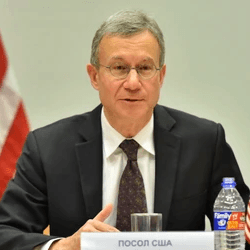
Daniel Rosenblum
AFL-CIO Free Trade Institute U.S. State Department, Retired, Former US Ambassador
Biography
This interview includes three separate videos and transcripts. The additional interviews can be accessed through the links below.
(2): U.S. State Department, Coordinator of U.S. Assistance to Europe, Eurasia, and Central Asia
(3): Impact of US Politics of Policy towards Russia
Ambassador Rosenblum’s interest in the Soviet Union started as a child through his father, who helped establish the American movement to save Soviet Jews from religious persecution,growing up immersed in Cold War politics. This led him to study Russian history and language at Yale. After a four years advising U.S. Senator Carl Levin (D-MI) on foreign affairs and international trade, he earned a Master’s degree in Soviet Studies from Johns Hopkins School of Advanced International Studies.
Following grad school, he worked for the AFL-CIO’s Free Trade Union Institute, an NGO that supported independent labor unions in the former Soviet Union.
Joining the State Department in 1997, the first part of his diplomatic career was spent administering U.S. foreign aid programs supporting the sovereignty and stability of Eurasia and the Western Balkans. He then served as Coordinator of U.S. Assistance to Europe, Eurasia and Central Asia from 2008-2014, including oversight of US aid programs in Russia.
During his last decade at State, he focused on the five Central Asian states as Deputy Assistant Secretary of State for Central Asia (2014-19). Subsequently, he served as U.S. Ambassador to Uzbekistan and then to Kazakhstan. Ambassador Rosenblum retired from the State Department in March 2025.
Summary of Main Topics Covered
Daniel Rosenblum’s interview offers a detailed insider account of U.S. assistance policy toward Russia and the former Soviet states during the 1990s and early 2000s, illuminating both the ambition and the limits of America’s largest post–Cold War engagement effort. Moving from work with the AFL-CIO’s Free Trade Union Institute into the State Department’s Office of the Coordinator of U.S. Assistance to the New Independent States (S/NIS/C), Rosenblum explains how the 1992 FREEDOM Support Act created a new framework for coordinating billions of dollars in aid—approximately $6.3 billion during the 1990s alone—aimed at fostering market economies and democratic governance.
The interview highlights the mechanics and politics of that effort: vertical and horizontal coordination across agencies including USAID, Treasury, Commerce, USDA, and Defense; oversight of enterprise funds such as the U.S.-Russia Investment Fund (TUSRIF); and the experimentation that defined the period, from American Business Centers and BISNIS to the Eurasia Foundation and large-scale exchange programs. Rosenblum describes his leadership of the Regional Investment Initiative under the Gore-Chernomyrdin Commission, focusing assistance on Novgorod, Samara, Tomsk, and the Russian Far East—regions selected for reformist governors and investment potential. He recounts both early optimism and the growing suspicion that followed, as centralization under Vladimir Putin, media attacks, and concerns about foreign-funded NGOs led ultimately to the closure of USAID’s presence in Russia in 2012.
Spanning humanitarian airlifts, food aid controversies, people-to-people partnerships, and the evolution toward locally implemented grants, Rosenblum’s reflections capture the scale, experimentation, and ideological confidence that characterized U.S.–Russian engagement in the post-Soviet decade. His account provides essential historical perspective on how American policymakers believed transition could be guided—and why that belief ultimately collided with political realities inside Russia—making this interview a vital record of the largest sustained interaction between Americans and Russians in modern history.
Daniel Satinsky: Okay. Well, great. Good morning. I’m speaking with Ambassador Rosenblum, and we’re going to go over a really interesting and long career in Russia. So, let me just start by asking you how did you get interested in Russia as a…at the very beginning, in your…as a young person?
Daniel Rosenblum: Yeah, so I had an unusual childhood, I suppose, that got me interested very early on. My father, who was a scientist at NASA—he was a chemist, worked for 30 years at NASA developing rocket fuels and later solar, photovoltaic panels for the satellites—he, in his spare time, I guess you could say, had a second life as a human rights activist, and he got very interested, in the early 1960s, in the plight of Soviet Jews, and he and some members of his synagogue formed sort of a discussion group, which led them to do some reading, and they concluded that the community of Jews in the Soviet Union was under threat, both from antisemitism from the Soviet regime and also just sort of cultural extinction because they couldn’t practice their religion.
So, they began to highlight this through education and advocacy, and eventually it evolved into a political movement, sort of, where they were pressuring the U.S. government to adopt restrictions on the relationship with the Soviet Union because of the Soviets’ human rights record, and specifically related to Jews. So, in the end—and by that way, that, in the end, led to the adoption of the so-called Jackson-Vanik Amendment. Vanik, by the way, was a congressman, Charlie Vanik from Cleveland, who was my father’s congressman. It was our district. It was not a coincidence that Vanik was the co-sponsor of that bill.
Daniel Satinsky: Oh, okay. And was this an organization? Did it form into an organization?
Daniel Rosenblum: It did, yeah. Well, originally it was the Cleveland Council on Soviet Antisemitism. I grew up in Cleveland, Ohio. But then they kind of joined forces with other, similar organizations that were emerging in cities around the United States and Canada, and they formed, in the 1970s, something called the Union of Councils for Soviet Jews. My father, Lou Rosenblum, was the first chairman of the Union of Councils of Soviet Jews, and it was, you know, it became a national and international movement. They joined up with people in Great Britain, and France and Israel itself.
Anyway, long story short, my dad was completely immersed in this activity for a period of probably about 15 to 20 years, and so it sort of took over our home, to some extent. His office was in the basement of our house. And I still remember when I was little my best friend and I used to play in the basement, and, you know, play imaginary games, and we used to have this…we had this competition to see what would it take to get my dad’s attention, like what outrageous things could we do that he would actually notice. So, we would have pillow fights and throw things around. And the reason that was a game was that my dad was so focused on this work. You know, he had this ability to just laser focus. And so, he didn’t even notice what we were up to.
But anyway, it wasn’t, this wasn’t, for me, just abstract in the sense that my dad’s working on this stuff, and I don’t really understand what he’s doing. It was very real. I mean, he brought me to protest demonstrations. We had, like if there was a Soviet cultural group, dancers or musicians visiting Cleveland, which they sometimes did on tours, we would, you know, there would be a protest with signs.
We had projects to send things into Jews in the Soviet Union, because eventually this led to building contacts, and there was actually a regular—there were phone calls, there were letters being sent. Obviously, some of it was blocked by the Soviet censors or, you know, just didn’t get to the recipients. But over time they were sending packets. Like for Passover every year there would be like a gift, you know, a care package being sent to specific Jewish families in the Soviet Union.
So, there were these phone calls, and I would sometimes listen in and hear the Russian being spoken. There would be an interpreter there. And then some of the Jews got out eventually who wanted to emigrate because they couldn’t practice their religion freely in the Soviet Union, and these are the so-called refuseniks. I’m sure that term is probably familiar to a lot of people of our generation.
Daniel Satinsky: Sure.
Daniel Rosenblum: People who had been refused permission to emigrate but eventually did get out. And some of these refuseniks actually came to our house in Cleveland and would kind of visit with my father, debrief with him, and also, he would take them on speaking tours around the United States, to synagogues and community centers and places around—again, part of this educational process.
And so it was part of my childhood, part of my growing up. And I was intrigued, of course, as one would be by all of this, and wondered…I wanted to know more, wondered like what’s really going on, what’s it really like in the Soviet Union. And then the Cold War and everything around relations between the United States and the Soviet Union was fascinating to me. That’s how I kind of got started. When I went to college I decided to study Russian history, Russian language, Russian literature so I would understand the place better.
Daniel Satinsky: Where did you go to college?
Daniel Rosenblum: I went to Yale University. So, I started freshman year with my Russian studies. And I remember—
Daniel Satinsky: And in what year?
Daniel Rosenblum: This was 1980.
Daniel Satinsky: 1980, okay.
Daniel Rosenblum: Yeah, I entered in 1980. And I still remember the Russian Department at Yale was in the basement of a building. It was called the Hall of Graduate Studies. I think the building’s still there, I know it’s still there. The basement’s probably nicer now than it was then. It’s been fixed up. But it was kind of this sort of dank, you know, shabby set of rooms. And that’s where we were drilled on Russian grammar.
And there was this old couple who I think were émigrés from the Soviet Union from a much earlier era, I don’t know when, maybe the ‘40s or ‘50s, the Hramovs. And Emelia and Konstantin Hramov. And they were sticklers for Russian grammar. It had to be…you had to really learn the grammar. And so, my grammar knowledge is still pretty good, even as my proficiency, as I get older and don’t practice it as much, has gone down, I still have really good Russian grammar because of the Hramovs, so that’s the legacy—
Daniel Satinsky: They taught you well.
Daniel Rosenblum: But anyway, yeah, so I was, in the end, a history major, not specifically a Russian studies major. And ironically, my father sort of talked me out of being a Russian and East European studies major, which is what I first wanted to do, because he—his logic was that if I got too specialized too young, and then sort of followed a track where I could only study one thing or one subject, then it could lead to a limitation later in life, especially—and this is kind of revealing of the mentality at the time—he said, well, let’s say you need to do research, and you go to Russia, go to the Soviet Union to do research, and you get in trouble with the KGB or something because—well, I’ll get to this in a second, why he was thinking that, but I—and then you’ll be barred from ever going back, and then you can’t do your job. So, anyway, I bought into it and I figured I’m just an undergraduate, so I stayed broader. But I took a lot of courses on Russian literature, Russian history, Soviet history, etc.
By the way, the one thing I didn’t mention, this fear about the KGB, that I didn’t mention about my father’s experience and my family’s experience that was again formative for me growing up was that my…both my father and later one of my sisters, who became active in the Soviet Jewry movement, visited, you know, went to the country as tourists, you know, technically an Intourist package, but in fact they were there to visit refuseniks and to bring things like Jewish ritual items, books, Hebrew books and so on, and to kind of build this tie, this bond with the Soviet Jews. So, my dad went, I think, in 1973 with a small group, and they made like little films and videos that they were able to bring out, which wasn’t such an easy thing.
And then my sister and her then boyfriend, now husband still, many years later, visited in 1974, and they got picked up by the KGB. I think, I want to say it might have been in Kyiv, because they did a multicity tour, and they were held for like 24 hours, and questioned. They had been well briefed and well prepared for the trip, so they basically said we’ll only tell you what you’re asking about if we have somebody from the United States embassy present, and they kept insisting on that. They weren’t—my sister was just, you know, got some rough questions. I think my brother-in-law was roughed up a little bit. Not serious torture, but just kind of he was not treated very well.
Anyway, they got out. But of course, the story of their detention, a big deal in the family. I think there were actually, at the time the Los Angeles Times had a correspondent in Moscow who covered the story and wrote articles for the L.A. Times about it. So, again, this was like formative for me, this image of the Soviet Union. And I guess maybe I’ll conclude this part of the answer because I’m going on a bit, but by talking about sort of my first experience visiting the Soviet Union and visiting Russia after all of this, okay.
So, I finished undergrad at Yale. I ended up, I didn’t go right to grad school. I spent…I got a—I went to Washington because I was always really interested in government and politics, and I had done an internship one of the semesters in college in Washington and worked for my senator and my congresswoman for six months, and so I went back there after graduating. And I got a job on Capitol Hill working for a senator from Michigan named Carl Levin, who passed away a few years ago. Great man, I think, great public servant, senator for 36 years.
And Levin, in Levin’s office I did do some work with human rights issues, including Soviet Jewry issues, as well as—so this is like from ’85 to ’89, so we’re talking late 1980s, Gorbachev period, a lot of things changing, a lot of interesting ideas in the air, which I was following as closely as I could. And I still remember in the late ‘80s there were sometimes people coming from the then Soviet government to Washington, and there were think tanks that were holding events where they were starting to talk about experimentation with the economic reforms, and the cooperatives and other things that started to emerge in the ‘80s under Gorbachev. And there was a lot of skepticism among some in Washington about how real this was, is this just window dressing, is it real. And again, I was very much sort of drawn into all of that.
So, I spent—oh, and one other thing I should mention about Levin and that time that got me…that sort of drew me in a certain direction. He had a lot of constituents from Eastern Europe in Michigan from the different—a lot of Hungarians, a lot of Poles, a lot of Romanians and so on—and at one point I got pretty involved in some efforts by the Polish community to try to support Solidarity, Solidarnosc in Poland. And I had taken some seminars at Yale about Eastern Europe, and I remember reading the story of Solidarnosc and what had happened in Poland in the early ‘80s. And I have to say, again, it was inspiring to me. Like I really felt like this is something worth supporting in some way, and maybe something like this can happen someday in the Soviet Union. That thought did occur to me.
And so by the time I left Levin’s office I had decided—the reason I left after about four years was I thought okay, this has been a great experience. I’ve learned a lot about Washington and how government works, how politics works. It was frankly like the best possible education you could have if you want to understand Washington, to work on Capitol Hill. I still believe that. But everything, my knowledge, I felt, of everything was kind of superficial, it was very skin deep. Because I covered a half dozen different issues for Levin, not just—I did some foreign policy, but a lot of it was domestic stuff, transportation issues, veterans’ issues, etc., and I wanted to go deep on something. I wanted to understand something better.
So, I went to grad school starting in 1989 to Johns Hopkins, SAIS, School of Advanced International Studies. I went and pursued my Master’s in Soviet Studies, which was still a thing. There was still a thing called Soviet Studies then. And by the way, the SAIS requirement—and I don’t know if this is still true, but it was when I was there—is that you had a list, a choice of your concentration that was long, there were a lot of choices—I chose Soviet Studies—but everyone also had to have a concentration in International Economics. That was a requirement. So, I did take a lot of economics courses.
And I ended up writing my Master’s thesis about the cooperative movement in the Soviet Union, which was just emerging, this sort of nascent private sector activity which was, you know, they were trying to call it something different to differentiate it from the evil West, which…I mean, some of that rhetoric was starting to dissipate, I’d say, by the late ‘80s, but there was still this idea that we’re not going to become capitalists, we’re going to do something that’s sort of in between that’s more socially minded or something. And that was this cooperative movement.
So, I actually used—you were required to use primary source material, so I was getting stuff from Russian newspapers of the day, you know, Komsomolskaya Pravda, and Izvestia, and a whole bunch of other newspapers which the Johns Hopkins library had copies of, so I was able to use those, and to read what was being said and written about this cooperative movement. I probably have the paper somewhere. I haven’t read it in a long time. But my conclusion, as I recall, was that this was something real, it seemed like something real. Even though they were cloaking it in this rhetoric of “not capitalism,” in fact it was proto capitalism that was happening on the ground. So, that was kind of my exposure.
Daniel Satinsky: And these cooperatives were purely Russian; these weren’t the early joint ventures between Americans and Russians? These were Russian cooperative organizations that were quasi private?
Daniel Rosenblum: Exactly. Yeah, exactly. It wasn’t—yeah, they weren’t…now there might have been some cases, although I don’t remember writing about this at the time, where there were foreign investors involved in the cooperatives, even at that time, but I suspect… But the stuff I was reading about were purely Russian.
Daniel Satinsky: I’m only asking to clarify that because we do have, in the archive, several of the Soviet era joint ventures, so there were several, and TrenMos, the restaurant, was one, and Dialog, which was sort of a multifaceted collaboration, was another. So, I was just differentiating them from what you’re describing. Yeah, go ahead. I’m sorry, go ahead.
Daniel Rosenblum: No, not at all.
Daniel Satinsky: You finished…as part of that experience you went to the Soviet Union then while you were doing this?
Daniel Rosenblum: Yes, that’s right. Yeah, that’s where I was leading. Thank you for taking me back to the road that I was on there. Yes, exactly. So, during my time at Johns Hopkins, the summer after my first semester, because I started in January of 1989, so this is ’89 we’re talking about, I spent a summer, three months or so, in Moscow. I signed up for a program of an organization that was at the time called American Council of Teachers of Russian, ACTR.
Daniel Satinsky: Ah, right.
Daniel Rosenblum: They sponsored these language study programs. And they placed me at a place in Moscow called the Plekhanov Institute, which was an economics institute, although again, the economics they were teaching and studying was a kind of hybrid of market economics and Marxism-Leninism. It felt like they had to retain this ideological purity or something so that they had to make reference to Marxism-Leninism, but they were grappling with, you know, that model’s not working, clearly, we need something new. And of course, Gorbachev was officially sanctioning this new approach and this experimentation, so they were teaching that. I was really not there, though, to study economics, I was there to study Russian language, because the purpose of the program was to kind of get my language high enough where I could pass the—
Daniel Satinsky: I want to interrupt you just for a minute because this is a doctor calling me, so I’m going to pause.
Daniel Rosenblum: Okay.
Daniel Satinsky: Hold on.
Daniel Rosenblum: Give me a chance to eat my bagel a little bit.
Daniel Satinsky: All right, okay, good, good. So, you were describing learning language at the Plekhanov Institute.
Daniel Rosenblum: At the Plekhanov Institute, yeah. So, that was…so yeah, the focus was on Russian language, and so we were with the fakultet ruskovo yazika, the Russian language faculty there. And I lived in the dormitories. They had foreign students who were studying there and living in the same dormitory that the other students did, although they did have a floor that had been specially—we were told—specially renovated for the Americans, so our conditions would be slightly better. And it did look kind of new, like the beds and the, you know, walls and doors seemed like they were fairly new.
I will say that the plumbing was not new, because I distinctly remember that it was breaking down all the time, and also there were long stretches where we didn’t have any hot water. In those days there used to be like they would be having—they said they were having special maintenance or cleaning going on and they’d cut off hot water for stretches at a time. And I don’t think it was just the dormitory building, I think it was parts of the city, because it was all centrally supplied, you know, hot water was centrally supplied.
And so anyway, so that was the dormitory. And we ate a lot of our meals at the university, which was pretty pathetic. Now this time, in 1989, economically was a really bad time for Moscow and the whole Soviet Union. There were shortages of everything. The economy was tanking. And that was reflected in our life there, and what we saw in the city.
I remember you’d go into a store, the typical state-owned grocery store, and there would be almost nothing on the shelves, and what there was there would be lines for the few things that were there, and you had to develop strategies. I mean, one of the strategies people at the time practiced, which we as students learned, is that when you’re walking around the city you always carry a bag with you, like a shopping bag, just in case you find something that is, you know, in deficit, as they would say, you know, short supply. And so, you could be there and be ready to carry it home.
Daniel Satinsky: Right. So, when you were…so were you primarily amongst Americans learning Russian or did you have, by that time, an opportunity to get to know Russians more informally?
Daniel Rosenblum: Great question, because in fact, yes, I did have a chance to meet Russians informally, and that became, I would say, the highlight and the most important part of my time there. In fact, by the end of my three months or so I was skipping class a lot. It was apparently not that hard to…they didn’t notice if you just didn’t show up. Because my friends who I had—I’d made Russian friends, young people in their 20s, mostly, who I had met one way or another, and they were always inviting me to join them for a picnic or go to somebody’s house and hang out. What was interesting to me was that these—well, and I’ll just say that I learned a lot more Russian from those experiences than I did in the classroom.
It was the time I spent just hanging out with people and talking that helped me, by the end of that summer, to get to a point where I was, I wouldn’t say necessarily—I certainly wasn’t fluent in the native sense, but it was pretty good. I was having dreams in Russian by the end of that summer. And I often tell people that that summer of ’89 was the peak of my Russian ability, in fact, because in the years that followed, even though I at times used Russian professionally, I was never again in an immersion experience like that, living and speaking it every single day.
And I really think—and like I said, it depends on…people are different in their language acquisition ability, but for me, I need that immersion to really be able to think in the language. Still now my Russian is, I would say, atrophied, to some extent over the years, but I still, I haven’t reached that point, or returned to that point where you’re thinking and dreaming in the language. Now I sort of have to translate in my head.
But anyway, that summer, the time I spent with friends, in addition to improving my Russian, it also gave me some insights into what the society was like and what people were thinking. So, for example, I was kind of, I was puzzled at first why my Russian friends always seemed to be free to just have picnics and hang out. They would always tell me—and by the way, a lot of the people I knew had a scientific background and they worked in like a laboratory or a research facility, so these were kind of like very educated folks who were part of the professional class. And at that time, I think, in the Soviet system a lot of people were channeled into the sciences and into that kind of work, whether they wanted to or not.
But they were always telling me “sevodniya sanitarniy den,” so, you know, today like they’re cleaning up the lab, they’re going to, you know. But it was a joke because it was clearly just they were either playing hooky and just not going to work or it was closed because, I don’t know, there was no money or there was no work to do. So, anyway, so a lot of free time and a lot of time to just muse about everything.
And of course the sort of, I don’t know, the philosophical nature of the Russian people came out in a lot of those conversations, talking about how the world was changing, and different models, and will your stuff that you do, your capitalism actually work with the Russian people and so on, so that was part of the atmosphere. And the other thing that was notable about that summer and my interactions was how incredibly popular Americans were there. I mean, you could, you know, you’d walk down the street, and you were identifiable by the way you were dressed and just the way you looked and carried yourself.
Daniel Satinsky: Often by your shoes.
Daniel Rosenblum: Right, yes, exactly. Shoes was a key indicator of somebody from the West. And I was constantly being stopped by people, sometimes just wanting to say hello or practice their English, and sometimes wanting to sell me things, or buy things from me, assuming that I was there to like sell jeans or something like that. And usually these were just fleeting encounters, but sometimes they led to longer conversations, and even like a follow-up or something, so it was that kind of atmosphere. People were curious, they were intrigued, and they were also, you know, it was a positive thing, it wasn’t negative.
There was one exception to that which I guess maybe sort of revealed to me maybe, you might say, the uglier side of the Russian spirit, the atmosphere at the time, and that was… So, they took us, the students in this ACTR program, who were living together in the dorm—and by the way, you asked earlier about spending time. I did spend a little bit of time with my fellow American students, but I knew at the time what I’m going to get out of this is from encounters with Russians, so I really did focus on that. But we would go out and do stuff together.
And at one point the program actually organized a field trip to Leningrad, as it was still called then, and we took the train up to Leningrad, and we stayed in a dormitory at a university there that was terrible. It was like that was more of the real conditions in the dormitory compared to the renovated one we had at Plekhanov. And we had a couple days to tour and just kind of explore Leningrad. And I loved the city, actually, just the architecture and the museums and everything were amazing. But anyway, I remember one of the days we were there we went to see what is now called Kazanski Sabor on Nevsky Prospekt in St. Petersburg, which is this cathedral, but at the time it was still the Museum of Atheism, because that’s—
Daniel Satinsky: I remember it. Yes, I’ve been there, yes.
Daniel Rosenblum: Yes, it had been repurposed for that during the Soviet period in the ‘30s, I think. And so, we visited the museum. And it was like, you know, it was kind of like curiosity to see, well, what are they going to say about religion in this museum. So, we see the museum, and then afterward there was a small group of us, and we kind of split up, we went different ways, and I was by myself. And I was hanging out in a small park really close, just off Nevsky Prospekt and just people watching and seeing what was going on. And it was towards evening.
And there was a group of young people probably in their 20s or something who were drunk, and you could sort of, I could tell from watching them a little bit that they were drunk. And they noticed me. They noticed me, and one of them, or a couple of them came up to me and they started talking to me in Russian. And I could tell, I knew what they were saying, but I decided to play dumb, because they were being very aggressive and very hostile. And what they were saying was who are you, where are you from, what nationality are you. They kept saying what nationality are you. Now, I don’t know if it was, they wanted to identify me as an American and they hated Americans. Maybe it was because they thought I was Jewish, which is also possible, and they were targeting that. But they were aggressively asking me these questions, and I decided, I don’t know why, but I decided my best strategy was to pretend I don’t understand, right?
So, eventually one of them actually pushed me and I fell down. And I think what happened was—I mean, he pushed me really hard in the chest and I fell down, fell backwards. And I think that maybe they got a little scared that they had gone too far because they sort of ran away. And then a bunch of other people came up, and somebody helped me up, and people were being very kind and considerate and sort of embarrassed by that behavior. So, anyway, so it ended well, I suppose, but it was scary. In the moment it was very scary. It was this real hostility that was…and of course the drinking was clearly part of it. So, that was my one not so pleasant incident, but it also, I think, revealed a little bit about what was happening kind of in Russian society.
Daniel Satinsky: Sure.
Daniel Rosenblum: So, that was my first time in the country. And by the way, just to kind of end that story, at the end of the program I had made plans to meet my then girlfriend/partner, now wife of 34 years, Sharon, who was back in Washington, to meet her in Eastern Europe. So, she flew—I took the train all the way from Moscow to Prague, via Poland, which was quite an experience in and of itself, and then met her in Prague. And we ended up traveling all over Czechoslovakia and Hungary for about two weeks by train, you know, and just kind of slowly going around and stopping and seeing things and seeing places.
And what was interesting was, you know—so this is summer of 1989, pre-Berlin Wall falling. But change was in the air, as they say, and you could feel it both in terms of like the conversations we had with people who were in our compartment on the trains was interesting to, like, we were sort of probing what do people think about their government and what’s happening in the world. And then we even had, because we both had worked on Capitol Hill—actually, my wife was still working on Capitol Hill at the time. She worked for a senator from New Jersey named Frank Lautenberg at the time. And so we had some contacts, and we had set up a few meetings.
And I remember meeting with some guy who was like an opposition activist in Hungary, in Budapest, who later became, I think, the foreign minister of Hungary. and again, sort of asking him like, well, what’s really happening here. And it was clear that things were really…were changing, although of course no one had any idea how far it was going to go or how fast it was going to go. It’s not like I’m saying I predicted what was going to happen.
Daniel Satinsky: Right, but you could tell there was cracks, and changes, and things under the surface that were happening which meant some change.
Daniel Rosenblum: Yeah.
Daniel Satinsky: Yeah, I understand.
Daniel Rosenblum: And we saw, I remember—I have a photo of this somewhere which, it would be kind of an interesting archival photo—of graffiti in Prague on the wall of a building, and it just said “Havel.” The word Havel was just written on the wall. And at that time Havel was still a dissident, and not accepted by the government, in fact had been in prison. So, again, sort of change was in the air.
So, that was, yeah, so that was the end. And then I went back to school for three more semesters, got my masters in the end of 1990, and…well, anyway, I can go on about sort of what led me to my first job, kind of the post graduate thing, but did you want to intercede at all?
Daniel Satinsky: No-no-no, not at all. I would like to move to that. I’d like to move to your job because you began, I believe that first job was you began a career working in the midst of all this change, so that’s…let’s go there. Let’s do that. Okay, yeah.
Daniel Rosenblum: Yeah, sure. Yeah, so I…as I neared my graduation from SAIS, it was clear to me that I wanted to be part of the change that was happening. And by then, of course, by the end of 1990, seismic things had occurred, right? The Berlin Wall, these different revolutions in Eastern Europe, including the Velvet Revolution in Czechoslovakia, which was very inspiring to me. And Havel himself was an inspiring figure, was reading what he was writing.
And what was interesting was that during my two years at SAIS I felt like the events of the region had a great leveling effect between the students and the faculty because the faculty, who had been writing about the Soviet Union for, in some cases, decades, all of their assumptions were being blown up, right, that nobody anticipated change happening the way it did or at the speed that it did. And so they were learning as we were learning. We were learning together, trying to understand what was happening. So, it was a really good time to be going to grad school. I don’t know how you could recreate those conditions somewhere else.
But anyway, I was…I didn’t know what I wanted to do, but I knew I wanted to be involved in the region, that I wanted to be spending time back in Russia, and back in that area. And so, my first idea was I could join the foreign service. And I actually took the foreign service exam. So, this would have been like early 1991. And I passed it. I passed the written and the oral and they offered me a spot in a class to enter. But I turned it down. And the reason I turned it down was that I… First of all, I wasn’t sure that I wanted the lifestyle of a foreign service officer where you move every two or three years to a different country and you’re rotating around embassies. And you don’t necessarily get to choose where you go, especially in your early career. And I wanted to be in the Soviet Union or in Russia. That’s where I… I didn’t want to go to Madagascar or something like that, even though I would have had to. So, that was one factor.
I think also my wife played a role because she had a career. She was working on Capitol Hill. She was happy with her job, and she wasn’t necessarily into this lifestyle of moving around the world. And then the other thing was a better opportunity came along, at least as I saw it then. That was a job offer from something called the Free Trade Union Institute, which is affiliated—was—it doesn’t exist in the same form anymore. It’s sort of become part of a bigger organization years later. But at the time it was a 501(c)(3) organization that was very closely affiliated with the AFL-CIO.
It was part of the structure of the international department of the AFL-CIO. The reason it had this separate existence as a 501(c)(3) is that that allowed it to receive funding from outside donors, including, and especially, the U.S. government. And the structure then was the AFL-CIO had several of these institutes that were regional. So, the Free Trade Union Institute worked in Eastern Europe, and they hoped to work in the Soviet Union, although when I joined them, they were just starting that, they hadn’t managed to break in yet.
Daniel Satinsky: I assume they had worked with Solidarity and…
Daniel Rosenblum: They had, exactly. And that was kind of their bread and butter for years before that. In the ‘80s they were supporting Solidarity when it was an outlawed, underground organization in Poland. And frankly, that was one of the keys to Solidarity’s survival and eventual success in the late ‘80s, and then emergence of Lech Walesa, and him becoming president. It really had a lot to do with that support that they were getting from the American labor movement. And then they also had institutes for Latin America, and Africa, and East Asia, but I was being recruited by the institute that did Eastern Europe. We called it FTUI for short, F-T-U-I, so I’ll refer to it that way going forward.
It’s easier to say. So, FTUI wanted me because I had the background of Russian language, of a knowledge of the country, some knowledge, anyway, having been there and having studied it. And they were looking for someone to start basically a new program that they were conceiving to support emerging independent labor unions in Russia—actually, in the whole Soviet Union, but Russia was a major focal point of that. And it was still, this was early 1991, so still the Soviet Union. And I was excited by the opportunity. I thought first of all it will allow me to keep living in Washington, but to spend a lot of time in the region, because that was the way it was cast to me, like you will be the Washington program officer for these programs, but you’ll be out in the region a lot, you’ll be traveling in the region. So, I liked that. And I also, frankly, there was a sort of excitement about what was happening at the time, and especially in the labor movement.
And again, like historically, people may remember this who know the early history of the emergence of independent Russia and so on. The worker strikes were becoming a big deal. In 1989, 1990 and ’91 there were a series of coal miner strikes, in particular. The coal miners were going on strike on a regular basis. And the AFL-CIO was excited by it because they thought okay, this is the emergence of a real workers movement that’s not subordinate to the communist system or the state, which is representing the real aspirations, they thought, they said, of working people, and those are the kinds of organizations that we want to support and make common cause with.
Daniel Satinsky: And so, what does support mean in that context? What were they thinking? What was the then purpose of the activities? What activities would this engagement of support?
Daniel Rosenblum: So, that was…that gets to really my job and what I was [doing] exactly because my… So, my task was to get the funding to allow us to do programs in the Soviet Union, and the programs would be—and by the way, the source of funding was pretty clear. The National Endowment for Democracy, the NED, had been supporting the AFL-CIO for about—and particularly the institutes, directly this institute, FTUI, for probably six or seven years already at that point.
NED was created under the Reagan administration in the early ‘80s to support democratic development around the world, and there were four core institutes, so-called, of the NED. One was the National Democratic Institute, sort of an arm of the Democratic Party; International Republican Institute, arm of the Republican Party; Center for International Private Enterprise, or CIPE, which is an arm of the U.S. Chamber of Commerce, so business; and then labor, AFL-CIO institutes, including FTUI.
So, those were—and there was actually a core funding every year from NED, like a sort of basic budget that each of these institutes would get, each of the four. And then there were…you could then compete for additional grants for a specific program. So, part of my early work there was writing grant proposals. I wrote proposals explaining what we were going to do with the funding we got from NED.
I’ll just add here that later, not so much later, like in ’92, ’93, and beyond, we started getting a lot of grants from USAID because that was when AID was launching its big programs in Russia that were doing a whole host of different things. But one of them was support for civil society, democratic development, and under that rubric we were getting grants from AID. But early on it was National Endowment for Democracy. What were we doing, what were we going to do with the money? That was your question.
Daniel Satinsky: Yes, right.
Daniel Rosenblum: The idea was, first of all, to build relationships with these independent labor unions, so like part of it was just relationship-building initially. But the objective was to support these emerging organizations, which were an alternative to the official trade unions that were a legacy of the communist system, that had existed throughout the Soviet period. And the idea, again, going back to what I said earlier, is that these new organizations would be genuinely representative of workers, and genuinely democratic organizations, whereas the old unions were part of the apparatus, the state apparatus of control, essentially.
And by the way, I’ll just as an aside say that when I would go, later when I went and visited factories and workplaces around Russia there was often the old posters and slogans were still up on the walls. And one of the slogans that I remember very clearly was the trade unions or “profsoyuzy” are a transmission belt of the Communist Party of the Soviet Union. So, they were literally supposed to play this role of transmitting the ideology and the orders of the Communist Party to the workers. That’s not what the AFL-CIO thought unions should do, right, it was the opposite of what they should do.
Okay, so provide them—so this money would be used to build the relationships, to provide them with training, seminars and training experiences, even exchange programs where they would come to the United States, to give them the knowledge they would need to survive and thrive as representatives of workers. And that’s things like how do you recruit members, organizing, you know, labor organizing, which is something the AFL-CIO unions have a lot of experience with -- not always very successful in our country, especially when the laws are very much against them to make it easy to organize a union—but organizing, recruiting, collective bargaining with employers, you know, how do you engage in bargaining on behalf of your workers, health and safety.
There was a lot of emphasis on what is worker health and safety, how do you build a safety culture in the workplace. Which was a huge issue for the coal miners, by the way, as you would imagine, because the coal mine accidents were frequent and terrible in the Soviet mines at that time. And then part of it was about just bringing these nascent independent trade unions into the larger world of the international labor movement, so giving them contact and ties with unions around the world so that they could learn from them and build a sense of solidarity.
Daniel Satinsky: Right, so at this point you’re beginning the program, you’re getting money, you understand some of the programmatic activities you want to engage in. Did you actually have contact with these Soviet organizations? And how did that happen? Did they reach out to you, did you reach out to them, and how did you do that? How did you build those relationships?
Daniel Rosenblum: Yeah, great question. And it’s not a simple answer, but… So, it started, I think, because…there were two sort of streams that led to building the contacts. One was that we had some really smart and well-connected advisors and consultants working for us. And interestingly, these were people from the human rights movement in what had been the Soviet Union.
The key person was a woman named Lyudmila Alexeyeva, who, in human rights circles, is sort of legendary. She died about six years ago or something, but she had been one of the founders, back in the 1970s, of something called the Moscow Helsinki Group, which was a group of what we then called dissidents who were writing and advocating on behalf of sort of basic human rights, at a time when that would get you thrown in prison or in exile very quickly. And in fact, after several years of this activity of hers, she was exiled. She was basically forced to leave the country, I want to say, in the late ‘70s, and she ended up living in Burke, Virginia, not too far from Washington, D.C., for probably 20 or 25 years. During that—but she maintained a lot of her contacts in the Soviet Union. And during that, the latter part of that, so we’re talking about getting into the late ‘80s and ‘90s, she became a consultant for the AFL-CIO.
The AFL-CIO, just looking, taking a step back, had always been first, virulently anti-communist, second, very focused on not just worker rights, but more broadly human rights, and had made common cause. They were one of the first to speak out on behalf of Andrei Sakharov and Alexander Solzhenitsyn, and all these people, and they were very clued into that.
And it’s interesting, I went into this job not knowing much about labor at all, either labor history or union organizing or anything. I wasn’t hired because of my knowledge of labor, I was hired because of my knowledge of the country and the region, and that’s what they wanted me to do. I learned some things, and one of the things I learned was that the labor movement in the ‘40s and ‘50s, there was this effort by the Communist Party of the U.S.A., and also other communist groups, to sort of infiltrate and take over the American labor movement. And there was this big struggle, internal struggle. And the AFL-CIO emerged out of that struggle as taking a position of we will not allow communism to take us over, we’re anti-communist. And then that became part of the international policy of the AFL-CIO.
So, just to give a very concrete example of how this manifests, in the 1960s the AFL-CIO and its president George Meany, at the time, were very supportive of the Vietnam War, at a time when many of their members, and of course the broader society, was turning against the war and protesting. Organized labor was staunchly pro-Vietnam War because it was about containment of communism, etc. And then because of this position the Soviet regime viewed the AFL-CIO as very much the enemy. They used to, in Soviet propaganda they were portrayed as the “AFL-CIA.” That was the name that was always used. They’re just part of the…they’re an arm of the intelligence of the United States, and they’re all spies, and blah-blah-blah. And by the way, that later came back to hit me in various ways when I went there, because whenever I would tell people, especially older people who I met in Russia that I was representing the AFL-CIO, they said oh, you must be a spy, right?
Daniel Satinsky: You must be a spy, right.
Daniel Rosenblum: Anyway, so…
Daniel Satinsky: You’re the consultants, and…
Daniel Rosenblum: Consultants. So, Lyudmila Alekseyeva was a key person. She knew and had contact with people who were in touch with the coal miners, especially, and then she in turn connected us with people living in Moscow, especially in Moscow, but in other places, too, who were plugged into that network.
And what was important was that the coal miners also—and it really all started from the coal miners’ unions. That was the entry point, I would say. The coal miners were very politically sophisticated, I would say, and early on their demands, when they went on strike, were not just economic, they were also political. Not only did they want better wages, better working conditions, safety, all those things for their members, but they wanted a change in the management of the coal industry which would start by getting rid of the control by the All-Union entities. Because of course they were all state owned.
They were state owned enterprises. Get rid of that and move control to the republic level. This is even before the breakup of the Soviet Union. They were saying the Ukraine Republic and the Russia Republic, whatever, they’re the ones who should have the control. And essentially what this ended up doing was making them allies of Boris Yeltsin.
And Yeltsin was encouraging the activity of the strikers, and Gorbachev was fighting against it. So, in this power struggle that was going on at the time between Gorbachev and Yeltsin, the miners were on Yeltsin’s side. And it was a key element of Yeltsin’s support which I think may have had a lot to do with him eventually emerging as the leader of Russia and so on. So, that was how we started, was with the coal miners.
Daniel Satinsky: Okay, so let me just pause that for a second because there’s a parallel that just struck me while you were speaking, is that in the area of business, many of the early businesses arose out of contacts that came out of the citizen diplomacy movement, that there were Americans and Russians in contact over the fear of nuclear war, primarily, in the ‘80s, which built relationships and then led to some of the very early business and reform and business organization from those contacts. So, the contacts that existed between Americans and Russians in the ‘80s are important for how the ‘90s developed. And you’re describing how that happened within the human rights community, that that human rights community, in a sense, morphed into something else, or it helped to explain how it merged your context with the labor movement, and your efforts to form these unions, right?
Daniel Rosenblum: I think that’s a very good analogy. Yes, I agree. Although interestingly, ideologically or politically it’s the same process, but kind of approaching it from a different perspective, right? Because the citizen diplomacy you’re describing was people who were upset that we were in such contention and conflict with the Soviet Union, danger of nuclear war and so on, and they wanted to build the links to lower the tension and to maybe make us nicer to the Soviets so they’d be nicer to us. And this other strand that I was describing was more…was very anti-Soviet.
Daniel Satinsky: Yeah, it was oppositional.
Daniel Rosenblum: It was oppositional, exactly. You’re right, but the process was very similar in terms of the links that were made, and then it leading in the ‘90s to a relationship with these bigger [units].
So, I mentioned Lyudmila Alexeyeva in part because she was so prominent in all of this, and also, I grew very fond of her, and we spent a lot of time together. We would travel around Russia together on planes and then go to different mining towns and so on, and I just had enormous respect for her. She was actually the one who, they asked her to test me, to test my Russian before they hired me.
I had to like pass a test with Lyuda before they would hire me. But anyway, so what happened was the leaders of these coal miner unions became…they also were fond of Lyuda, and then through her we expanded our contacts. And one of the early important moments, I think, was in the summer of 1991, when—and this was just a few months after I had started working for FTUI—there was a big conference in Moscow, a human rights conference. It was called the Andrei Sakharov Memorial Congress because Sakharov had just died the previous year, I think, late ’90—I can’t remember exactly—but within a few months they had this conference, they had this big event.
And it wasn’t just human rights groups that were there, it was worker organizations, including the coal miners’ unions, and Lane Kirkland, who was then the president of the AFL-CIO, went to the conference, and I was part of his delegation. It was a pretty large delegation. And he had me—he met with Boris Yeltsin, and I got to sit in on the meeting, and it was kind of interesting to watch. And of course this was Yeltsin in fine form. He was, you know, he was still functioning really well, and was hard, and energetic, and charismatic. But Lane Kirkland was one of these standard bearers of the old AFL-CIO anti-communism and pro human rights legacy. But Kirkland also met with the leaders of the coal miners’ unions.
And at the time—so the hotbed of activity was in Siberia, in western Siberia, what’s called the Kuzbas, which is the Kuznetsk Basin. The region is called Kemerovo, Kemerovo Oblast, and the big city is Novokuznetsk. And following this conference I was part of a smaller group that actually went out to Novokuznetsk to visit the miners there. And then later that year I organized a big delegation that was—and this was kind of an interesting structure. It was tripartite, so we had representatives of American labor unions, so the United Mine Workers Union sent their secretary-treasurer, a senior official, and then maybe there was a couple other people from the AFL-CIO who were there. We had—
Daniel Satinsky: And the mine workers weren’t part of AFL-CIO at that point, or were they? Had they rejoined or not?
Daniel Rosenblum: I think they had rejoined. I think they were part at that point.
Daniel Satinsky: Oh, okay.
Daniel Rosenblum: They sort of went in and out at different stages, and I think they were part of it then. And actually, by the way, I just remembered, I had forgotten this, the guy who went on the trip, who was secretary-treasurer, was a guy named Richard Trumka—
Daniel Satinsky: Wow, who became president.
Daniel Rosenblum: Who later became president. And then I think he might have even been AFL-CIO president for a little while later.
Daniel Satinsky: Might have been, yeah.
Daniel Rosenblum: So, it was Trumka and then there were some others. Then we had management, so there were representatives of the…I think it was called the Bituminous Coal Operators Association, BCOA, who was there representing the industry. And then we had government. We had, not only, we had people from the Department of Labor, and particularly there’s this thing I assume still exists called the Mine Safety & Health Administration, MSHA.
Daniel Satinsky: Yeah, uh-huh.
Daniel Rosenblum: So, there was an MSHA person there. And also, from the government we had people from the State Department, from the Democracy Human Rights & Labor Bureau at State, or what called DRL were part of it, too. And we were supported by the…the U.S. embassy in Moscow supported the trip in some ways, and might have even sent someone along, I can’t remember. So, it was this…
But the idea was we’re like it’s a model, we’re presenting a model of how our system can work when it’s working well—of course it doesn’t always work that way with all this foreign conflict—of labor, management and government cooperating to create better working conditions, increase safety, and also, by the way, increase productivity and efficiency of the operation, which is good for the business. So, we—
Daniel Satinsky: So, you went from there to…from Moscow to Kemerovo?
Daniel Rosenblum: To Kemerovo, and we spent I don’t remember how, like maybe four days in Kemerovo meeting with a lot of people in the coal mining industry, so their equivalents, like local officials, mine owners, and the workers. We toured the mines. We actually went down into some coal mines. And by the way, so this trip was quite an undertaking because on the same trip we also went to Donbas in Ukraine and did the same thing there. We also had meetings. And I have to…to be honest, my memories of the Donbas trip are even sharper because the mines there were in such incredibly bad condition and were so tiny we were literally crawling on our hands and knees to get into the coal seams where the miners were working because they were such…they’re such shallow seams or whatever in these old mines in Donbas. I imagine some of the, a lot of the coal mines we visited are probably long closed now, but this was 35 years ago. And so…and I still have a piece of Donbas coal that I brought back with me that I saved as a souvenir.
But what was interesting was that they seemed to be very receptive to this idea of management, labor and government working together in some way. But also, this was, you know, not long after all these strikes had happened, so there still was this streak of militancy. And it was clear that the relationships were still sorting themselves out. They were understandably confused about what kind of system they were going to have, who was going to own what. There was a certain amount of, I don’t know, ambiguity and even chaos around the system, which is, again, you would expect that to be happening in this very—
Daniel Satinsky: This is still while the Soviet Union was in existence.
Daniel Rosenblum: Yes. So, this is like summer—
Daniel Satinsky: Right, last days—
Daniel Rosenblum: —of ’91, yeah.
Daniel Satinsky: Yeah, last days of the Soviet system.
Daniel Rosenblum: Yeah, exactly. So, that first trip sort of set the parameters for a lot of our interactions with the miners, but then as time went on—
Daniel Satinsky: Let me stop you for a second. So, when you say, “the miners,” was there…there was a traditional trade union…miners trade union leadership, and there must have been different people who were leading these insurgent miners, so who did you meet with? Did you meet with everybody, or only the insurgents, or how did you do that?
Daniel Rosenblum: We met with the insurgents, who by then had formed an organization they called “nezavisimy profsoyuz gornyakov,” the Independent Trade Union of Miners, NPG, they called it. And initially it was an all Soviet Union, all-Soviet labor union, right, so the Donbas miners were allied with the miners in Kuzbas, and they were also allied with miners—and I won’t go into detail about this part because I know your focus is Russia, but I will say that there were also miners in Kazakhstan. So, we had the Karaganda region of Kazakhstan, coal mining region. There was an NPG in Karaganda also, and later we visited that as well. So, they had an organization.
And when we would go to the different regions, and sometimes even when we would go to individual mines, sometimes the official union was also represented there, because by this point I think in the miner sector the official unions recognized that all the dynamism and energy was with the independent miners, because they were the ones who started the strikes, right, and that was the big deal for everyone, was these strikes and what had resulted from them. So, in some places the official miners had kind of glommed onto it. They said this is the [way], we’re going to jump on the bandwagon, and change our rhetoric and change our approach. And in some cases, they had been welcomed to do that. So, we did meet with…some of those official mine officials were there in some meetings, in other places they were not. It varied depending on the local relationships.
And speaking of local relationships, the other thing I remember that was quite interesting was that they had…these miners had become real, like, local players, you know, because they had been recognized as having this significant role, and especially recognized by Boris Yeltsin himself as their staunch supporters. So, they were starting to build their networks out locally. And I remember one case in Kuzbas when—and this may not have been for that initial trip with the big delegation, because I went out there a number of times later. So, I think on one of those later trips they said we want to show you something that we think has potential, economic potential for our region. It doesn’t have anything to do with mining, per se. And they took us on…we went on a Soviet military helicopter which looked like it had been well used. Maybe it was used in Afghanistan, for all I know. I don’t know. But it was not in great shape. And you sort of took your life into your hands in these situations.
They put us on this helicopter and they rode us, they flew us out to the middle of nowhere. It was the Taiga, you know, that area which is kind of swampy, and it thaws in the summer, but it’s frozen most of the year. And in the middle of the Taiga, they landed this helicopter and they said this is the site of a future resort for tourists, like we’re going to develop this into a wonderful—isn’t it beautiful? You know, lovely nature, there’s wildlife, it’s fresh air. People are going to love it. And we’re looking around saying how do you get here, other than by helicopter, first of all, and are people really going to want to come?
But it turned out that they had formed an alliance with some local group of businessmen, “biznesmeny,” you know, like entrepreneurs who wanted to start a tourism business, and they thought okay, this could be good for us because if we—we, the independent labor union—actually become partners, then we’ll have some income, too. So, that’s the way people were thinking then. They were always looking for an angle, right, and how they can make some extra money. So, that was just…there were a number of incidents like that, but that one really sticks in my mind, probably because of the helicopter.
Daniel Satinsky: So, you formed these relationships where you were in regular contact with the leaders of these organizations.
Daniel Rosenblum: Yes, yeah.
Daniel Satinsky: And you were…how did—I mean, I assume this was…my god, in those days it was by fax or telex. I mean, difficult to stay in very much contact. So, what, you held events or training sessions with them on site in Russia?
Daniel Rosenblum: Yeah. So, initially, in these first trips, there was almost like ad hoc training going on because we would bring people with us like that delegation I was talking about where we had a mine safety and health expert, we had a union expert, we had…I think we, on one of these trips, that first one that I mentioned, we even had a guy named Bill—I remember this guy because he was quite a character—his name was Bill Usery, and Bill Usery was a famous labor mediator, like he was someone—
Daniel Satinsky: Yeah, a very famous guy, yeah.
Daniel Rosenblum: You’d call him in when the railroad workers were on strike in the U.S. and somebody needed to help mediate the conflict somehow. And he, you know, this was—he was well up in his career and his years by this point, but he thought it was like a great adventure to go out to, you know, to the Soviet Union, to Russia to do this, so he was part of that trip. And then he would almost, he did like almost a seminar on how I approach mediating conflict, and what’s necessary in terms of the, I don’t know, the attitude of the parties and where they’re coming from. So, yeah, so early on it was sort of this ad hoc approach.
And it wasn’t until a little bit later, probably by the end of ’91 into ’92, where we kind of institutionalized it more. So, the first thing we did was we actually opened a field office in Moscow. And by the way we later, we also had field offices in Kyiv, in Almaty, and in Warsaw. The Warsaw office was covering Belarus and Lithuania, making, you know, building ties with unions in those countries. But the Moscow office obviously responsible for Russia. That one…and the office was staffed, we had a local staff of Russians who would help with like interpreting and translating documents, and also just maintaining the contacts that we needed to have to organize things.
One of our key early hires was a woman named Irene Stevenson, who at the time, she—really interesting person—she had been, in her younger days, I think she was a fashion model, but she also—and I think she went to Princeton or something, and she was Russian studies, and got just totally fascinated by Russia and the Soviet Union, and ended up moving to Moscow I guess probably, it would have been in the ‘80s. And she actually worked for ITAR-TASS for a while.
Daniel Satinsky: Wow.
Daniel Rosenblum: Maybe doing translation or something. And then she got a job in like ’89 or ’90 with Baker McKenzie, the U.S. law firm, which had opened a Moscow office, and she was a paralegal. And that’s where we found her. I don’t even remember the circumstances, how we discovered her. And we ended up hiring her to help open our field office in Moscow, and she stayed for a long time. She was like sort of the deputy director of the office. But she was the one who knew how to deal with Russians and how to get things done in Russia, because she had a lot of experience, and she just had that kind of personality, you know, this really dynamic personality.
And then the director of the office was—and this was the model that was supposed to be followed in each of our field offices. You would have an American labor organizer or labor expert to be the director. And our first director was a guy named Tom Bradley. And I don’t recall anymore what union he came out of in the United States, but I know he was an experienced labor organizer. He didn’t have a clue about Russia, didn’t speak Russian, hadn’t studied anything about the region, so he had a lot to learn. To be honest, I’m not sure that he was as effective as he might have been, probably because of that. He relied on Irene Stevenson a lot, which was fine.
And so anyway, going back to your question, by the time we had our field office set up and we had a staff, we were also starting to get the grants that we had, you know, and the money was flowing from the National Endowment for Democracy initially, and then later USAID. And then we were able to organize more structured trainings, seminars, bringing experts in, and even sometimes bringing union leaders to the United States for exchange visits, though that really started kicking in probably more in like ’92 is when that all got going more dynamically.
And so…and some of the…and then just going back again to the question of like how we got to make the contacts and to meet people, it started with the miners. And then the coal miners introduced us to a lot of other labor activists and people in different sectors who were trying to do the same thing they had done, that is, form independent labor unions, new organizations that were not part of the old communist trade union structure, and learn how do you get members. And the miners had started, really because of, in this very kind of conflictual situation, this fraught situation, and with strikes, and it was the strikes that attracted members to them, like because they were speaking out for the things that people wanted to make noise about.
But for these other unions—and they started emerging in places like, maybe some unlikely places. So, one of the early ones were the air traffic controllers, the Russian air traffic control. Actually, it wasn’t just Russian initially, but then there was a Russian branch of it. Air traffic controllers were very mobilized, I would say, and organized early on. And they, I think they had a couple of strikes at some point.
But the thing was you can’t just organize by striking, right? First of all, a strike isn’t always even the best tactic to use. Sometimes it—and particularly if you’re a public employee like an air traffic controller, it’s difficult. We saw what happened with our air traffic controllers when Reagan fired all of them in 1981 or whatever, and that got rid of the union that existed at the time. But…so it was air traffic controllers, teachers. It was interesting. We started getting some teachers unions emerging, and we got introduced to them. Textile workers were among the early ones. Some steelworkers, I think, in some of the steel plants also were organizing.
But early on we confronted this question which you asked about before about who we were meeting with, like was it just the independent unions or the official unions, which was that the independent unions were still small, relatively, and not in much of the economy. They were just in a couple of key sectors. And so the question is if this is going to expand into something bigger in terms of our efforts, our programs, do we need to look beyond just this, you know, the purity of independent unions, right?
And to be honest, in the time, I was with FTUI for six years, we never really resolved that question very well. There were internal debates. And I would say we stayed…we tried to stay pure, as much as possible, for the entire time I was there. There were some tentative efforts and some actual invitations given to people from other unions that were part of the old structure, or [removed] from the old structure. When—and this was—we only did it when there was kind of an endorsement by one of the independent unions, where they would say, yeah, we work with these guys, we know these guys, we trust them. Okay, yeah, they’re part of the old structure, but they really do care about their members, they really are advocating for worker [rights] and health and safety and all those things. And so in those cases we invited, you know, they would be invited to events.
Daniel Satinsky: And these new nascent independents were scattered all over the country, I assume. But probably not primarily in Moscow or St. Petersburg. They were in the regions.
Daniel Rosenblum: That’s true. Primarily in the regions. I mean, I think some of them had a Moscow based representative or structure. The air traffic controllers definitely had a Moscow base, I remember that. But a lot of them were enterprise based, right? They were based at specific, usually state-owned enterprise, because privatization hadn’t gone so far at that point. And that’s a whole ‘nother subject that we could get into about what was happening with privatization, how that was affecting all of this. But the point is that yes, I would say it was heavily in the regions and not so much in Moscow and St. Petersburg.
Daniel Satinsky: And was it centered around personalities in those, that some leading personality sort of took the lead and formed one of these groups?
Daniel Rosenblum: Yes, it was. And actually, and that was part of the weakness, frankly, early on, was that a lot of it was personality-based. You had these charismatic people, mostly men—I was going to say guys—but there were a few women, especially in the textile industry, I remember, there were some female leaders, but mostly men. Charismatic men who had captured the imagination of their fellow workers and were able to kind of build a movement based on that alone. And as things became more standardized or bureaucratized, and some of these people moved on and went on to other roles, it affected the dynamism of the movement.
I’ll give you one example that I remember. Actually, there were two guys who were among the leaders of the Kuzbas coal miners when they…starting from 1989, when they went on strike. One guy was Anatoly Malykhin, and I remember Anatoly because—or Tolya, as we called him—because he was like the prototype of a Soviet worker, right? He was like big, and looked strong and kind of rough, and not very…he didn’t look like an intellectual, let’s put it that way, like a Moscow intellectual, right? And he also, I think he was bald or almost bald, and so he had like this shiny bald head, and he looked like a guy who would be in mixed martial arts or something like that. Anyway, but he was super smart and really had an instinct for rhetoric and for firing people up and all that stuff. So, he was one of the leaders of the strikes.
And at the time of the attempted coup in August of 1991, he was among…he was kind of like part of, I guess you would say, the Yeltsin shock troops who were out there supporting Boris Yeltsin as he was standing down the tanks. And I remember being in Moscow not too long after the August coup attempt, probably in that fall, and Russian television was still covering the aftermath of that that was happening, and Malykhin had become like a TV personality because he was so, like, dramatically outspoken. And I remember, the image that sticks in my mind is him on the day of the coup or the period when the tanks were in Moscow, and he’s out on the street with a gun, like he actually had an automatic weapon. It may not have even been loaded, I don’t know. So, he was the epitome of the militant worker.
Well, when it came to standardizing the work of the NPG, the independent miner’s union, and turning it into an effective long-term organization, Malykhin turned out to be kind of a disaster, right? I mean, he wasn’t good at that kind of thing. And so, I don’t remember exactly where he ended up or what happened to him, but he kind of faded away pretty quickly because he was part of that early phase.
Another guy who was among the Kuzbass miners was named Mikhail Kislyuk. And I remember Kislyuk because he had a very different personality than Malykhin. Much more reserved and kind of soft-spoken, but very articulate. And he was typical of a number of these miners’ leaders in that he had higher education, like he was—I don’t remember if he had a degree in physics or something. He had gone to a very good university. Maybe he studied in Moscow, I don’t remember.
And it was interesting, like in the late Soviet period I think coal miners were being paid a lot better than people in other professions, which I guess made sense because it was dangerous work and they should be. But even before the independent miners emerged, people were attracted to go work there because the pay was better. So, even very highly educated people, who could have, I don’t know, been academics or something like that, ended up in the coal miners’ union. And Kislyuk was one of these people. And then what happened was after the coup in ’91, and after he had—he and Malykhin and the others had proven themselves to be loyal to Yeltsin, he got appointed by Yeltsin as the governor of Kemerovo Oblast.
Daniel Satinsky: Wow.
Daniel Rosenblum: And he served—actually, I had forgotten this. I looked it up when I was going over my notes here. He served as governor of Kemerovo from ’91 to ’97, so for a good long time. And I don’t remember thinking when I met Kisluk like oh, this guy is political leader material or something like that, but he was clearly going somewhere, he was going places. And so these are kind of extreme examples, but not untypical of what happened to some of these early union leaders, is that they had talent which made them effective in that situation, and then they left the labor movement and went into other things because they were able to use those talents, their talents were recognized. So, anyway, so that—
Daniel Satinsky: Yeah, that’s interesting. And so you were trying to help these guys institutionalize their new emerging unions, right, turn them into long-term institutions.
Daniel Rosenblum: Yeah.
Daniel Satinsky: And how would you evaluate the success of that?
Daniel Rosenblum: Good question, one I’ve thought a lot about over the years. Well, first of all I have to stipulate that once I left FTUI in 1997 and joined the State Department I didn’t pay nearly as close attention to developments in the labor movement, so I don’t really have a granular sense of how these organizations fared. But from the little bit that I followed, I think by and large they failed to develop into sustainable organizations, and growing ones that expanded their membership and became not only a factor as worker representatives and in the economy, but as a political factor in the way that, for example, the American labor movement used to be in our country. I’m not sure how much it is today, but, you know, politically significant. And it failed in Russia.
And I think—well, we can get into some of the reasons that may be the case, but I think that there was this period in the early ‘90s when they were kind of on the upswing, and because of that, and especially the most visible groups like the coal miners and the air traffic controllers, other workers started to get interested in forming their own independent unions. But at the same time, you had a lot of countervailing pressures, for example, privatization, which completely scrambled the relationships, often reduced the size of the workforce by a lot. You also had—and again, I don’t have a granular memory of this—but there was adoption of new legislation in the Russian Federation regarding labor relations, and I think some of that was not very favorable to union organizing, kind of like we have in the United States, and so that made it even more difficult for them.
But at bottom, kind of bottom line here is that I think there was an idea that the AFL-CIO had, that FTUI had about the role that independent unions could play in a transitioning Russia that was moving to a more market oriented economy and to more democracy, right, a democratic system, that turned out to be very unrealistic. So, I do think they were deeply affected. I know this from being inside the organization, by the example of Solidarnosc in Poland, and the support that had happened in the ‘80s, and then the historical role that Solidarnosc played in bringing about change in Poland, and arguably change in the whole communist bloc, right? That showed that things could be different. And it was Lech Walesa and other leaders of Solidarity, and it was the alliance that they made with other forces in Polish society—the Catholic church, civil society groups—which made them so significant, right?
Daniel Satinsky: Right.
Daniel Rosenblum: So, in the minds of the leadership of my organization at the time, like where is the Russian Solidarnosc going to come from? It’s going to come from somewhere—maybe it’s the coal miners. And who is the Russian Lech Walesa going to be, right? I’m not saying that they were totally deluded and thought this is going to happen overnight or that it’s going to be easy, but I do believe that they really thought this was going to germinate into something much bigger, grow and become politically significant, too, and be related to the transition that at the time we all thought was going to go in the direction of democracy and market economy.
Daniel Satinsky: So, you were—and I’m focused on this period a lot because you have a unique perspective on it that’s different than many other people I’ve interviewed, so I’m lingering on it because I’m really interested in how you see it. So, you’re involved with people in the workforce at a time where huge numbers of people weren’t being paid. They weren’t being paid at all. They were showing up to work and not being paid. And how did this impact this notion of the labor movement? If you have people working and not being paid, and then privatization on top of it. It had to be enormously complex in order to figure out what position for labor unions to take vis-à-vis these external conditions. Am I correct in that?
Daniel Rosenblum: Yes, you’re 100% correct. And it turns out that this became a major obsession of mine in my later years at FTUI because, I mean, just to kind of give the context here. As we developed these field offices and got the grants flowing—and I should say that it wasn’t hard to get funding in the early ‘90s from the U.S. government for anything that was related to democracy-building. There was a lot of money flowing. The budgets were huge at that time. And so, our grant proposals, in the early years you could write it on the back of a napkin and get a couple million dollars. I’m exaggerating, but only slightly. Later the requirements for these proposals got much more rigorous, and you had to, you know, the budgets were very detailed, etc.
But anyway, we were able to get the funding without much trouble. So, we had the funding, we had the field offices, we had programs in place. And what that meant for me in my job was that I had time and a more kind of—well, my responsibility for kind of running programs became much less because we had people doing that in the field. And so I had time to reflect, and analyze, and look more systematically at what was happening in the Soviet Union—I’m sorry, the former Soviet Union, in all the regions we were working in, and particularly in Russia.
And at a certain point, and I want to say it was probably like ’94, ’95, ’96, it was my last three years at FTUI, where I became really focused on this issue of wage arrears that you were talking about, because it was, you know—well, I wasn’t the only one looking at it, of course. People were talking about it a lot. It was obvious that it was happening, but the question was why was it happening, what were the causes of it, and then how were employees reacting, and what were they going to do about it. And I ended up writing some articles about it, and I even appeared on some radio show that the Kennan Institute in Washington ran at the time to talk about wage arrears.
So, I guess I’ll say two things about it. One, kind of what my conclusions were, and two, what it meant for the labor movement and the unions in Russia. So, in terms of the issue, there was clearly a lot going on that—and by the way, the article that I wrote that I was proudest of was in a journal called Demokratizatsiya, which was a journal.
And there was this woman who I still run into sometimes in Washington named Louise Shelley. And Louise is an expert. She used to be affiliated with George Mason University, and I think maybe she still is. But she is an expert on corruption in the post-Soviet world, and particularly in Russia, and for years she did stuff for the—the Department of Justice had programs focused on anti-corruption, anti money laundering, and she was involved in those, but she’s also studied it. And she was one of the editors of Demokratizatsiya, so she was the one who got my article in there. But anyway. And the title of it was “They Pretend to Pay Us,” which is from this old, there was this old Soviet expression, “they pretend to pay us, and we pretend to work.”
Daniel Satinsky: Pretend to work, yes.
Daniel Rosenblum: And so…and that was what was happening, of course, in this period, was that they were pretending to pay, and they weren’t paying for months at a time, and sometimes when workers did get “paid,” in quotation marks, they were paid in kind. If it was a sausage factory they would get sausage. I remember there was a great picture that I think was included in the article that I eventually got published that was…it was workers from a tire factory somewhere in…not in Moscow, I can’t remember, somewhere in one of the Russian regions, and—
Daniel Satinsky: Yaroslavl, maybe.
Daniel Rosenblum: Maybe Yaroslavl, yes. That could have been it. And the photo was of workers coming home rolling the tires that they had been paid as their wages, like they were given tires. So, that stuff was happening all over the place. And it was clear that the whole system had broken down in terms of the way money flowed in the economy, the way enterprises were managed, and the way enterprise managers did their payroll, right?
There was also, there were issues of debt. There was a kind of debt overhang in the entire economy at the time, and enterprises were hugely in debt to the utility companies. They hadn’t paid their electric bills for months and months and months. And then the utility companies, in turn, went into debt and couldn’t pay the banks that they might have, you know, the Russian banks that they might have borrowed money from, and it was a cascading effect that went through the whole system.
But obviously the workers were kind of at the…they got the brunt of the effect because they literally weren’t bringing home a paycheck that they could spend for food for their families. So, the effect this was having on the unions was it was making it very difficult for them to talk about the set of issues where they could actually do something for their members, right? So, as they’re trying to recruit and they’re saying well, if you join our union we’ll bargain with and we’ll put pressure on, even with the threat of strikes, management to get you higher wages, and better working conditions, and better benefits and so on and so forth. And the potential members are basically saying first we need to get paid, like we’re not even being paid anything, so what’s the point? People were just much less focused on this whole suite of issues because there was something so basic that wasn’t happening.
And the unions, these independent unions, weren’t offering solutions. They had no answer to how to get the wage arrears cleared up, right, because it was so complicated. Nobody had answers at the time. It was like it seemed to be beyond the control of any single actor in the system. So, it really complicated their organizing efforts, and I think that the communist unions, who were sort of their competitors, in a sense, at least could often say well, we are the ones who, we’re part of—we have…we’re in the system, like we have our friends who work at the local bank, or our friends who work in the local oblast administration or whatever, and so sooner or later we’ll fix this, but you need to rely on us and our trusted contacts. It’s not about militancy, or strikes or pressure, it’s about like knowing the right people who will give us tires instead of sausage, instead of a paycheck.
And of course, that’s the way traditionally the whole system worked in the Soviet period, that there was that old (Russian) expression “blat,” right? Blat was about your connections and your ability to get stuff. And that carried over into this post Soviet period where the normal mechanisms of the market economy were completely not functioning. And so again it boiled down to who you knew and who you could trust. And the communist unions were, at some level, trusted because they were familiar, right? So, that whole thing was pretty devastating, I think, also for the independents.
Daniel Satinsky: Right. And in terms of privatization, so this was still, people got privatization vouchers. Did they feel positive about privatization? Were they in support of it? Were you in support of it? I mean, how did…what position did you take as an organization towards privatization?
Daniel Rosenblum: Yeah, no, another good, fundamental question that we grappled with a lot in those years. You know, I think that the basic model that the AFL-CIO and FTUI were putting out there was what’s labor’s role—what should labor’s role be in a market economy. Like our starting assumption was it’s going to eventually be something more like the United States or Europe, and workers need to be prepared for that, and to play a role, play a, you know, have some power that could protect their interests.
So, there was an assumption that there was going to be privatization, because if you’re going to get to that point it has to happen, and the question was how to do it in a way that didn’t hurt people too badly, and that also resulted, ended up resulting in viable economic units that would produce profits and lead to more prosperity for everyone, including the workers. So, that was the underlying assumption of how it was going to work. But I do remember we were, our organization was critical of the way that privatization was being handled and being advised by Western advisors. I’m sure other people in your archive have talked about the whole, what was it called, the Harvard Institute for International Development, HIID—
Daniel Satinsky: Right.
Daniel Rosenblum: —the scandal around that. And generally, USAID and Western support for privatization, the voucher scheme and all that, the AFL-CIO, it wasn’t like…we weren’t super outspoken. We weren’t issuing statements about this all the time. But behind the scenes, and sometimes publicly, we were saying we don’t think this is being done in a way that adequately protects worker rights, and there’s no real worker voice in the way it’s being conceived and carried out, either.
And again, going back to models that we were talking about earlier, I think there was a—I remember we published some things, some articles and talked up the idea of look at Poland, like Poland is maybe a better model. Now Poland is, you know, later was famous for Jeffrey Sachs, shock therapy and all that stuff initially. But arguably, the way they handled privatization was a little more…was more effective than the way it was done in Russia and led to less out and out theft and corruption and oligarchy emerging.
But now of course the conditions in Poland were very different because you had, first of all, Solidarnosc was already well established, had really good…had power in the system. Secondly, Poland had a lot of private actors, private sector already, even before the fall of the communist government, because they had been [organizing] for years, especially in agriculture, but also in terms of small business and so on, they already had… So, they weren’t starting from scratch. So, there were a lot of things that were different. But the AFL-CIO was touting that as a model. And again, it always came back to like the way things happened there is the way they should happen in Russia, with a strong labor component, worker component, and so that was, to the extent that we were advocating anything, it was essentially the Polish model.
And yeah, and we were critical, and some of the, like the things that I was writing about wage arrears and all that, there was an implicit undertone which was saying that we’re not helping, the U.S. and what we’re doing through our USAID project and stuff is not helping the situation and we need to take a fresh look at how we’re supporting privatization.
Daniel Satinsky: Oh, okay. So, you were, on the one hand, relying on USAID, but another, being kind of the loyal opposition, in a way, to say maybe what you’re doing, your policies aren’t helping the situation on the ground.
Daniel Rosenblum: Yeah, exactly.
Daniel Satinsky: Yeah, okay. So, I want to ask you two more questions, and then I want us to schedule a second interview because we have a lot more to cover.
Daniel Rosenblum: Yes.
Daniel Satinsky: So, 1993, Boris Yeltsin, in his assault on the White House and the Soviet parliament, used undemocratic means in the attempt or stated goal of creating a democratic society. What position did you take, or were you…about that assault on the Soviet parliament?
Daniel Rosenblum: Yeah, great question. I actually had…I was just looking at my notes, and I had something in there to talk about 1993 and the conflict with the Duma, so I’m glad you brought it up. So, I mean, first just to answer your question directly, the AFL-CIO and FTUI were, I would say, if not all in, at least sympathetically inclined toward Yeltsin from the get-go. And of course, that had something to do with the emergence of independent Russia and the role that the coal miners played, and the coal miners’ alliance with Yeltsin. So, we were predisposed to think that Yeltsin was probably, even if some of his methods were undemocratic or unfortunate, that in the long run it was better for reform and democracy and Russia if Yeltsin was in charge.
And of course this was partly his, you know, what Yeltsin endeavored to do at that time, which was to paint the Duma opposition as being reactionaries, and being very much like the coup plotters from August 1991, of that ilk, right? And I don’t know—and again, I haven’t studied this deeply, so I don’t know if there was some truth to that or not. I don’t remember enough about the circumstances. But the point is that we, to some extent I think we bought into that.
Now, no one was necessarily looking to the AFL-CIO, per se, as like, you know, asking us for like what’s your position on this. But in practice, and in terms of our actions, we were again in this camp that, well, you know, we’ve got to keep riding the Yeltsin train because that’s the best hope for reform in Russia in the long run. And part of the way this manifested itself was that when Yeltsin called the constitutional referendum in December of ’93 to, you know, basically change the constitution to give more power to the presidency, which I guess is still the same, it’s more or less the same constitution today.
Daniel Satinsky: Yeah, and it’s been amended, but yeah.
Daniel Rosenblum: Yeah, yeah. And that referendum, we were part of a consortium of international organizations, many American organizations that were already working in Russia, that volunteered to be observers for the referendum, to go out around the country and observe the voting process. And I remember this very well because I had a kind of a colorful experience around that referendum. So, I went with my friend and colleague Irene Stevenson, this woman I was talking about earlier, who was a great travel companion, especially because she, like, her Russian was so damn good, it was amazing. She was like completely fluent. And she also, it wasn’t just language, she kind of knew…she fluently spoke Russian culture and society, too.
Daniel Satinsky: Yeah.
Daniel Rosenblum: But she was an excellent person to accompany me. And we, the two of us, went to a city called Saransk, which is the capital of the Mordovian Republic, or Mordovia. Which is one of these, you know, titular ethnic republics. And at the time in the ‘90s of course Yeltsin was encouraging, at least rhetorically he was encouraging the republics to—the constituent regions of Russia to take more power to themselves, and to experiment, and do things locally, because it’s like this decentralization model. Which of course then Putin completely reversed ten years later.
But the point is that at the time Mordovia was being touted—by the way, there are only, there’s like less than 10% of the inhabitants of Mordovia at that time—and I assume it’s similar today—actually are ethnically Mordovian. Mordovians are, it’s actually…they’re…I think it’s a Turkic people originally who speak a Finno-Ugric language, but everyone there speaks Russian, and the Mordovians don’t have much of a presence.
Anyway, so we went to Saransk and we observed the referendum. And there wasn’t really much to see. People dutifully went out and voted, and overwhelmingly in favor of the constitutional referendum because the president had said they should. And the voting procedures seemed to be…I mean, we didn’t find any glaring violations.
But what was more interesting was that while we were there, there was a kind of parallel conflict between the president of Mordovia, who had been appointed by Yeltsin in 1991, and the parliament of the Mordovian Republic, the local parliament. And it was a very similar tension where, like the president was this reformer type who had come in wanting to upend everything and make it more democratic.
And interestingly, his background was he was some kind of obscure midlevel bureaucrat who had protested some corruption scandal in the late ‘80s and essentially become like a human rights activist, and very outspoken, and led a public movement to root out corruption in Mordovia. And then he eventually, he got appointed by Yeltsin to be the, not just the governor, but the “president” of the Mordovian Republic, which they called it then. But then the parliament was pushing back. And this guy was clearly kind of…he was a bit naïve, and not very politically astute, which you would expect from a kind of idealistic human rights activist, right?
Daniel Satinsky: Right, right.
Daniel Rosenblum: He was losing in the conflict at the time. And we, Irene and I, actually got a meeting with him because we were like…we were the only international observers in Saransk, I think, so we were a big deal, right? We were the Americans who had come there. So, we had a meeting with the president. And first of all, the parliament at the time—I mean, the presidential building was surrounded by protestors or demonstrators who I guess were supporting the parliament in the conflict, and they were holding up signs. So, we go through this cordon, and we get led up to the office.
And the president’s all by himself. He had no aides, no staff or anything, it’s just us and the president. And there didn’t seem to be many people around, in general. I think he was…like they were deserting him, basically, being left alone. So, we have this conversation, and he’s giving us his perspective, and like, you know, we’re…I’m fighting for democracy in Mordovia, and we need support from outside, and President Yeltsin is supporting me, but he’s distracted by other things, obviously.
So, anyway, so we leave Saransk, and at the airport, as we’re flying out, we’re checking in for our flight, and I…the woman who was—and the rules were kind of loose in those days, too, about the security was almost nothing, and the whole system was, as reflecting larger trends, was very chaotic. So, the woman who was checking me in, first of all, she didn’t speak English at all. So, I hand her my American passport, which she couldn’t read, and she couldn’t understand anything in it. And she didn’t even know, she had to, like it was like a handwritten ticket, you know, it was a physical ticket, and she was writing it down. And she was clearly searching for my name. And what I really noticed at the time was that in my passport I had stuck the business card of the president of Mordovia. Vasily Guslyannikov was his name. So, his card was in—and it must have fallen out when she opened my passport. And so, she wrote on the ticket Vasily Guslyannikov.
Daniel Satinsky: [Laughs.]
Daniel Rosenblum: So, I was…that was my name.
Daniel Satinsky: You get on the plane—
Daniel Rosenblum: And I got on the plane. Of course nobody stopped me, like they weren’t checking to make sure that the name on the ticket and the passport were the same. I get on the plane, and I traveled back to Moscow as Vasily Guslyannikov, the president of Mordovia. Like really bizarre kind of, you know, real experience.
But what it revealed, I think, at the time, and also as I reflect on it later, was that this conflict between the reformers, so-called, this new generation and the old guard, the old establishment, was not resolved. It was still very much playing itself out. While Yeltsin won in his conflict with the Duma and stayed in power for another seven years or whatever, Guslyannikov lost. So, not too long after we left, he got booted out by the Mordovian parliament, and they put in their own person, like the chairman of the Duma of Mordovia became the new leader. And I think they abolished the presidency altogether or something like that. So, you could see these trends playing out, and whatever was happening in Moscow, which was what everyone was paying attention to, the story was not the same in the regions, necessarily. So, anyway, that was my—
Daniel Satinsky: So, my last question before we schedule our next interview is 1996. So, I think I know how you turn out on 1996, but the 1996 presidential election. Yeltsin, by that time most people recognized him as kind of a falling down drunk. He was sick. He was way behind in the polls. And then elements of the Russian oligarchs rallied behind him, and they had a lot of support from the United States in resuscitating his fortunes, and he won that election, or it’s believed he won that election, let’s put it that way. And so did you have any role in …your organization have any role in that election with Yeltsin?
Daniel Rosenblum: Not to my recollection, no.
Daniel Satinsky: Okay.
Daniel Rosenblum: I don’t think we did. And I will say that the organizations that we were continuing to support at that point through our programs and so on were almost uniformly still pro-Yeltsin, and probably played a role in the campaign, and campaigned for him. But we were not directly involved in that. And I suppose, I guess the other way in which we were sort of implicated, you might say, was that we were funded by the U.S. government, and the U.S. government, as you said, was squarely pushing for Yeltsin to win.
And so, we were kind of guilty by association, you might say. But I don’t recall any direct role we played, because that wasn’t our brief, in a sense. Politics wasn’t our brief. It was probably different for like NDI and IRI, which both had programs in Russia at the time. I don’t know whether you’ve talked to anyone from those two organizations yet.
Daniel Satinsky: No, I haven’t.
Daniel Rosenblum: It was not my project, but…because I know some of the people who were working in Russia during the ‘90s for NDI and—including, by the way, Mike McFaul, who you may know, so McFaul, who later became ambassador to Russia under Obama and has been very outspoken, and still comes out, is on TV a lot on MSNBC or whatever. McFaul worked for NDI in Russia in the 1990s.
Daniel Satinsky: The National Democratic Institute.
Daniel Rosenblum: National Democratic Institute, which was one of the four core institutes for Democracy.
Daniel Satinsky: Okay. So, but were you looking at it? I mean, it was part of the environment you were working in. Were you nervous about that election while it was going on?
Daniel Rosenblum: Yeah.
Daniel Satinsky: And what it meant, what it would mean for you in your work in the unions?
Daniel Rosenblum: Yeah, I think so. I mean, you know, I do think that we had a—looking back on it, and maybe not even so many years afterwards, we had a much more nuanced view of what was going on than people did at the time. But I remember—it’s hard sometimes to separate out what you think you remember of something versus your 20/20 hindsight much later of what you were really thinking at the time, right? So, I admit that my memory might be clouded. There’s some expression that someone said, this famous expression, like I don’t remember…it’s something like I remember more than… Anyway, I’ll come up with the quote. It’s a great quote that I—
Daniel Satinsky: Right.
Daniel Rosenblum: —what I just said that some wise person once said. But anyway, I remember that the main, you know, Yeltsin’s main opponent at the time was Zyuganov, I believe, the head of—
Daniel Satinsky: Right. Zyuganov was ahead in the polls at one point.
Daniel Rosenblum: Was ahead in the polls at one point.
Daniel Satinsky: Was the head of reformed Communist Party.
Daniel Rosenblum: Yes. And I know that because of, again, you know, we were…I was steeped in this idea that, you know, communism was a terrible tragedy for the Russian people, and that the worst thing that could happen to Russia would be to go back to the communist system. And so even though it was, as you say, it was portrayed as the reformed Communist Party, there was an automatic assumption that if Zyuganov wins it’s a disaster.
Including for these—especially for these independent trade unions that we were supporting because they had emerged very specifically as a reaction against the communist trade unions, which presumably were allied with Zyuganov, right? So, I think at the basic level we were rooting for Yeltsin to beat Zyuganov, because we thought it would be really bad for everything we did if Zyuganov won.
The aspect of the oligarchs and the oligarchs who supported Yeltsin and kind of enabling all this, that wasn’t secret at the time, right, and it was known what was going on, I think to a large extent. And I do remember…I think I remember, put it that way, being troubled by that in the sense of like okay, this is not the Boris Yeltsin that I met in 1991 at the human rights conference with Lane Kirkland, right? The bloom is off the rose a bit here, and there’s compromises being made. But to the extent that I sorted it out in my head and decided what I thought about it, or what we as FTUI thought about it, I think it was kind of like, you know, the lesser of two evils kind of calculation. Like okay, he’s far from perfect, and he’s associating with some bad people, but sometimes that’s what politics, is, right? You make alliances and compromises. So, there was an element of that justification being made.
And then just reflecting back on our earlier conversation about privatization and so on, and I do…there were lots of troubling things happening in the ‘90s with respect to the way the economy was developing, the whole privatization process, the way it was done, the emergence of these oligarchs. And I’m sure, I know that I was troubled at the time. Like it’s not just looking back on it. I was troubled at the time.
But I think it’s putting it in the larger context of what we thought was happening and hoped would happen in terms of transition to market-based economy and democracy, there was always this element of like okay, well, we’ve just got to get past this stage. It’s not being done in the best way, and there are compromises being made, including some moral compromises, but if it all comes out well in the end, and continues to move in a generally positive direction, it’s worth it. That was kind of like the way I justified it. And I don’t think I was alone in approaching it that way. So, yeah, that’s kind of where I came out.
Daniel Satinsky: Okay, good. Well, look, I know at this point, at some point soon in this narrative you leave FTUI, and we go to another stage of your involvement with Russia, which I want to give us a full amount of time to do, so let’s do that in a second—
Daniel Rosenblum: Sure.
Daniel Satinsky: —interview if that works for you.
Daniel Rosenblum: That’s great. Yeah, no, I’m glad it worked out that way because it definitely gave me a chance to fully explore this early period, and now, yeah, I think it’s better to do a separate session for the State Department.
Daniel Satinsky: Okay, okay. Excellent. So, I’m going to stop recording.