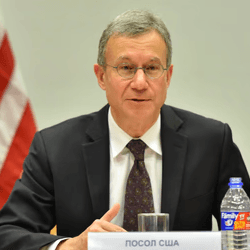
Daniel Rosenblum
AFL-CIO Free Trade Institute U.S. State Department, Retired, Former US Ambassador
Biography
This interview includes three separate videos and transcripts. The additional interviews can be accessed through the links below.
(1): AFL-CIO Free Trade Institute, working with independent Russian labor unions
(3): Impact of US Politics of Policy towards Russia
Ambassador Rosenblum’s interest in the Soviet Union started as a child through his father, who helped establish the American movement to save Soviet Jews from religious persecution,growing up immersed in Cold War politics. This led him to study Russian history and language at Yale. After a four years advising U.S. Senator Carl Levin (D-MI) on foreign affairs and international trade, he earned a Master’s degree in Soviet Studies from Johns Hopkins School of Advanced International Studies.
Following grad school, he worked for the AFL-CIO’s Free Trade Union Institute, an NGO that supported independent labor unions in the former Soviet Union.
Joining the State Department in 1997, the first part of his diplomatic career was spent administering U.S. foreign aid programs supporting the sovereignty and stability of Eurasia and the Western Balkans. He then served as Coordinator of U.S. Assistance to Europe, Eurasia and Central Asia from 2008-2014, including oversight of US aid programs in Russia.
During his last decade at State, he focused on the five Central Asian states as Deputy Assistant Secretary of State for Central Asia (2014-19). Subsequently, he served as U.S. Ambassador to Uzbekistan and then to Kazakhstan. Ambassador Rosenblum retired from the State Department in March 2025.
Summary of Main Topics Covered
Daniel Rosenblum’s interview offers a detailed insider account of U.S. assistance policy toward Russia and the former Soviet states during the 1990s and early 2000s, illuminating both the ambition and the limits of America’s largest post–Cold War engagement effort. Moving from work with the AFL-CIO’s Free Trade Union Institute into the State Department’s Office of the Coordinator of U.S. Assistance to the New Independent States (S/NIS/C), Rosenblum explains how the 1992 FREEDOM Support Act created a new framework for coordinating billions of dollars in aid—approximately $6.3 billion during the 1990s alone—aimed at fostering market economies and democratic governance .
The interview highlights the mechanics and politics of that effort: vertical and horizontal coordination across agencies including USAID, Treasury, Commerce, USDA, and Defense; oversight of enterprise funds such as the U.S.-Russia Investment Fund (TUSRIF); and the experimentation that defined the period, from American Business Centers and BISNIS to the Eurasia Foundation and large-scale exchange programs. Rosenblum describes his leadership of the Regional Investment Initiative under the Gore-Chernomyrdin Commission, focusing assistance on Novgorod, Samara, Tomsk, and the Russian Far East—regions selected for reformist governors and investment potential. He recounts both early optimism and the growing suspicion that followed, as centralization under Vladimir Putin, media attacks, and concerns about foreign-funded NGOs led ultimately to the closure of USAID’s presence in Russia in 2012.
Spanning humanitarian airlifts, food aid controversies, people-to-people partnerships, and the evolution toward locally implemented grants, Rosenblum’s reflections capture the scale, experimentation, and ideological confidence that characterized U.S.–Russian engagement in the post-Soviet decade. His account provides essential historical perspective on how American policymakers believed transition could be guided—and why that belief ultimately collided with political realities inside Russia—making this interview a vital record of the largest sustained interaction between Americans and Russians in modern history.
Daniel Satinsky: Okay, so this is our second part of our conversation, and the last time we talked extensively about your experience with the labor movement and assistance to free trade unions in Russia, and I think we reached the point where, 1997, and you were making a transition from that work to work for USAID, so the focus of today’s conversation is going to be about USAID. But why don’t you just start with just a little bit about that transition, what made you do it and then take it forward from there.
Daniel Rosenblum: Sure, okay. Well, great. First of all, I’ll explain the transition and why it happened, and how it happened, but also—but maybe before I do that, because I want to make sure that anyone listening to this has a clear picture—when I moved to the State Department I actually wasn’t working for USAID.
And this is…and I have to say I’ve had to explain this thousands of times over the years to people, and its key to understand what I was doing, and more importantly, what the office that I worked in did. So, let me just explain that a little.
Daniel Satinsky: Sure.
Daniel Rosenblum: The place I went to work was called the Office of the Coordinator of U.S. Assistance to the New Independent States of the former Soviet Union, so it was a very long name. And in the ‘90s they actually referred to it as the NIS, New Independent States. And our office was called—and the State Department has its own nomenclature to identify offices by acronyms, or by a series of letters, so our office was S/NIS/C. And the S stands for Secretary, as in the Secretary of State, who at the time was Madeleine Albright, when I came in, which meant that our office reported directly to the Secretary of State, which is not typical within the State Department. Usually you’re…there’s a hierarchy, and you’re reporting to some undersecretary or assistant secretary, but we reported directly to the secretary. And the NIS stood for New independent States, and the C stood for Coordination, as in coordination of assistance. Now our office—
Daniel Satinsky: Let me ask you a quick question. When was that office established, do you know?
Daniel Rosenblum: It was established in 1992 at the time that Congress passed something called the FREEDOM Support Act. The FREEDOM Support Act. And by the way, that sounds like a straightforward name, but the word FREEDOM is actually an acronym which stands for—I may get this not exactly right—but it was something like Freedom for Russia and East European Democracies and Open Markets.
Daniel Satinsky: Ah. [Laughs.]
Daniel Rosenblum: So, they got a, you know, as Congress does, they came up with some fancy acronym that was a little, a mouthful, but… So, that legislation that was passed in, I believe, sometime in maybe the fall of 1992, was the authorization for us to give assistance, foreign assistance, to the countries of the former Soviet Union. It had been preceded three years earlier by a similar piece of legislation called the SEED Act, which stands for Support for East European Democracies, SEED Act. SEED was for all the Central and East European countries, so Poland, Czech Republic, Slovakia, the Baltic states, etc., Hungary and so on. And so the SEED Act was kind of the model that the FREEDOM Support Act was based on.
And the idea, first of all, was okay, it’s okay for us to give aid—because of course for all of our history up until that point the idea that we would be giving assistance to countries that were part of the so-called communist bloc was absurd—why would we be helping them in any way to develop or support themselves. But obviously the world had changed after the fall of the Berlin Wall, and then later the breakup of the Soviet Union, so Congress wanted to make a point of saying okay, we can now give assistance.
And importantly, that assistance is not just about development in the classic sense—and here I should explain that foreign aid over the years, starting in the early 1960s under John F. Kennedy, which is when we started having a foreign aid program and USAID was created, the U.S. Agency for International Development—it was supposed to be mostly about lifting nations out of poverty, so it was about helping farmers be more productive, or dealing with health issues in very poor countries, or just generally helping them to restructure themselves so that they could provide for their people, for their populations.
And in this case the idea, although as we later discovered, as we got more involved in this, it was a somewhat flawed idea. That is, I think we overestimated the level of development of some of these former Soviet countries. But the point was that we thought it was more of a political transition where they needed to change the system of governance, which they had all declared at that point they intended to do, to be more democratic, more representative, and to adopt a market economy which hadn’t existed before, because you had the centrally planned socialist economy. And so the idea is that this so-called political transition would require a more political strategy and oversight. And that’s what our office in the State Department was created to do.
So, this office that I started out explaining this complicated name, S/NIC/C, was created by Congress. It was literally in the legislation that was passed in 1992. And by the way, there was a separate coordinator for Central and Eastern Europe called the SEED coordinator, who was also created by that legislation. So, these two coordinators were supposed to provide that strategic lens for designing what kind of assistance we were going to do and the oversight to make sure that it was following that direction of helping with the transition. Okay, so that was the office I was going into.
Now USAID, the Agency for International Development, which existed as a separate entity—now recently we, of course AID was essentially abolished by pretty much getting rid of everyone by the Trump administration, getting rid of everyone who worked there. They can’t really abolish it in the literal sense because it was created by Congress, and Congress has not revoked that, so AID I think still exists on paper somewhere, but in practice it doesn’t exist. But for, what, 60 years, give or take, 60, 65 years AID operated as the leading arm of the U.S. government to provide this development assistance that I was talking about, to help lift countries out of poverty, help them develop, help them deal with health challenges, etc.
Daniel Satinsky: And let me ask you ask you a question about that, too. So, it’s my impression that the way they did that was by giving grants to mostly American organizations, that the money, it was not as the common perception, a transfer of money from Americans to foreigners, that foreigners were supposed to benefit from those programs. Have I got that right? Is that how this worked?
Daniel Rosenblum: Yes, that is correct. The overwhelming majority—and I don’t have, I don’t remember the exact percentage, and I’m sure it changed over time—but the overwhelming majority of dollars that AID spent went to American organizations, contractors, subcontractors to carry out programs to benefit those countries, or to help them develop in a certain way. But it was not a blank check. It was not us handing money to the government and saying spend this as you see fit.
There were occasionally exceptions to that where we did what’s called budget support, where essentially for a short-term period of time we transferred money to a government to spend on its own needs and expenses, but when that was done—and there was one case, I won’t go into the details, but we did this with Georgia following the Russian invasion in 2008. We actually gave them budget support because they were in a crisis mode where their entire economy was collapsing, and we thought the whole country would collapse and would maybe be annexed by Russia. Not that Russia would ever annex another country, that would never happen.
But we had to make sure, before we did this—obviously we had to get congressional approval, and we had to put in all kinds of safeguards to ensure the money would be spent with a lot of oversight and scrutiny, and could only be spent on certain things, so that was very rarely done by USAID. But for the most part it was projects or programs to help a country do a whole number of things—develop its tax system, or to promote the growth of small and medium business to help a country develop faster, or to reform its healthcare system so that it would be better delivering care to people in rural villages or etc., etc. I mean, I could go on with lots of examples.
Daniel Satinsky: Right, right, but those priorities were set by your office, or were they set by the host government and the U.S. contractors were paid to carry it out? Where were priorities set? And particularly, you know, we’re going to get into this with Russia, but I’m just curious, because this is relevant. I’m just reassuring everyone this is really relevant because of the large amounts of funds that went in, relative to the time. They came in through USAID in the aftermath of the dissolution of the Soviet Union. And so the priorities and how priorities get set is an important question. If you could speak to that a little bit.
Daniel Rosenblum: Sure, sure. Yeah, so—and I’ll speak to that in just a couple seconds. I just want to finish the point on the relationship—
Daniel Satinsky: Okay, please.
Daniel Rosenblum: —the relationship of our office to USAID and other U.S. government agencies, just to make sure we understand the distinction that I’m making here between what we did and what they did. So, AID did all these projects that I was just describing, often with contractors or with NGOs or something doing the implementation. But AID was not the only agency doing assistance in the former Soviet Union. And this was true throughout the world, but I think it became much more pronounced in Eastern Europe and the former Soviet Union where we brought in other U.S. government agencies.
So, for example, the Department of Treasury had an office called the Office of Technical Assistance which provides advisors who specialize in budget policy, or debt management, or banking, and they actually place these advisors in countries to give them expertise in how to set up those kinds of systems. So, Treasury is doing foreign assistance. The U.S. Department of Agriculture has a whole, they have something called the Foreign Agricultural Service which places people around the world, and under the Foreign Agricultural Service they have a number of assistance programs where they’re helping countries be more productive in their agriculture.
Obviously with USDA there’s another agenda, and this is true with a lot—we can get into this later—it’s true of a lot of these agencies. They also want foreign countries to buy more of our ag products, you know, to export to them, so some of what they’re doing is oriented towards that. But USDA, Treasury, the Commerce Department does a lot of technical assistance related to…it’s usually business policy, the investment climate for countries, the legal framework for dealing with business. So, that’s three examples, but there’s many more—the Defense Department, etc., etc.
Daniel Satinsky: When I was writing my book, in the beginning, my book “Creating the Post-Soviet Russian Market Economy: Through American Eyes,” that book, I actually had an intern who spent maybe six weeks trying to sort out and create a spreadsheet of all the different programs, because there were so many, and there was no really publicly available, at least to me, catalogue of all of them. And there was a huge number of—the Library of Congress was involved, I mean, as you say, the Commerce, and Ag, and Treasury, and the Federal Reserve. I mean, everybody was involved at that point, and all with their own, apparently, own ideas of what they wanted to do and who they wanted to work with, so it was a mélange of people and organizations.
Daniel Rosenblum: Yes. And that’s where the coordinator’s office comes in. So, our function, as I often explain to people, was vertical and horizontal coordination. The vertical coordination was to ensure that the policy was clear to everyone, what is the overall U.S. policy behind this assistance, that is, what are we trying to achieve, what objectives do we have, and that the assistance was coordinated with that policy that was supporting that policy. Not just that—USAID was not just doing whatever they thought was nice to do, you know, to help farmers or whatever they wanted to do, or that Commerce wasn’t just pursuing its own objectives, that it was all fitting into a coherent whole and aimed towards the ultimate objectives. So, that was the vertical coordination.
The horizontal coordination is about making sure everyone’s working together and complementing one another, that what they’re doing is not conflicting or at odds, at cross purposes. And I could regale you for hours with the cross purposes that were often going on or were about to go on which we tried to head off in a variety of ways. So, that was the fundamental idea of our office, was this coordination of vertically and horizontally.
By the way, the horizontal coordination was not just about U.S. government entities doing assistance, all these different agencies that you mentioned, the mélange of U.S. agencies, it was about international coordination, too. So, we spent a lot of time talking to other donors who were working in Russia and the other former Soviet countries to figure out what are they doing, what are they planning, and how can we, again, complement one another. That was harder to do, in a way, because of course every country has its own laws, systems, ways of doing things, and they have to follow their system. They can’t just twist and shape it to fit what we think is best. So, that was a more delicate matter. But I think we may have had some success. So, that was the function we played.
And essentially, we were the overarching framework around this mélange of agencies that were, I would say at any given time there were anywhere from 10 to 15 different U.S. government agencies involved in assistance. And there were periods in the ‘90s and the early 2000s where even very small agencies—you mentioned the Federal Reserve, but like, I don’t know, the Federal Aviation Administration or these sorts of small, independent agencies, the Securities and Exchange Commission, they all somehow got involved in one way or another in providing expertise. And honestly, it was hard to keep track of.
There was an annual report that our office produced, and so you were talking about sources where you could see all of it in one place. And this started pre-electronic, but I imagine that somewhere electronically these reports are still available. I think they were issued every year from like 1993 until 2008 or 2010 or something, so for a long time we would do this annually. At a certain point it became very burdensome, and there was less interest in Congress and in the public in what we were doing. The interest peaked in the ‘90s, I think, and then it was kind of a decline after that, so we stopped doing the report at a certain point. But that report is, you know, if anyone who’s watching this is a researcher and wants to get the definitive look at everything we were doing, that report was comprehensive.
Daniel Satinsky: Excellent.
Daniel Rosenblum: It covered everything. So, now, so back to your question about what the strategy was or where it came from, you know, who decided what we were doing and what we weren’t doing. And that was…that is a more complicated question than it might seem on its face. The short answer is our office was the one who guided and led the process of determining what we would do and what we wouldn’t do, and tried to develop an overarching framework.
But first of all, we couldn’t ignore what the agencies themselves thought. We always, we had to try to listen to them and hear what they thought, especially because they were the ones actually carrying out the programs, so they had an idea, as time went on, of what was working and what wasn’t working. So, we actually developed a process called the Annual Budget Reviews, or ABRs that we would do. This didn’t happen until the early 2000s, actually. When I became more involved in the leadership I thought we really needed to do this.
And so we would actually sit down once a year with each agency in a very kind of comprehensive way, look at what they had done the previous year, what they wanted to do, and how much money they wanted to get to do it the next year, and what the results were, what kind of results we were getting. And we had a, you know, they were required to submit something in advance of the discussion that would lay out all this stuff and to prove to us that they were actually getting results. And then, so you had the agencies.
You also had our embassies out in the field, embassy Moscow, embassy Kyiv, all these embassies, and we wanted to give them a voice because again, they were on the ground, they knew what was happening pretty well. They were reporting back to Washington on all the political and economic developments. But they weren’t regularly reporting on the assistance, what the assistance was doing, so we were encouraging them we want your input, we want your ideas. There’s also this idea underlying U.S. diplomacy that the ambassador in each country is the chief of mission who has a lot of authority to determine what happens under the U.S. flag in his or her country, and so we wanted to make sure that these chiefs of mission, these ambassadors, had a voice.
And so we set up this other process we called the Straw Man Budget, which was essentially an opportunity for the embassy to come in with their idea of how the money should be divided up. We would give them a notional—this was usually before the appropriation occurred from Congress, so we didn’t actually have the money yet each year, but we would ask the embassy if you had X—and we would usually have a pretty rough idea—if you had, I don’t know, we’ll say 40 million, I’ll take that as an example, which might have been a typical budget for a country like Kyrgyzstan at that time, 40 million, how would you divide it up among programs and agencies. And then of course they would start with the last year as a kind of starting point, and then they would tell us. And then that would be factored into our decision-making process.
And then the last thing I should mention, because you referred to it, and this is very important, is what about the governments and the populations of the countries themselves, what kind of voice did they have. That’s also, that’s a complex topic because there’s this idea in foreign assistance, in the foreign assistance world, what they call country ownership. So, what you do with foreign assistance, the country that you’re doing it in should feel a sense of ownership, because if they don’t, it’s likely to fail.
You can’t force people to change things that they don’t have the political will to change, and you can’t have the whole program appear to be an imposition. I mean, that goes—then you’re back to the colonial period, right, where you have imperialism or whatever, and you’re just we know best, and we’re going to tell you how to do things. So, you have to make sure—and of course to spend money effectively on these kinds of programs there has to be some element of local involvement, a heavy element, one would hope.
So, we did, our office and our embassies, especially our embassies, we’d spend a lot of time meeting with government officials, or with the leaders of non-governmental organizations, or local business people, and getting their input, what’s working, what’s not working so well, what do you need, what are the needs, what are the priorities. So, that was definitely an element.
But going back to something I think we talked about in the first interview, I do believe, as I look back on that period, particularly the late ‘90s, early 2000s, that there was a heavy overlay of United States government and all the people working on this thinking we’ve got this, like we kind of know what’s needed, and so we’re just going to do these things. Obviously we’re going to bring in local partners and we’re going to gather input, but we sort of generally have a pretty good idea of what’s necessary in order to—and this goes back to the overarching objectives—to have a transition to a market-based economy that functions on market principles and a democratic system of governance that is a reflection of popular will and respects rights, etc., etc. So, that overriding philosophy of what we’re trying to do I think made us push out a lot of things that you could argue was based on local ownership and local input, but it did reflect a bias, I would say, in the sense of what America thought it was trying to do.
Daniel Satinsky: Mm-hmm. And did you, at that time, think that Russia would evolve so that it would be parallel to the way the U.S. society operates, or did operate, or is structured? Did you believe that at the time?
Daniel Rosenblum: Yeah, I think… Well, of course this question of what I believed personally and what the general belief—
Daniel Satinsky: Well, both.
Daniel Rosenblum: Well, yeah, yeah. I mean, I…obviously hindsight is always 20/20, and so it’s easy for me to say—
Daniel Satinsky: Yeah, but I’m more interested in what you thought at the time.
Daniel Rosenblum: I know, I know. But it’s hard to, sometimes it’s hard to unpack that from what you know now. I think at the time I did believe there was a chance that Russia and the other countries would develop to something much closer to what we have in the United States. I was aware, as a student of Russia who had been studying Russian history and culture since the early ‘80s in college, I was well aware that there were historical and cultural aspects that made it distinct and different and something not recognizable to Western eyes, in a sense, and that that could not be overcome easily or completely. I think I always thought that whatever form of democracy or whatever form of a market economy Russia had wouldn’t be identical to what we had.
But I also believed—I think I, to a large extent, I bought into this idea that our model had proven itself so superior in terms of producing prosperity for people, and stable societies and whatever, that we’re relatively well governed, that that would win out, you know, that it would prove itself to be so attractive to people that eventually the majority of Russians, and the same for the other countries, would adopt it. So, yes, I do think—and so that’s me, and I do think that that belief was widely shared in the U.S. government.
Daniel Satinsky: So, I started my book with a quote from Brzezinski from a Foreign Affairs article I think in 1990 where he said that Russia was then in a state of receivership to the West, and that sort of this…the…I mean, a little more extreme than the position you were taking, but, you know. But I think it just was kind of a common idea, right, at the time.
Daniel Rosenblum: Yeah, it was. And it was, you know. And of course, there’s lots of analysis that’s been done since about why Putin emerged as he did, and consolidated power, and why the Russian population seems to, broadly speaking, like what Putin has done over the years. And, you know, I think you can’t understand that without understanding what things were like in the ‘90s and the attitude on both sides. Russia was weak and was in a receiving mode, so to speak. We were strong and a little too intoxicated by our dominance. And also, I think too caught up in this ideological sense that liberal democracy was triumphant, and had proven itself as the preferred form of organization, and so therefore it was inevitable that it was going to happen that way in Russia as well.
Daniel Satinsky: So, let me—I can’t resist asking you this question because you had the dual objectives of a market economy and a democratic system. And in the research I’ve done and the people I’ve spoken with, it’s more about the creation of the market economy. And it’s my belief that Russia made a transition to a market economy. Not the same as elsewhere, but it still has a market economy, heavily dominated at the top by the state, but still its resilience is as a result of that transition that took place in the ‘90s, and the economic institutions that were built.
At the same time I’ve never seen any real evidence that Boris Yeltsin was committed to democratic institutions. I know he was committed politically to preventing the reemergence of socialism, but their political parties were weak on the ground, political organization was weak. There didn’t seem to be the same emphasis on creating the institutions of a functioning democracy. Do you…does that ring true to you, or is there something I’m missing with that?
And particularly because a lot of this was done with U.S. help and support. I mean, the Russian stock exchange was done by a USAID grant and the assistance of the Federal Reserve, and private banks borrowed heavily from the U.S. The real estate sector developed heavily borrowing from the U.S. The entertainment system all refined and revised, all these things, but the political system didn’t evolve the same way. And I don’t know…I know it was an emphasis of USAID, but I don’t know much.
Daniel Rosenblum: Yeah, yeah. So, that—
Daniel Satinsky: A big question, I’m sorry, and—
Daniel Rosenblum: And it’s a big question that probably, you know, books have already been written, and many more will.
Daniel Satinsky: Yes.
Daniel Rosenblum: So, just very briefly I’ll say that I, I mean, I agree with your analysis of what succeeded, what didn’t succeed, where there was a commitment among Russians and where there wasn’t a commitment. I think that’s a correct assessment. There was a lot of focus on the U.S. government side on the democracy piece of this. It clearly was not successful in terms of what our assistance accomplished. And perhaps there was a—going back to what I was saying earlier—there was a certain naïveté that it was inevitable anyway, it was going to move in that direction, so we just had to enable certain forces to play the role they were going to play anyway, and it was going to happen.
And it clearly was not inevitable, and if anything, many people I think would agree that we’ve gone backwards in terms of the level of democracy from what was happening in the ‘90s to what it is today. Now of course many Russians experienced the ‘90s not as democratization, but as chaos, and instability, and uncertainty, and that’s partly why they’re so, you know, they embraced—many, many Russians, obviously not all—but many Russians seemed to embrace Putin’s much more top-down and tightly controlled system of governance.
But the fact is that there was more freedom of expression in the ‘90s allowable, that there was more…that elections, many elections were not entirely free and fair, but much more free and fair than they have been since, that there were multiple political parties emerging. Again, you know, you could…lots of criticisms of how those parties operated. They were more about personalities than they were about platforms and positions. But the fact is there were multiple parties. And also—and this will come back when I talk about my own early experience—there was a lot more decentralization of government authority into the regions and the cities, and the ability of local leaders to kind of take responsibility for what was happening locally.
Daniel Satinsky: Right. So, let’s use that to go back to where we started, where you’re making this transition before I led you astray with all these questions which probably belong at the end of this interview rather than the beginning, so go ahead, please, into the transition.
Daniel Rosenblum: Yeah, so okay. So, my personal transition, I had been with the Free Trade Union Institute, AFL-CIO for six years, and I think I might have alluded to this in the first interview, but I reached a point where I felt there was a sort of glass ceiling to my further advancement there. I was not a labor person, I didn’t come from the labor movement, and I wasn’t going to move up in the organization. And secondly, there was a bit of disillusionment that had set in in terms of what we could actually accomplish. We went from this euphoria of 1991 and ’92 where we thought the next Solidarnosc was going to emerge in Russia or Ukraine, and by ’96, ’97 it was clear that wasn’t happening. So, I thought I need to change course.
And I spent actually quite a bit of time looking for my next job because I didn’t, you know, I wasn’t desperate to leave, I could take my time. I talked to a lot of people. I actually did a lot of what people refer to as informational interviews, where you have a contact, you go in just to learn something about what’s available, not for a specific job. And that actually proved later to be very useful that I had done that because many of the people I talked to were in the U.S. government in different agencies, and then when I later became employed by the coordinator’s office I worked with those same people because I was coordinating all the agency stuff. Anyway, very useful.
And in early ’97 I—and this is, I guess, the way things often happen in life—my wife opened a door for me. My wife worked on Capitol Hill for many years. For 25 years she worked in the U.S. Senate, and at the time she was working for a senator from New Jersey, Frank Lautenberg. And she had a lot of contacts—part of her job involved foreign affairs, and she had a lot of contact with the State Department, and she had befriended a woman who worked in the Legislative Affairs office at State, a woman named Kathy Kavalec. And then Kathy’s next job—because in the State Department, you’re always rotating every couple years—was in the coordinator’s office, the S/NIS/C office that I talked about earlier. And so, my wife said you should go talk to Kathy, she’s a great person, she’ll give you some insight, and who knows what’s going on in that office. And it felt like it was something that would be interesting to me, given my background.
So, I went in to talk to Kathy, and as luck would have it, they were looking for someone right then and there, that week, to hire to start to carry out a new project that they were just starting in Russia. And I’ll explain the project in a minute. It involved something under what was then called the Gore-Chernomyrdin Commission. And I was in the right place at the right time, basically. I had the Russian background, the language, the understanding, and I seemed like a reasonably, I don’t know, capable person. I wasn’t drooling when I went into the office.
And so, Kathy actually took me to meet the deputy coordinator at the time, who was sort of her boss, a guy named Bill Taylor. Bill later became U.S. Ambassador to Ukraine about 10, 15 years later, and then I still to this day am very good friends, and he’s sort of a mentor to me. So, I talked to Bill. And eventually the coordinator at the time, a guy named Richard Morningstar, decided to hire me, in part based on a recommendation he got, a sort of affirmation from my old senate office, you know, Senator Levin, when I worked for Levin back in the ‘80s. So, I got a job.
But the interesting thing was—I think I mentioned earlier that when I finished grad school in 1990, I applied to the foreign service, and I turned it down, basically. They offered a position, and I turned it down. And so now I was coming into the State Department a different route, and I was hired as a contractor. So, initially I was not a civil servant and I was not a full-time government employee, I was a contractor. This office of the coordinator had lots of authority to do a lot of different things, and a lot of money at the time. And so they had a large contract with a, what do they call it, an 8A company. So, there’s this provision under, I think it’s the Small Business Administration, that encourages government agencies to enter into contracts with minority owned or disadvantaged owned companies.
Daniel Satinsky: Or women owned, right.
Daniel Rosenblum: Or women owned, right. So, under that they had a contract with a company called McFadden & Associates. Mr. McFadden, as I recall, was hearing impaired, so that was what qualified the company for this contract. Anyway, it doesn’t matter. So, I was actually an employee of McFadden for my first several years at the State Department. But every day I did not work at McFadden, I worked in this office of the coordinator.
And they hired me to do a project they had just started called the Regional Investment Initiative, RII. RII had been launched under the Gore-Chernomyrdin Commission the previous fall, so this is—we’re now talking early spring 1997. In fall of ’96 Gore and Chernomyrdin, who at the time were meeting, I think, twice a year—they were having these meetings of the so-called GCC, Gore-Chernomyrdin Commission, and they had announced a new initiative called the Regional Investment Initiative, the idea being that the U.S. would focus its assistance, its foreign assistance and its finance and trade agency efforts—and by that I mean export-import bank, trade and development agency, TDA, OPIC, Overseas Private Investment Corporation, that all of those would focus their money and efforts on specific regions of Russia.
And the idea was that if we find regions with governors and policies that are encouraging the attraction of foreign investment by creating good policies for business that it will bring money in, it will bring jobs in, those regions will prosper and succeed, and they will form sort of a replication effect, that other regions will see oh, you know, our neighboring region’s doing so well, we should…let’s study what they’re doing and copy it. And so that was the sort of philosophy behind it. The idea was… So, the job was to identify which regions we were going to focus on.
Daniel Satinsky: Ah. You didn’t have regions at that point. You identified them.
Daniel Rosenblum: Initially, when they announced it in late ’96, they didn’t have the regions picked.
Daniel Satinsky: Okay.
Daniel Rosenblum: So, by the time I came on in March of ’97 they had already picked the first two regions. The first one was—and by the way, I should just add that Yeltsin, earlier in the ‘90s, had made some statement to the, you know, like a speech to all the governors or the heads of the different regions in Russia where he basically said take all the power you can, like, you know, like encouraging them to take responsibility and take authority locally to solve your problems. It was sort of a classic statement of federalism, as we would call it.
And the U.S. was sort of applauding this, we were cheering it on. We said, yeah, this is a great way. You can have these laboratories of experimentation locally and see who’s successful. It’s often the way our states operate in the United States and the attitude we’ve had towards states. So, that was sort of the origin of the Regional Investment Initiative.
The first region that was picked was Novgorod, Novgorod Oblast. And this is not—many people…it’s often confused with Nizhny Novgorod, which is much more well-known, and Boris Nemtsov was once governor of Nizhny Novgorod, and he became famous later, so the idea is, you know, that’s what people think of. Novgorod is a much smaller region in the northwest of Russia, not far—very close to St. Petersburg, and historically important in Russia because there was a Novgorod kingdom. If you go back, what is that, 800 years or something like that they were actually a power at the time. Anyway. And it’s a beautiful city, which I’ve had a chance to visit, with very nicely preserved old fortress and churches, and yeah, it’s lovely.
Daniel Satinsky: Yeah, I’ve been there. Yeah, a beautiful place, yeah.
Daniel Rosenblum: Yeah, so you know what I’m talking about. But Novgorod also happened at the time to have a very progressive governor, at least he was seen that way. I think his name was Prusak, Mikhail Prusak. And he actually remained governor for a long time. Even after Putin came in I think he stayed on. But Prusak was known at the time—at least his reputation was as someone who was willing to experiment with different policies and really oriented on bringing jobs and prosperity to the people there, and maybe not as corrupt as some of the other governors. So, Novgorod was chosen as this first, like, laboratory of reform.
And the second region that was picked—and this one was more problematic, because it was actually multi region, was the Russian Far East. And this came…and this was very common in our work in those days, in those years. There were different imperatives pushing us to do certain things. So, we had this Regional Investment Initiative, which sort of had a logic to it that was about trying to improve the investment climate at the local level by focusing efforts. So, the idea was we shouldn’t dissipate our assistance all over Russia, let’s focus in and create some success stories.
At the same time, though, we had a big push politically, and also from the business side, to focus on the Russian Far East. The biggest driver of that was Senator Ted Stevens of Alaska, who was also, who was the chairman of the Appropriations Committee, a very important person for anything to do with foreign assistance, because you needed to get the money appropriated by Congress. And Stevens actually had gone to the extent of putting into the legislation, the appropriations bill in I don’t remember what year, let’s say ’95 or ’96, an earmark that said we have to spend a certain amount of money just in the Russian Far East from our foreign aid dollars.
And I want to say the annual earmark for a number of years running was like $25 million, which was a lot to spend on assistance in a region that doesn’t have a very big population, and doesn’t have a lot of big cities. I mean, Vladivostok is the biggest city, but there’s not much else. But Stevens’ idea was…it wasn’t just because—well, Alaska, of course, is very close to the Russian Far East, right? It’s just across the Bering Strait there. But also he saw that there was a lot of enthusiasm in his state for building closer ties to Russia, and there already were a lot of efforts by this time—this is ’97 we’re talking now—to increase business to business links, university to university links, University of Alaska at Anchorage was very active in this. To have NGOs working together. A lot of the so-called citizen diplomacy at the time was going on between Alaska and people in the Russian Far East.
And then on top of that—and by the way, it wasn’t just Alaska, even though Stevens was the driver of a lot of this. Washington state, people in Seattle, people from Oregon and Portland. I don’t think it went…there was a little bit in California, too, but the Californians were never as enthusiastic as the people from especially Washington and Alaska, at least in my experience. There were lots of efforts going on. And you may well have interviewed people who were involved in some of that.
Daniel Satinsky: I have. So, well, for people listening to this, there will be links to other people involved in that region. Go ahead.
Daniel Rosenblum: So, we felt obligated, in a way, to pick the Russian Far East as a focus region for this initiative. It just made sense. But of course, the Russian Far East is actually multiple Russian oblasts, multiple Russian regions, and so we decided initially to focus on three of them primarily. One was Primorksy Krai, which is where Vladivostok is, because that’s the population center. And second one was Khabarovsk.
And Khabarovsk was chosen in part because again there was a belief, which I think later turned out not to be very well founded, but the governor of Khabarovsk was a reformer, was someone who wanted to change things, and so we should support that. And the third was Sakhalin. And Sakhalin was not chosen because of the reform credentials of the local administration, but because U.S. companies had a big stake there. So, we had big oil companies and then all the service companies that support them were extremely active at that time in developing Sakhalin oil production.
And of course, Russia in general was very open at that time to joint ventures and to foreign investment coming in to develop these things. So, I remember we—Exxon Mobil was a cheerleader for this Regional Investment Initiative. They thought it was a great idea. And they were willing to put in some of their own money to support certain social initiatives locally in Sakhalin that would be kind of under the umbrella of this Regional Investment Initiative. So, those were our two.
And at the time I came in there was an active discussion going on about picking a third region, because I think we sort of generally decided okay, let’s start with three. More than that is going to be too burdensome, so let’s start with that. And the third region was picked based on a lot of input from our embassy in Moscow that had views about the different governors and the different local conditions. And they had a list of, I don’t know, four or five different to choose from. We ended up going with Samara, which, Samara, you know, also an important industrial center.
The auto industry at the time was focused very near Samara in Tolyatti, which is in the Samara oblast. And Samara itself was a transportation center where a lot of the railroad lines came together. Also, a lot of energy nexuses. And it was a relatively successful region to that point in terms of attracting foreign investment. And there were, I think, I want to say there were four or five different big U.S. multinationals that already had some activity going on in Samara. And, again, the perception was that the governor at the time, who was a guy named Konstantin Titov, was a reformer, that he was a modern, forward-thinking person. That was the idea. So, anyway, we said okay, we’re going to do Samara.
And then there was a lot of coordination going on with the vice president’s office on all this stuff because, again, Gore-Chernomyrdin was the framework for the initiative. And one thing I should say for context for those who were not around at the time is that in the late ‘90s, the second Clinton administration, the Gore-Chernomyrdin Commission had become, in some ways, the main channel for U.S.-Russian relations. I think Vice President Gore had been given a lot of authority to manage the relationship with Russia under this commission. And the commission itself had many committees underneath it. I don’t remember how many. There might have been 15 different committees. Some of them were focused on arms control, and security, and nonproliferation, some of them on business promotion and business investment, U.S. companies. And there was one that was focused, I think it was foreign assistance, essentially. And of course, that was the one that we were the most active in.
But these meetings of the Gore-Chernomyrdin Commission, the big ones between the vice president and the Russian prime minister, Viktor Chernomyrdin, I believe happened twice a year, and they would alternate between one in the United States and one in Russia. And then in between those meetings the committees underneath the larger commission would meet or talk on the phone or whatever; they would engage. And they were supposed to report at each meeting on what they had accomplished. So, there was a lot of pressure to do things and to actually have activities.
So, we were talking a lot about what was happening with the Regional Investment Initiative to the vice president’s office, and at some point in, again, the spring of 1997, they…someone had the idea that the next meeting of the Gore-Chernomyrdin Commission should happen in Samara, the new region that we had just decided on for the Regional Investment Initiative. And as the newbie, as the guy who had just been hired, I was tasked with making it happen, like let’s, you know, Rosenblum, Samara, you’re on it, right?
So, now obviously there were a lot of things that I didn’t control and that I wasn’t even responsible for that involved the vice president’s schedule, and the logistics, and the Secret Service, etc., etc. But I worked very closely with the embassy at figuring out what the visit would look like, what kind of events would happen, and how we were going to announce this new, the Regional Investment Initiative and so on, and kind of putting meat on the bones, so to speak. So, I spent my first several months in the coordinator’s office doing a lot on this stuff.
And then something happened which I still refer to years later as my Andy Warhol 15 minutes of fame, you know that old expression? He said everyone in the future, everyone will be famous for 15 minutes. So, my 15 minutes came in Samara under this meeting of the vice president.
Daniel Satinsky: And so, you were saying about your 15 minutes of fame?
Daniel Rosenblum: Yes, yes. So, as I said, I was very involved in the preparations for this Gore-Chernomyrdin meeting in Samara, and the vice president’s office contacted me and asked for background information so that they could prepare his talking points, and his background memos, and his speeches, because one of the events that we decided on was there would be a luncheon hosted by the president and the prime minister for the U.S. and local business community, and that at the luncheon there would be speeches, as there normally are, so they had to figure out what to say.
Anyway, so I sent them a lot of information about this Regional Investment Initiative that we were starting, and I also, while I was immersed in all of this, it just happened fortuitously I got a packet of stuff from my mother about a family member of ours—so my great-uncle, my mother’s uncle, had actually worked in Russia in the early 1920s, and he had left behind a trove of papers and so on that she had become the possessor of. He never married. He didn’t have another family. And she sent me a holiday card in Russian, that was written in Russian on the back and asked me if I would translate it because she was trying to figure out what it was. And it turned out it was a Christmas card from the people of Samara, represented by the local staff of something called the American Relief Administration.
Daniel Satinsky: Wow.
Daniel Rosenblum: And I translated it. The greeting was very simple. It was just, you know, we hope you’re doing well in this holiday season kind of thing. But my mother had all these other papers, and I asked if I could see them. And it turned out that my great-uncle had worked for the American Relief Administration, which was under Herbert Hoover. This was like during the…well, post-World War I, but then leading up into the Russian Civil War period, where the United States, arguably for the first time in its history, decided to provide humanitarian relief to a foreign country and provided massive food aid, and some medical aid during the period of the Russian Civil War, when there were huge epidemics, disease epidemics and famine in many parts of Russia due to the dislocation caused by the war.
And my uncle, my great-uncle apparently had volunteered to be in the ARA, the American Relief Administration. He had fought in World War I in Europe, and then I think he just kind of stayed over there and got involved in various other activities because he was…the adventure of being overseas was attractive to him. And anyway, there’s a picture—actually, I don’t know whether you can see this, but… And I’m not sure whether this will—how this will appear on the camera, and whether you can actually see it at all. So, this is a photograph. Can you see anything?
Daniel Satinsky: Yeah, you can see it, yeah.
Daniel Rosenblum: This is a photograph that was in my uncle’s papers of him—and he is…it’s a little hard to do it this way, but he is, this person right here is Louis Landy, who was my great-uncle. And he was part of a team of Americans. So, in this photo the Americans are sort of in this row here, mostly men in suits. I think there might be one woman. And all the other people were the local staff, so they’re Russians. Although it’s interesting, when you look closely at the faces, many of them look Caucasian, you know, like from the North Caucasus, or are wearing things that indicate they were probably Muslim, so I think it was a multiethnic group. And anyway, so I have, it turned out that I had family roots in assistance to Russia that went back to the early 1920s, which is kind of incredible to think about. So, anyway, I sent some information about this to this vice president’s speechwriter because I just thought it was kind of a funny little coincidence, and I might have sent him a photo or something so he could see. And he got very excited and he said wow, this is great, you know, this is great human-interest stuff, and we’ve got to figure out a way to work this in. But I had no idea what he was going to do with it and so I just forgot about it, and then I got caught up in the details of preparing for the visit.
So, I get to Samara maybe two days before the vice president was scheduled to arrive, and I was busily involved in preparing the different site visits. They were going to see some local factories, I think, and points of historical interest in Samara, and then there was this lunch that I mentioned, this big business lunch, and then there were some other meetings on the side. And funny thing, the biggest controversial point in the lead-up to this business luncheon was whether the vice president could have his traditional can of Diet Coke on the table in front of him because the Pepsi-Cola people, who were very active in Samara, objected to having cans of Coke on the table because, you know—
Daniel Satinsky: Wow.
Daniel Rosenblum: So, there was a whole big, like it took us the better part of a day to figure out how we were going to manage the cola wars in Samara. Because apparently the vice president like had to have his Diet Coke. You know, he always had a can of Diet Coke. So, I think we figured out some way to have him drink the Diet Coke off stage, so to speak, in the wings.
Then we had no Coke or Pepsi on the table, because if we had one we had to have the other, and it was too [controversial]. Anyway, so this is like, you know, this is diplomacy in action. So, anyway, so we get to the lunch, I’m sitting at table. I was very junior at the time, right, so I was sitting like away from the—very far from the rostrum where the principals were sitting. And my colleagues from the U.S. embassy and other people from the U.S. government were scattered around at different tables. And of course there were local Samara people there, too. So, at the beginning the vice president stands up to make his speech, and he starts out, you know, 80 years ago a young U.S. Army captain named Louis Landy came here to Samara to help the people of Russia in their time of need. I’m so pleased to say that his nephew, Dan Rosenblum, is with us here today. Dan, will you please stand up?”
The vice president is singling me out in his speech. It’s like the lead of the speech. And I looked over to the speechwriter, who was in the vice president’s party, and he kind of winked at me, you know. Oh, you did that, didn’t you? So, I stand up, there’s, you know, a standing ovation, and then I sit back down. And then later in the lunch—so he makes the rest of his speech about the Regional Investment Initiative, and the U.S.-Russian friendship, and how important it is to the world. And after the speeches were done and people were eating lunch, my boss at the time, Richard Morningstar, who was the coordinator of assistance, came over to my table, he sort of sought me out. And he takes me by the arm, and he said I want to introduce you to the vice president. And he took me up to the head table and he introduced me both to—I actually met Chernomyrdin, too, who was sitting next to him, and I exchanged a few words in Russian with Chernomyrdin. And I met Gore. So, it was just like this is a big moment, you know, my first State Department trip ever, and I’m talking to the vice president.
So, I later learned from Morningstar—so Morningstar, by the way, I didn’t mention this, but he was very well connected politically. He was a political appointee, not a career person. I think he went to law school with Hillary Clinton, if I’m not mistaken, or he had some connection with Hillary Clinton, and through that knew Bill Clinton, so he had been appointed. Before he served as the coordinator of assistance, he was an important official at OPIC. I don’t think he was the head of it, he was like the executive vice president or something of OPIC. And then he moved from that to being in this job as the assistance coordinator, which was a big deal at the time.
Nowadays people who do foreign assistance—well, most of them are out of a job today—but in recent decades they are several tiers below the top in terms of political prominence within administrations. But in the ‘90s the people who were doing assistance to Russia and the other Soviet countries were a big deal, and Morningstar was one of these people. So, he also knew Gore, and I think he had traveled there on the plane with the vice president. He was like on Air Force 2, you know, the vice president.
So, anyway, he goes back to the U.S. with Gore on the plane, and he told me the next day, or when I got back to Washington, that the vice president couldn’t stop talking about this Louis Landy thing. [Laughs.] He was so taken with it. And he said that after I had come up and been introduced to the prime minister and the vice president that Chernomyrdin told Gore that this was very personal for him because apparently his wife’s family came from Samara.
Daniel Satinsky: Wow.
Daniel Rosenblum: And his wife remembered, as a little girl, being told stories by her parents and older people about the famine and the epidemics after the civil war, and they remembered American aid coming in and saving lives, like they still remembered it. And Chernomyrdin, so for him it was a very emotional experience.
Anyway, so I started out my State Department career in a pretty splashy way. And it was after I got back to Washington and would see people, even just passing people in the hall, they would all remember, like this is what they remembered about me, was that the vice president mentioned me in his speech. You know, that was the big [thing]. Anyway. As the years went on fewer and fewer people focused on that, but it was a good way to get started.
The other thing I remember from my early days in the coordinator’s office was that one of my first trips, which might have actually been before this Russia Samara thing, was to the U.S. West Coast with Morningstar. Morningstar was very committed to this idea of building links between the U.S. and Russia at every level, so not just at the government level, but at the citizen-to-citizen level, business-to-business, etc. And so he was a big enthusiast for this U.S. West Coast, Russian Far East link. And so one of my early trips, and it might have been my first month on the job, in fact, I went with him to Seattle and then to Anchorage, where we met with a lot of the local folks there who were driving this effort to build ties to the Russian Far East.
One of the people I remember meeting was a woman named Carol Vipperman, who I’ve stayed in touch with over the years on Facebook and so on, and she had started something called the Foundation for Russian American Economic Cooperation, or FRAEC. And it was, you know, she was just kind of running it. There were lots of other people who were giving it substance. But Carol was one of the sort of missionaries of this building ties. And then in Alaska there were a bunch of people, and I have to—
Daniel Satinsky: There is an interview with Carol that’s going to be in our archive, just as a note.
Daniel Rosenblum: Excellent, excellent. Yeah, she’s a perfect person to talk about this stuff. And then in Alaska there were a number of people, too. And there the names, there aren’t names that really stick out to me anymore, although I could look back in my files; I’m sure they’re there. But there were people, as I mentioned earlier, the University of Alaska Anchorage. I remember visiting there and talking to them. They had a lot of students from the Russian Far East who were studying there, and they were doing faculty exchanges with universities in the Russian Far East. There was obviously…there were a lot of small businesses that were trying to make their way.
At that time, I remember there were direct flights to the Russian Far East from Anchorage. I think there was one to Magadan, and there was one to Sakhalin. I later heard that—and I’m sure this probably came up in some of your other histories that you got—but I remember that that did not end well because I think Alaska Airlines that was running the flights ran into some real problems with local air traffic control and local airport maintenance that were not up to standard.
And there was even one incident, the one that sticks in my mind was there was an Alaska Airlines plane landing probably in Yuzhno-Sakhalinsk that they neglected to tell the pilot that they had just repaved the runway with fresh tar, and it hadn’t dried completely, so when he landed the tar was thrown up by the wheels into the engine of the plane, of the jet, and it just completely—I don’t know if they ever salvaged that jet and made it work again, but it was crippling for that aircraft.
Daniel Satinsky: Yeah, I have an interview with another account of that same incident, so I actually…this, sort of this regional connection is really an interesting one, and it actually goes back to a joint venture fishing in Soviet times that was started by a Seattle businessman. I think for people interested in this there will be links to other interviews here—
Daniel Rosenblum: Yeah, yeah.
Daniel Satinsky: —to build out on this. It’s a very interesting regional connection.
Daniel Rosenblum: It is, it is. And it was… What I remember being struck by on this trip—and then I had subsequent trips where I went by myself without Morningstar, to keep that link going—I remember being struck by the enthusiasm and the energy that I felt from the Americans who were involved in this. They really believed in the power of people-to-people links to improve relations between countries. And of course they all had their own specific interest, whether it was educational, commercial, or in some cases it was about civil society, they wanted to help develop Russian civil society, so they thought okay, our organization will make common cause with our Russian counterparts and we’ll help them develop, so there was that aspect, too. And yeah, there were—anyway, there were just so many people I was so impressed with at the time at their level of activity.
And the U.S. government, who I was representing, was looking for ways to support this activity. And obviously the main way we could support was with money, but the question is what do you spend the money on. I do recall in those years we gave grants to Carol Vipperman’s organization, to the University of Alaska, to other initiatives that were happening in this people-to-people. We were paying for a lot of exchanges that brought Russian students or Russian professionals to the United States for periods of time.
The Russian students—and of course there’s a much bigger program that continues to this day that brings high school students to the United States for an academic year where they live with an American host family. Now it’s called the FLEX program (Future Leaders Exchange program). In those days people often referred to it as the Bradley program because it was Senator Bill Bradley who started it in the early ‘90s. So, we were, through our exchanges, supporting a lot of this activity. But then sometimes we would actually give these institutional grants to an American organization to support its efforts.
And for a while I remember there was something called the Ad Hoc Working Group, or AHWG, of the Gore-Chernomyrdin Subcommittee on U.S.-Russia…Russian Far East West Coast activity, because there was actually a part of the Gore-Chernomyrdin Commission had a subcommittee that only focused on that, the U.S. West Coast connection. And so this Ad Hoc Working Group was not, strictly speaking, a U.S. government body. It was these nongovernmental people from both regions. And they had meetings, and they launched their own initiatives that they would sometimes finance themselves. Sometimes they were also looking for U.S. government support. And again, it was the whole spectrum of activity, from civil society, commercial, educational.
And of course, part of our motivation for this, too, honestly, was to spend the $25 million that Ted Stevens earmarked for us, because it wasn’t so easy to figure out good uses of that money. So, we had a lot to work with. And that went on for… So, I was heavily involved with the U.S. West Coast-Russian Far East focal point for about maybe three years, from like ’97 to 2000, and I used to visit the Russian Far East a couple of times a year.
I remember taking a number of train trips from—and the distances are huge out there, so you’d be on these overnight trains from Vladivostok to Khabarovsk, and then a few times I went to Yuzhno-Sakhalinsk as well. I even once, when I was in Yuzhno-Sakhalinsk I remember going out on a boat for a picnic one day. We went out to this island somewhere way, way out very far from the main island of Sakhalin, and at one point we went right past where KAL 007 was shot down by a missile in 1983 or whenever that was. And I remember the person who was captaining the boat saying it was right there, that’s where the plane went down. So, anyway, it was quite interesting.
But just back to the Regional Investment Initiative, which is kind of where I started with this. So, we now had three regions that were focus regions, and we decided to hire American personnel to actually go and live in the region and be in charge of coordinating all the various U.S. government activities that were taking place. So, in a way it was kind of like a reflection of what our office did in Washington to coordinate all the U.S. government agencies. We wanted to have somebody locally doing the same thing.
And so, with a contracting mechanism we hired these, we called them, RII coordinators. There was a woman who went out to Novgorod named Rachel Freeman , who I think had previously worked at the EBRD, the European Bank for Reconstruction and Development. A young American woman with a heavy Russia background. She spoke Russian fluently, and she had studied in Russia and worked there. And so she lived in Novgorod for a couple of years and developed ties with the local government and the local business community, and was just kind of, again, the focal point for all the activity.
We hired a guy in the Far East named Michael Allen who had previously worked for Exxon Mobil. But Michael, like Rachel, was very much a kind of Russianist who spoke beautiful Russian and knew the culture. He had been living there already for several years, and he was very fluent, not just in the language, but in the culture. And Michael also had the—we had the advantage there was that he had these links with the U.S. oil companies. He knew the people and the projects quite well, and that was an important element of what we were doing out there.
And by the way, the idea was, as I said at the beginning, was that these local governments would adopt investment-friendly policies, that they would create a good climate for doing business in their region. Now obviously there’s a large range of things that are possible under that heading, from tax policy to regulatory policy, to incentives that local governments could give to individual investment projects to make them more viable. And it was tough to do that at the time, as I recall, because even if we had selected these reformist governors, or people we thought were reformist, there were forces at play that really pushed against the idea of liberalizing the business climate. There were lots of local vested interests who wanted their piece of whatever investment came in. There was a tendency on the part of the different regulatory agencies to be very zealous in—probably, maybe because they were looking for a bribe, or just because that’s the way they did things, you know, inspections and harassment.
Daniel Satinsky: Like fire inspection, safety and health, things like that, right?
Daniel Rosenblum: Exactly. Exactly. And there wasn’t, you know, there was no national, at the time, at least not that we could see, there wasn’t a national push to create better conditions, especially for small and medium business, by easing up on some of that. Well, I guess you could say overzealous or maybe predatory behavior, depending on your point of view by these local regulatory agencies.
And so, our local coordinators were constantly getting complaints, not just from American companies that were trying to do business there, but from local business that they were supporting through various U.S. government programs. At the time, by the way, we had a big suite of programming, assistance programming that could be tapped into, and we made sure in the coordinator’s office that those programs were all operating at a fairly high level of funding for the RII regions in particular. That was the idea, was to focus the assistance.
Daniel Satinsky: And were there business centers, American business centers in those areas as well?
Daniel Rosenblum: There were, yes, that’s right. And thanks for reminding me about it. That was a Commerce Department program which we had in, I want to say it was maybe a dozen different cities around Russia, where you actually had these local entities that were there to support American companies when they came looking for opportunities. And supporting by giving them leads, or by giving them advice on how to operate in that community. And also, just very literally like a place to sit and a computer to connect to. Computers were still somewhat in their infancy, I suppose, at the time, but it was helpful to have that, communications and so on. They were set up to provide all that support.
And that was one example of many of kind of experimentation that was going on under the FREEDOM Support Act, so this legislation which authorized aid to Russia and the former Soviet states was, in many ways, seen as a departure from traditional U.S. foreign assistance. First of all, it wasn’t going to all go through USAID. Secondly, it was more, again, as I—and I’m not…people use this term in different ways, but it was more “political” than it was developmental, right? It had a political objective of this transition to democracy and free market economies. And it was…the idea was we should think outside the box in the way we approach these things. So, there was a lot of experimentation and new approaches that had never been tried before.
The American business centers that you mentioned, or the ABCs, as we called them, was one example of that, and it was the Commerce Department that was managing these centers. The ABCs, I can’t remember the exact year when they phased out, but they didn’t last that long. It was like from the mid ‘90s until maybe 2004 or something like that. They were very expensive to maintain, and of course a lot of the companies that we were supporting, which were mostly large U.S. corporations—there were a few smaller companies who were the adventurers or whatever, but the ones using the ABCs generally tended to be larger companies. But then at a certain point they didn’t need it because they put their own infrastructure in place, and they certainly had the money to invest in that, so the ABCs phased out.
But we also had—there was another thing created in this period of experimentation called BISNIS, B-I-S-N-I-S, and BISNIS was the Business Information Service for the NIS, the New Independent States. And this program was basically about providing leads and investment opportunities to American business. It was like a database of here’s an opportunity in Samara Oblast, where the local government is looking to build, I don’t know, a phosphate processing plant or something, and they need investment from companies that have these characteristics. Or it could be something as simple as giving some statistics, economic statistics about what’s happening in the Russian economy, but at a granular level so that companies could really analyze and what’s the tax policy, and how much revenue is being collected, things like that. And BISNIS existed longer than ABCs did, probably right up until maybe 2010 or something like that. I can’t remember the exact year when it was phased out. And I think it generally got good reviews.
Again, the Commerce Department, to my knowledge, obviously the Commerce Department has foreign commercial officers deployed in various key countries around the world where we have a lot of trade, and those foreign commercial officers were providing this kind of information on request to U.S. companies, but BISNIS was much broader and more systematic, focused on providing this information. It went way beyond what you would normally do for U.S. companies in other parts of the world.
And this was, again, an illustration of the importance that was attached by Congress and the administration in the ‘90s to aid to Russia, and what was at stake, right? We’re going to invest very large sums, and we’re going to do it through a bunch of new, innovative channels, and it’s all aimed at this same goal of establishing a market economy, establishing democracy, and we’re not going to fail for lack of trying, right, or for lack of investment, was the idea.
Daniel Satinsky: Right. And so back to your regional initiative. So, they lasted for only a few years? Is that what you’re saying?
Daniel Rosenblum: Yeah, yeah. So, just to take that story to its conclusion. We ended up deciding we should have a fourth region as well, and so about a year and a half or so in—so now we’re in like 1999 or so—we had sort of a beauty contest where we looked across Russia at like what’s another region that seems progressive and a good opportunity. We ended up picking Tomsk region.
To be honest, I don’t remember all the criteria, but I think Tomsk was one of three we were looking at. And I actually went on a trip where we visited the different regions. One of the other ones was Perm, and I don’t remember why Perm was picked, too. I think there was a lot of energy—
Daniel Satinsky: There was a reform governor. We actually did some work—I did some work for that governor at one point.
Daniel Rosenblum: Okay. That was probably what was driving it. It was probably the reform governor, yeah. We ended up picking Tomsk. And we also put an American coordinator there in Tomsk, a guy named Glen Lockwood. He had previously been working for the Eurasia Foundation, which had a big presence.
And by the way, Eurasia is another example of a new approach to foreign assistance that was being tried in the ‘90s. There was a belief in the early ‘90s that AID’s traditional way or accustomed way of supporting democracy was flawed because AID didn’t really understand—I don’t know what the reasoning was, that they didn’t really get it, or they were too bureaucratic, that was it. They were too… And so money wasn’t getting out in the way it should support local initiatives and local NGOs. And so, somebody had the bright idea, I guess, of creating a whole new organization called Eurasia Foundation that would—it’s called a foundation, but it’s kind of a misnomer because there was no endowment. It was not set up with, like, okay, here’s $200 million and now you’re going to use the endowment to finance these initiatives.
It was dependent on annual budget transfers from our office, essentially, from the coordinator’s office, from FREEDOM Support Act money. And I think they started out with maybe 50 million, and then each year they would get an additional 20 to 30 million or something like that. But the idea of Eurasia was that it was going to be much more expeditionary, and go out there and find local NGOs, and local independent media that was operating in far-flung areas of Russia—not just Russia, though, the whole former Soviet Union—and would essentially give grants to support it. And obviously there would be criteria and oversight, or what’s the word, due diligence on the grants. But it was all about jumpstarting, you might say, civil society in Russia.
And Eurasia, over the years, got into other things. They ended up doing a lot with SMEs, you know, small business stuff. They even did some micro lending type initiatives. But their bread and butter remained support for civil society through grantmaking. But Eurasia was very active in the Russian Far East, and they had a big office, probably in Vladivostok. And anyway, this guy Glen Lockwood and another one of our coordinators, a guy named Ben [Hanson], who ended up going to Samara, also I believe had worked for Eurasia Foundation, so that was kind of a source.
Anyway, so that… So, about two or three—let’s say three years into the Regional Investment Initiative, so now we’re in 2000—and of course this was right at the time Yeltsin relinquished the reins and Putin came in. But things didn’t immediately change like overnight when Putin came in, and of course he came in promising to continue to pursue market reform, and he was seen by many in the West at the time as a reformer, right, because he was associated with Sobchak, and St. Petersburg and all that.
So, we didn’t see an immediate change with the Regional Investment Initiative, but there was one incident that happened, and I think it was in 2000, that was maybe a warning sign, in retrospect, which was that an article appeared in a Russian newspaper, and I no longer remember which one it was, but it was a classic KGB or FSB hit job. You could just tell from the tone of it and some of the tropes that appeared in it that that’s where it came from, because it was reminiscent of Cold War information operations.
And essentially what it said, the premise of the article was that the Regional Investment Initiative of the United States was essentially an elaborate cover for an espionage operation, and that we had selected the regions we selected based on where the most valuable intelligence gathering could take place, and that we had placed in each region these Americans who were spies, basically. They had been sent out to gather intelligence.
Now this was at best a stretch, from many perspectives, if you looked at it objectively. First of all, why would we pick Novgorod if we had—which is this cute little historically important Russian small city. Well, the article gave a reason for each one. They said the reason why we picked Novgorod was because it’s not that far from St. Petersburg and the ports on the Baltic Sea, like it’s up there, and so the American spy who’s living in Novgorod could easily collect intelligence in St. Petersburg. Okay, so wow, that’s a bit of a stretch.
What about Samara? Why would we pick Samara? Samara is at the crossroads of energy supply, so if the Americans wanted to sabotage our energy network, they could do it in Samara. And Tomsk, which was also interesting, because not too far from Tomsk, or at least the city of Tomsk in Tomsk Oblast, is one of these—was, at the time, one of these closed cities that was like a research place for nuclear stuff in the Soviet period, and these had these secret closed cities, and so the allegation was that our representative in Tomsk was there to gather intelligence on the closed city, so it went on from there. And it was beyond absurd the kind of allegations that were being made.
But what was interesting was they never once mentioned in the article that this initiative had been launched as a joint project between the U.S. and Russian governments, it was fully endorsed by the Gore-Chernomyrdin Commission, by the prime minister at the time in ’97, and as far as we knew, it had been approved up and down the chain in the Russian government, by the foreign ministry, and of course by the local government. The local governments were fully engaged, and by all indications they wanted American assistance, they wanted our local representatives to be there. For them it was almost like, it was prestigious that they had been chosen for this.
But the winds were blowing a little differently in 2000 than they had been in 1997. I don’t know whether, at what point Putin started making his declarations about kind of bringing power back to the center and kind of re-centralizing the power, reestablishing the power vertical, as they call it, but in addition to this article we started feeling, from our local partners, a bit of less enthusiasm for the projects, and some of our local coordinators were getting some harassment. They would get unexpected phone calls or knocks at the door, and locally they were occasionally feeling like they were being surveilled. There were things that were unpleasant that were happening to them.
So, anyway, by 2001 I think we had already phased out the Novgorod one. And we sort of called it a success, like, you know, they did good things in Novgorod, Novgorod’s doing well as a region, so we’re just going to close it up. And probably by 2002, 2003, in that range, we started gradually phasing out the other ones. We still had programming in those regions through our various range of assistance projects, but we no longer had local coordinators. They had all left probably by 2003.
And then the initiative itself, we stopped referring to it, as a certain point, as the Regional Investment Initiative, and we just called it the Regional Initiative. We got rid—the word Investment went away. And I think that was partly an acknowledgment that it hadn’t been that successful in its original objectives in terms of attracting a lot of foreign investment. Some of the regions were attracting it anyway, but for reasons that had nothing to do with the programs under the Regional Investment Initiative. But we didn’t see this flood that we had hoped to see that would then provide an example to other regions.
We actually made some effort to foster this replication effect. At one point—I don’t remember exactly what stage this was, probably by around 2000 or so—we even had money for some exchange visits between regions where we could bring people from some other regions to come look at here’s what we’re doing in Samara, here’s what we’re doing in Novgorod, and hopefully learn some things or be inspired. So, there was a little bit of that. But to be honest, the evidence for replication was pretty thin. We just weren’t seeing it.
And then at a certain point it became clear, around probably 2002, 2003, that we weren’t getting a lot of traction with the investment goal, the climate had changed in Russia, and especially the idea of letting the regions determine their own local policies, and the suspicion of what America was up to had grown in certain quarters. It was probably always there with some people, but particularly those associated with the security services and so on, they were getting more traction, they had more of a voice. And they never liked the idea that you got—that there’s Americans running around here doing things that we don’t really understand.
And that comes to just a more general point which applies to a lot of our assistance and to the ultimate fate that it faced in Russia, and not even just assistance, but things like the Peace Corps, for example, what happened to the Peace Corps, and that is repeatedly in my years in Russia there was a kind of… And this is not a general application to all Russians at all that I met because I worked with and met so many who were very receptive, very welcoming of what we were trying to do, and wanted to work with us because they actually saw benefit from it. They said we can learn things, but we can also—you’re helping to empower us to get done the things we want to do in our society.
However, there was always this prevalent attitude among a lot of people I met that’s like, you know, what’s your real motivation here? What are you really about? We can’t believe—for example, and this was like Peace Corps was the epitome of this—why would these young Americans volunteer and essentially just be paid a tiny, tiny stipend to live on to live for two years in some godforsaken Russian village and just supposedly help people? Like what’s the—there’s got to be another agenda here. And of course the agenda is well, they’re just, they’re spies, or they’re part of the CIA or whatever, that’s really what this is all about.
And of course, I mentioned this thing with the Regional Investment Initiative, the same idea. Why are these Americans here, why are they doing all this stuff for altruistic reasons? It can’t be altruistic. It must be…there must be some base motives here. And that was…as the years went on, I think that attitude, if anything, increased. Again, I’m sure it was always there under the surface, but it became more and more prominent, and it complicated things like our assistance programs, especially, because again, people need to understand why you’re doing what you’re doing, and if you can’t articulate it well, it’s going to lead to misunderstanding.
Daniel Satinsky: Right. I encountered this, I guess, through the phrase “stop telling us how to live,” that that phrase got repeated by numbers of Russians that I encountered in the late ‘90s, early 2000s period. And in my experience by the 2000s it absorbed so much of this information about how market economy works, and business skills that they felt self-confident that they didn’t need to be told what to do, they were going to go ahead and do things, and that motive that you expressed, like, well, what’s your real objective, what do you really want from this, that just rings so true in terms of what I heard at different times.
Daniel Rosenblum: Yeah, yeah. Yeah, no, it’s…and so, you know, when I think about how our assistance programs and strategies evolved, I do think we were sensitive to that perception, and we tried to…well, there were two things that we tried to do that were intended to lessen this feeling that you’re just here to tell us what to do. One was that we wanted to empower these people-to-people links. And there was actually a kind of marketing effort in terms of our assistance in the U.S., you know, to like market it to Congress and people we needed the support of for the funding. And I think this was the brainchild of Dick Morningstar, who was the coordinator when I started there, and it was called the Partnership for Freedom.
And so when we presented our budget proposal for fiscal year ’97, maybe—I think it was ’97 and ’98—it was under the rubric of Partnership for Freedom. And the idea of that was the focus was on the word partnership. Everything we do, the narrative went, should be aimed at building partnerships between American institutions and people and Russian institutions and people. Again, it wasn’t just about Russia, it was extended to the whole program, including Ukraine, Georgia, Armenia, and all the others, but Russia was still, at the time, the main focus.
And so this was everything from what I already talked about with the U.S. West Coast and the Russian Far East, it was a heavy emphasis on exchange programs. The funding for exchanges went through the roof at this point. And that was high school students, college students, graduate students. We had something called the Muskie program, Muskie fellowship, which was for people getting master’s degrees in the United States. But it went beyond that. It was also about linking American organizations directly to Russian counterparts and letting them figure out what do we want to learn from each other. It’s not one-way, it’s not supposed to be one-way, it’s like what are we going to learn from each other, and how are we going to cooperate in ways that benefit both of us.
So, we had, I think it was the American Hospital Association or something like that got a big grant to do—so where American hospitals would partner with Russian hospitals, and they would together work on projects. Now to be fair, it was a fairly one-sided exchange in that the Russians were eager to learn and benefit from what we knew, and I don’t think the Americans thought we’re going to learn a lot from how a Russian hospital operates, necessarily. And there was a similar thing with utilities, like electricity and all the other, the public utilities in the United States. There was some kind of utilities association that got a grant to partner with Russian counterparts on how the electricity grid works and how it could be changed for the better. And we had…I’m trying to think of other examples. There were like teachers’ groups, education association groups in both countries that partnered and got grants to foster the exchange.
And the idea was not just that—I mean, it was partly that the power of people-to-people links will solidify our relationship and give it ballast that will overcome the changes in political views at the top, and so we’ll have a stronger relationship. But I think there was a genuine belief that this is the best way to achieve our assistance goals, that we’ve now, we’ve kind of run out, or we’ve reached the limits of the utility of just sending an advisor to come out and give you the A to Z of how to set up a stock market or whatever it is, a stock exchange, and we need to now focus on people learning from each other and hopefully—I think the other idea behind it was that these partnerships will take on a life of their own and will continue even after the U.S. government funding is over.
And I think that was a somewhat naïve, maybe idealistic idea that that would happen, although there are examples where it did happen, and I’m personally aware of them. Some of it is like sister city kinds of things, but when you have motivated people on both sides, they will continue those things. But it’s the minority. A lot of stuff we funded in those years did not sustain because it was just dependent on the U.S. grant, the U.S. government grant.
Daniel Satinsky: Were you involved with the Rotary Clubs and their initiatives in Russia at all? Was that all their money, or was that something [done] with you?
Daniel Rosenblum: I think that was all their money, although I have this vague memory of Rotary somehow being involved in some of the initiatives, so there might have been specific areas that Rotary was interested in where some of our funding helped support their initiatives. But I do think that overall Rotary was doing most of that on their own and with their own resources.
But yeah, so that was this Partnership for Freedom, the partnership model was a big part of what we did in the late ‘90s, early 2000s. And it was in part a reaction to that kind of attitude that you were referring to.
And the other thing that’s worth mentioning here in terms of specifically USAID, but maybe some of the other agencies, but primarily AID, was that as the years went on—and now we’re talking, this is probably more like post 2004 or 2005, like sort of the second Bush administration and later, the last… Effectively our AID programs or the stuff in country ended in 2012, when the Russian government kicked us out, they abrogated our bilateral assistance agreement and they basically kicked AID out.
But in that last period of, say, seven to ten years, there was a very strong trend of Russian organizations run by Russians, registered in Russia, implementing our assistance programs. So, instead of hiring an American firm like one of these so-called Beltway bandit companies that are in the Washington area that used to get a lot of USAID contracts, or even some American association, like I talked about the Hospital Association and the utilities, that rather than doing that, that AID would give a grant directly to a Russian entity to do technical assistance, and to do training, and to do—
Daniel Satinsky: Wow. That’s a big change.
Daniel Rosenblum: It’s a big change because first of all there’s a lot of requirements that those organizations have to meet in order to get a U.S. grant. They have to prove that they’re managed soundly, that they have good fiscal practices, and they have to do a lot of reporting, constant reporting and so on, so there’s a big demand on them. But AID I think made a conscious effort to try to build local capacity to be able to receive that money. So, in the later years of the program, I don’t remember what the percentage was, but I want to say close to 50% of the money that AID was spending in Russia was going through Russian entities.
And one example that I remember that sticks in my mind was there was something called the Institute for Urban Studies or something like that that was a Russian nonprofit organization that had been set up, with a lot of help from…they established themselves with a lot of technical assistance and advice from something called the Urban Institute, which exists in the United States, which is expert on city planning and zoning and all these aspects of running a city in the best way possible. So, the Urban Institute, and probably with a grant from USAID, partnered with this local entity and got them to the point where, sometime in the early 2000s, this Russian organization took over the grant completely.
And they were doing all, you know, like, I don’t know, budgeting, city budgets, and how do you figure out your revenues, and how you’re going to spend it, and what are the processes for determining how you’re going to spend money. And they would go to Russian cities and give them this advice. And oftentimes, as I recall, the Russian cities would pay for it, so they weren’t entirely dependent on the USAID grant, but what the USAID grant was paying for was for their basic institutional operation, that they could have an office, and a staff and whatever, and then they would get these self-funded engagements with Russian cities who wanted their services.
And there was an environmental group that did the same. I can’t remember what they were called anymore. There was a kind of Russian version of the Eurasia Foundation, which I talked about earlier, giving grants to civil society. And I think there was also a Russian organization that focused on small and medium enterprise development, which AID gave a direct grant to. So, that was, you know, if you want to look for local ownership, the term I used earlier, it was there in Russia. However, by that time very little of our assistance was actually going to government technical assistance. We were no longer… I mean, the urban planning thing is sort of verging on government, obviously, because it’s—
Daniel Satinsky: Right.
Daniel Rosenblum: But in terms of ministries, like the Ministry of Energy, or the Ministry of Economy in Moscow, whereas in the early years, in the ‘90s, there was a lot of direct technical assistance going to them, by the early 2000s very little of that. And so there was the Russian government’s ownership was becoming less and less, their direct interest. And what they saw was more of our dollars are going to support, broadly speaking, nongovernmental organizations, private sector, or civil society groups.
And of course especially the civil society groups they increasingly saw as a threat, because you had, whether it was election monitoring organizations, or human rights monitoring organizations, or even groups that focused on trafficking in persons and protecting the rights of victims of trafficking in persons, all of those things I think the government increasingly saw as a threat to their vision of how Russia should be run. And then of course for years you had Putin talking about foreign funding for NGOs as being a threat, a security threat, essentially.
And then once the various conspiracy theories about what the U.S. was trying to do culminated in what was it, the election in 2011 when there were protests and demonstrations, and Hillary Clinton was blamed for provoking the demonstrations, so it was really not a surprise in 2012 when we started getting demarches, as they call them in diplomatic circles, from the Russian government saying we have to look at this assistance agreement we have and see is it really balanced anymore, is it still relevant. And eventually the conclusion was no, it’s not, and do we need it at all, let’s get rid of it. And then sometime in 2012, I think it was, when we got the word that AID had to leave.
Daniel Satinsky: Yeah, okay.
Daniel Rosenblum: So, that was kind of the end of the story. But you could see… But I think it’s interesting that for all the things we’ve talked about where the U.S. approach might have been either a bit hubristic as far as, you know, what we thought, we can just go in and make this all created in our own image, so to speak, or whether it was a bit naïve or idealistic thinking okay, well, the solution is let’s make it all people-to-people, and the people will create something good.
For all of those weaknesses, I would say, there was an ability and a willingness to try to learn and to change and to evolve to make this still have an impact, but not in a way that was…well, that was offensive to Russians or that wasn’t going to work. Because I think by, again, towards the end, by that time since so much of the money was being managed by Russians themselves, we thought well, they know their own society, they know what it needs, and so if we’re guided by them, maybe this is going to do some good, right?
Daniel Satinsky: Uh-huh.
Daniel Rosenblum: But unfortunately, we never got to see how that unfolded.
Daniel Satinsky: Well, so, I mean, we’re getting towards sort of the end of this because your career goes on, but the Russia part of your career is ending around this time. So, I want to ask you a question that goes back to your 15 minutes of fame, which is the Chernomyrdin part of the story being that through the family there’s still remnants of what happened through the food aid in the ‘20s. And I think some of the big question will be what do you think will be left and passed down among Russians from this period of American engagement in Russia? We know now, we’re more separated from Russian society than we were during the Cold War. There was actually much more exchange then than there is now. So, there’s no direct, a whole generation of Russians won’t have direct experience with Americans. But there’s all this activity, this history, and do you…sort of going back to your relative’s experience, and I’m not sure how significant it was for Chernomyrdin, but do you think that some of that ‘90s will live through living memory of people from that period? Or not?
Daniel Rosenblum: Yeah, yeah, yeah. I think at the individual level it will. I do think there were people who were deeply impacted by the interaction with Americans in the ‘90s in a positive way and will always remember that. Unfortunately, I think it’s also the case that many of those people have now left Russia, that too many of the, you know, the diaspora from Russia, a lot of them are folks who were involved in the organizations that we used to support, or some of these Russian entities that got USAID money, for example, that I was talking about.
And even people who were more sympathetic to what the U.S. was trying to do and were interested in having Russia move more in that direction in its development by now have probably left for a variety of reasons. Of course there was a big exodus after the mobilization, the draft started in, what was it, September of 2022. I was in Kazakhstan at the time, and we had like a million Russians come over the border in about a six-month period.
It was incredible. Now, some of them went back, but a lot of them either moved on to third countries or stayed in Kazakhstan. But yeah, so there’s an…unfortunately, many of those who have a more positive view or who were personally impacted in a positive way are not living in Russia anymore.
So, yeah, I don’t know…I hate to think—and I’m sure you feel this way many times when you’re looking back -- that all the mental, physical and emotional energy that I put into this effort for 20 years or so was completely wasted, will have no long-term impact. I hate to even conceive that’s possible. I admit that it is theoretically possible.
I do believe that it wasn’t a waste. I think it was…there were good things that came out of it in the short run. And even in the long run—and you were alluding to this earlier—some of the basic institutions of market economy and of macroeconomic management and all that were a direct result of that engagement and U.S. assistance, and I think will, regardless of, putting aside what you think about Putin’s policies or the invasion of Ukraine, etc., will be to Russia’s benefit in the long run and its ability to function as a country. So, yeah, so that’s a sort of ambiguous answer, but—
Daniel Satinsky: Right, No, no, I—
Daniel Rosenblum: I don’t think it was wasted or that it will be totally forgotten.
Daniel Satinsky: Yeah. Yeah, yeah. Well, good. And I think it’s a good point for us to kind of conclude this. And I want to thank you for this. So, for me fascinating. I think it will be for others to see the inside view of this enormous effort and enormous interaction, the largest interaction of Russians and Americans in history, and of ordinary people, and so it’s great, and I want to thank you for taking the time and giving me this interview. And I hope you’ll be happy with it in the archive.
Daniel Rosenblum: You’re welcome. No, thank you. It was my pleasure. Dan, if you will indulge me, I realize, as we were just wrapping up or saying these—it’s a nice kind of circularity or conclusion there, I was just glancing at some of my notes and I realize there might be…maybe there’s like two more things that I should just mention for the record that are important.
Daniel Satinsky: Oh, all right.
Daniel Rosenblum: If you don’t mind. One of them was, because I realize I was talking a lot about assistance and budgets and so on. I never actually gave any numbers. And it might be, just it might help with the context. And so, from—so if you just look at the ‘90s, from fiscal year ’93, because our budget, you know, U.S. Congress appropriates by fiscal year, so fiscal year ’93 was really the first year that there was assistance for Russia, and that was from October 1, 1992. And if you take from there to fiscal year 2000, so the decade of the ‘90s, under the FREEDOM Support Act there was $6.3 billion appropriated.
Daniel Satinsky: That’s real money, yeah.
Daniel Rosenblum: It’s real money. And of that, about half of it went just to Russia. So, of course we had all the other republics, but Russia was definitely the focal point. So, you figure that’s, what is that, like eight years, 300…what is that I said, $6 billion, so $3 billion.
Daniel Satinsky: $3 billion.
Daniel Rosenblum: In about 8 years, which is roughly between three and four hundred million dollars a year, if you annualize it. So, yeah, that was real money. And of course, that was even more in the ‘90s than it is today if you consider inflation and so on. And so, you could understand why this coordinator’s office was created, because someone needed to kind of look at the whole big picture. There was a period in the early, the first couple of years when frankly, I don’t think the U.S. government had any idea what to do with it, with all that money, because this experience of transitioning to a market economy and transitioning to democracy was a new thing. It had not really been experienced before—what works, what doesn’t work and so on. So, as I said before, there was a lot of experimentation. And some of that experimentation involved putting very large sums of money into a few signature initiatives.
Daniel Satinsky: Right.
Daniel Rosenblum: I mentioned some of these Department of Commerce entities that were set up. I mentioned the Eurasia Foundation. One that I didn’t mention which absorbed a big chunk of money was something called The U.S.-Russia Investment Fund, or TUSRIF. And TUSRIF was part of a set of things called enterprise funds that, again, in the spirit of experimentation that they decided to set up, which were essentially like venture capital funds, or investment funds, but with the mission of promoting the development of a market economy.
And they operated as entities separate from the U.S. government. They had their own board, board of directors, they had their own staff that were not U.S. government employees, and they were supposed to operate like a private sector investment fund, looking at returns and so on, return on investment. But they had oversight because all of their capitalization came from USAID, a grant from USAID. In the case of TUSRIF, they were capitalized ultimately—they were authorized to get up to $440 million of capitalization. I think they only got about half of that, so maybe $220 million in the end. And so, AID would like go to their board meetings and be in the room, so to speak, but they were supposed to operate commercially.
And they did a lot of important experimentation, or innovative things, including mortgage lending. I think that the first mortgage lending that happened in Russia happened through money that came from The U.S.-Russia Investment Fund. They also took equity positions in a number of Russian companies which they later exited from, and they were successful in making money. They probably also did some stupid things or some foolish things, but I suppose that’s the way venture capital works, right? A majority of what you do normally, it goes bust.
And they were also under a lot of pressure from people like Ted Stevens, the senator from Alaska, who wanted them to essentially support American companies investing in Russia, which was not their mandate. So, I spent a lot of my time, one of my responsibilities from my early days in the coordinator’s office was to manage these—or not to manage—to oversee these enterprise funds, including the Russia fund. So, I spent a lot of time talking to these people and seeing what their strategies were and so on.
Daniel Satinsky: Right. Just as a note, Pat Cloherty is in our archive, so yeah.
Daniel Rosenblum: Great, great. Okay, so you’ve got all the stuff on TUSRIF.
Daniel Satinsky: Yeah.
Daniel Rosenblum: But I’ll just note that there was always a little bit of tension around this idea of a U.S. government funded but privately run investment fund. It was a bit like squaring the circle, or fitting a round peg into a square hole or whatever, because we had responsibility to the taxpayer, we felt, and we also had foreign policy mandates, and they were, and Pat Cloherty and her team were very much looking at it as return—well, as a capitalist would, as an investor would, right, and so there was sometimes some tension around that.
And then the other thing I wanted to mention was that in terms of how this money was all spent, these huge sums of money, and a lot of the individual entities that were involved in it, is that we had organizations—and some of them you’ve probably interviewed, some of the people who were involved in them that became kind of signature entities for our assistance.
I already talked about TUSRIF, I talked about Eurasia, but there was also something called the Financial Services Volunteer Corps, FSVC, which was essentially people who had been bankers or investment managers in an earlier life, and they were essentially—they were sent out to help reform the Russian banking system. And these were, you know, they were either retired or they were taking a hiatus from their professional life, and they would spend considerable amounts of time giving advice and technical assistance to their counterparts in Russia. We spent a lot on FSVC over the years.
There was also something called the International Executive Services Corps, IESC, which sent businesspeople out for engagements with Russian business. Often it was small business. And they did a lot over the years. And when I first came to the coordinator’s office I remember FSVC, IESC. Also, the Center for Citizen Initiative, Sharon Tennison, who did this community connections program, or these business internships. These were signature recipients, I would say, of our assistance dollars in those years.
And then the final, final point, coming full circle to my uncle and his…my great-uncle and his involvement with relief aid in the early 1920s, there were a couple of moments during those early years when we were actually giving food aid to Russia again. And you may have dealt with this in some of your earlier interviews with other people. But I just remember from being within the U.S. government at that time it was very controversial that we would again give food aid. There was a big drive to do it coming from the Clinton administration at the time. I think the feeling was Russia’s…we can’t, you know, we can’t afford Russia to fail. I guess there was a big financial crisis in 1998 and the ruble just, you know, plummeted in value, and there were real fears of food shortages and so on. But of course, in the U.S. we always had this other motivation, which is that we actually have…we grow too much for ourselves and our farmers and USDA want to ship our food abroad. And so that was another factor that led us to do it.
But I got pretty involved in the implementation of that program and figuring out what conditions we were going to be setting for how the food would be distributed. Of course, the idea was that the food…some of the food was just donated and some of the food was also supposed to be sold. It was actually sold on the local market. And you had to be very careful that you weren’t going to distort prices too much by dumping a lot of very cheap food and thereby hurting Russian farmers and hurting Russian grain production and so on. It was very complicated.
And I think in retrospect, again, it was…I think it did more harm than good. It got a lot of… I don’t think it… And of course, again we didn’t know exactly how things were going to go and whether there would be people going hungry, so you couldn’t ignore that. But I think had we done a more careful analysis that wasn’t driven by the passion of the moment and by the need for U.S. farmers’ food to be exported that we might have thought better of it. Because I think it got…it made people very cynical, even more than they already were, about what U.S. aid was about, and there was a lot of—we later learned with various audits and things that were done that food just trickled away in all sorts of side places. People were reselling it and making money. I think there was a fair amount of corruption involved. Not in our initial transfer, but in what happened down the chain.
And I think it was a mistake. I don’t think we should have done it at the time. It was very different than the 1920s, of course, and it was also different than the early ‘90s. And a lot of people no longer remember this, but there was a period in 1991 and ’92 when the U.S. was airlifting huge quantities, millions of metric tons of food, medicines and other supplies into Russia. And the office that I ended up working in, the coordinator’s office, started at that time, and it started under the leadership of a guy named Rich Armitage, who later became Deputy Secretary of State. He was the first Coordinator of Assistance. And Armitage masterminded this aid delivery, and we basically mobilized our defense assets, so we had military planes flying a lot of stuff in.
And after the initial airlifts in ’92 completed, the people who were doing that work stayed in the coordinator’s office, and for all the years that I was there, through 2014, we had a unit in our office that we called the Humanitarian Unit, and they were continuing to do humanitarian deliveries. It wasn’t the kind of emergency food aid stuff that we were doing in the early ‘90s, but a lot of it was donated medical supplies and other donated items like things for people with disabilities, for example, which we would pay the transport cost. American faith-based organizations and others would donate the stuff and then we would get it to the location. And then we had a network of local NGOs on the ground who would do the distribution.
And excess defense articles. So, we had—I shouldn’t say defense articles. It wasn’t like guns and missiles. It was…our military has an enormous network of medical stuff, medical and dental, even, diagnostic equipment, and medicines, and bandages, and blood pressure (monitors), you know, all this kind of stuff. And a lot of it is warehoused in Germany, and then at a certain point they say well, we’re going to write this off, we don’t need it anymore for our military. And our office, the coordinator’s office, our unit in the coordinator’s office had this system where they would collect a lot of this excess stuff and then donate it to people all over Russia and the former Soviet Union, and that went on for years and years.
So, again, it’s kind of an untold story of what we did. It built a lot of goodwill, I think, locally. It was great for our sort of public diplomacy. And frankly, I sort of fought to keep it going even in 2013 and 2014, but it died, unfortunately. It was the victim of OMB cuts. Anyway, but… So, in the end the humanitarian aspect of our assistance continued very late, and it always, for me it had, I don’t know, maybe a special resonance because of my family connection.
Daniel Satinsky: Right. Well, look, thanks for adding all those things because everything you’ve said is important, and as you and I talked about, the breadth of engagement between America and Russia in those years was so broad that it’s almost difficult to get your arms around and to describe completely. And I think you, if you and I sat for another hour we would still be talking about programs and engagement that are probably beginning to be lost in the fog of time, you know, but were part of this massive, massive engagement between Americans and Russians.
Daniel Rosenblum: Yeah.
Daniel Satinsky: So, you know, I hope that what you’ve told us and what others are doing will be a record of that for anyone who’s interested in understanding the breadth and depth of that engagement in that period. So, again, thank you for that.
Daniel Rosenblum: You’re welcome.
Daniel Satinsky: All right.