The Specter of the Decembrists: Why the Failed Revolt Still Haunts the Kremlin
Igor Torbakov
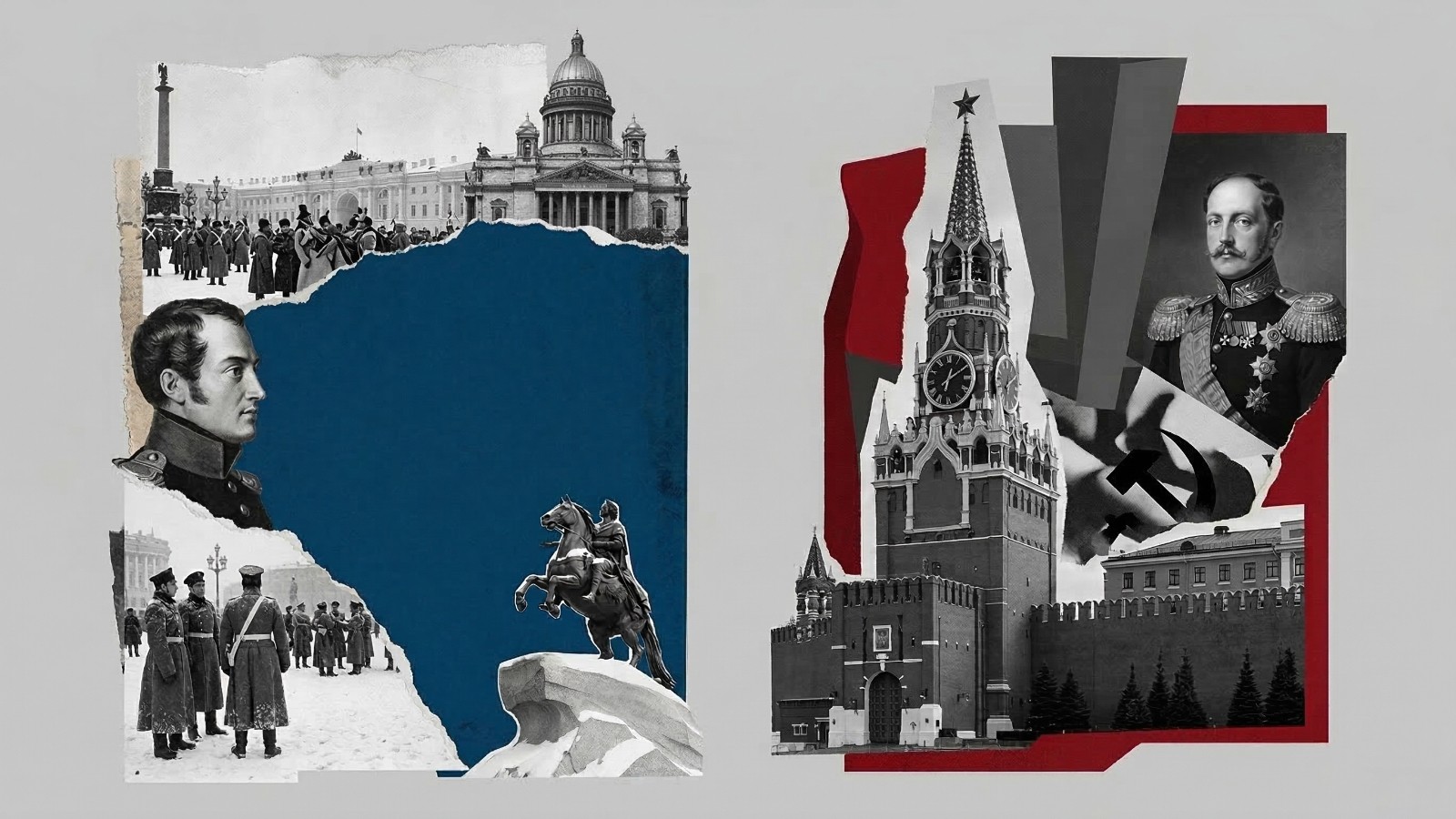
How does the myth of the 1825 Decembrist revolt continue to challenge Russia’s “power vertical”? Despite the uprising's immediate failure, it generated a powerful narrative of moral resistance against autocracy that inspired generations of Russian opposition figures, from 19th-century liberals to Soviet-era "Sixtiers". The article highlights a sharp contemporary divide: while modern Russian dissenters invoked the Decembrist tradition during the 2011–2012 protests, the Kremlin under Vladimir Putin has moved to suppress this revolutionary legacy. Instead, the current regime seeks to rehabilitate the image of Tsar Nicholas I as an "ideal autocrat," portraying the Decembrists as dangerous "internal enemies" and "subjects of foreign influence".
A specter is haunting the halls of power in Russia—the specter of the Decembrists. The rebellion led by a group of aristocratic officers in St. Petersburg 200 years ago, in late December 1825, ended quickly and in ignominious failure. Yet the Decembrists’ debacle gave rise to a powerful myth that has inspired several generations of opponents of repressive political regimes in Russia. In Vladimir Putin’s Russia, the bicentennial of the Decembrist revolt was all but ignored. In the Kremlin’s view, the mutinous nobles were dangerous political criminals, and today they are denounced no less harshly than they were at the time of Tsar Nicholas I.
There is an intriguing paradox here. Objectively, the historical significance of the Decembrist uprising, taken on its own, is rather modest, making the place it occupies in Russian historiography and the Russian political imagination disproportionately large. More scholarly works have been written about the Decembrists than about the transformative policies of Peter the Great, the Great Reforms of the 1860s and 1870s, the 1812 war against Napoleon, or the First World War. The only plausible explanation for this phenomenon is that Russian historians, along with the broader public, have been driven by a compelling mythological narrative that turns the Decembrists into cult heroes of Russian history and role models for generations of liberal-minded members of the intelligentsia.
“The story of the [Decembrist] conspiracy and of the revolt,” wrote the prominent literary scholar D. S. Mirsky a century ago, “is pathetic, so extraordinary was the muddle-headedness and ineffectiveness of the conspirators and rebels.”[^1] Notwithstanding the revolt’s tragic denouement, with guns firing point-blank at the rebels on Senate Square, the entire affair bore all the hallmarks of a comedy of errors. Nonetheless, the Decembrists’ brutal incarceration in the Peter and Paul Fortress, their trial, the execution of five ringleaders, and the exile of the remaining convicts to Siberia in chains are precisely the raw material from which legends are made. The martyrdom of noble-minded young idealists fighting for universal liberty against ruthless tyranny came to be perceived by posterity as an example of poetic justice: a demonstration of the intrinsic moral superiority of the vanquished Decembrists over the omnipotent Russian samoderzhavie (autocracy).
It was Alexander Herzen, an emigrant political thinker and brilliant writer, who in the early 1850s endowed the story of the Decembrists with an almost religious sanction. Herzen is the true author of the Decembrist myth, having created its key tropes and most evocative images. He claimed to have revealed the deeper symbolic meaning of the ill-fated 1825 rebellion and of the Decembrists’ self-sacrifice. The execution of their leaders, Herzen argued, symbolized Russia’s impending liberation, because the Decembrists’ heroic example would now inspire new fighters against tsarism. “This stupid tyrant,” Herzen wrote of Nicholas I, “did not understand that this is precisely how the gallows are transformed into a Cross before which entire generations bow.”[^2] In Herzen’s telling, the revolt’s failure prefigured the ultimate success of the Russian revolutionary movement. The Decembrists’ defeat itself, he insisted, crystallized the liberating mood: “The silent, mute inaction was ended. From the height of their gallows, these people awakened the soul of a new generation. The blindfold fell from their eyes.”[^3]
After Herzen, every opposition movement, group, or party in imperial Russia, from liberals to far-left radicals, claimed the Decembrists as their ideological and political precursors. The eagerness to appropriate the “blue-blooded revolutionaries” stemmed largely from the widespread perception of them as selfless Russian patriots who willingly sacrificed their social status and careers, and even their lives, for the lofty ideals of humanism. In this sense, the Decembrist myth proved irresistible. “The Decembrists neither destroyed nor created anything,” noted the Russian emigrant writer and editor Mark Aldanov in 1925. “The true value of what they had done lies exclusively in their legend.”[^4]
Another factor contributing to the appeal of the Decembrists’ political image was the elevated yet vague and internally incoherent nature of their reform plans. The problems generated by political absolutism, the suppression of individual liberty, and the abysmal living conditions of the masses, even after the abolition of serfdom in 1861, persisted throughout the final decades of Russia’s prerevolutionary history. Among the Decembrists’ principal political goals were the abolition or constitutional limitation of the monarchy, the liberation of the peasantry on more or less favorable terms, and the full or partial democratization of society—a program that was later embraced by a broad spectrum of Russian opposition forces.
After they came to power, the Bolsheviks canonized the Decembrists as their revolutionary forerunners, drawing a direct teleological line between 1825 and 1917. The political and social objectives articulated by the “first Russian revolutionaries,” Lenin and his comrades argued, were fully realized at the Revolution’s “proletarian stage.” In practice, however, Russian Communists presided over a sociopolitical system that proved far more repressive than the one that had existed under the tsars. The Bolsheviks’ former socialist and liberal peers seized on this contradiction, arguing forcefully that the Decembrists’ ideals of individual liberty, equality, and social justice remained unrealized in Soviet Russia. “The realities of Soviet life,” wryly observed Pavel Milyukov, the former Constitutional Democrat leader, “made many points of the Decembrists’ [political] program even more relevant than they had been before the [1917] Revolution.”[^5]
It did not take long for Communist ideologues to recognize the ambiguous, and potentially anti-regime, nature of the Decembrist myth. They therefore sought to strike an uneasy balance between hagiographic glorification of the Decembrists in the spirit of Herzen, portraying them as “heroes forged from pure steel from head to toe,”[^6] and Marxist class analysis, which emphasized the “historically conditioned” limitations and shortcomings of the gentry revolutionaries. As one leading Soviet literary critic noted in the 1930s, it was essential to understand that “the Decembrists’ limitations are historically overcome, while the positive elements of the [Decembrist] movement are passed on to subsequent generations of revolutionaries.”[^7]
However, the subversive potential of the Decembrist legend became increasingly pronounced. Young Soviet officers returning from the Second World War, much like the young Guards officers who came back to Russia after the European campaigns against Napoleon in 1813–14, invoked the image of the Decembrists. Anna Akhmatova drew such a parallel in a conversation with Nadezhda Mandelshtam in the 1940s. “‘They came to resemble the Decembrists,’ said Akhmatova. True, they did resemble the Decembrists, [Mandelshtam replied] and somewhere among them… a young artilleryman [Alexander Solzhenitsyn], with penal servitude and literature still ahead of him, was thinking about Russia.”[^8]
One of these Soviet soldiers returning from Germany, the 25-year-old poet David Samoilov, reflected on his own “war generation,” implicitly comparing it with Russia’s celebrated “1812 generation,” to which many Decembrists had belonged. “We, the generation of the 1940s in Russia, are destined to be a [ray of] light in the dark kingdom of postwar Europe,” Samoilov wrote in his notebook. “A generation of impeccably honest people – that’s what we should be called.”[^9] On December 26, 1945, the 120th anniversary of the Decembrist revolt, he made a striking entry in his diary: “The perfect type of man of our time,” Samoilov wrote, “is a Decembrist—but a Decembrist destined to come to power…”[^10]
The postwar political clampdown and the repressions of High Stalinism would prevent Samoilov’s vision from becoming reality. Yet the freedom-loving and emancipatory dimension of the Decembrist legend was further developed by members of the Soviet liberal-minded intelligentsia in the late 1960s and 1970s, following the brief interlude of the Khrushchev Thaw. The historical novels of Nathan Eidelman and Bulat Okudzhava, the scholarly works of Yuri Lotman, and the poetry and songs of Alexander Galich and Alexander Gorodnitsky were saturated with allusions and Aesopian rhetorical devices. For these authors, the Decembrists functioned as a metaphor for the Russian intelligentsia’s protest against despotic power. The Decembrist saga was framed within a thinly veiled historical parallel between the Brezhnev era and the reign of Nicholas I.
In a context where conditions for overt political action did not exist, Lotman, in his seminal 1975 essay “The Decembrist in Everyday Life,” proposed shifting the focus from the “revolutionary” or “ideological” dimension of the Decembrist tradition to its “human” aspect—specifically, to a tradition of a “certain type of behavior” that, he argued, the Decembrists had inaugurated. In Lotman’s interpretation, the Decembrists represented a fundamentally new type of person in Russian history. Their revolt was, above all, a moral act: a protest against amoral autocracy by decent and honest individuals driven by a spiritual impulse, for whom individual freedom was first and foremost an internalized value rather than merely a political objective.[^11] For the opposition-minded generation of the Soviet “Sixtiers,” deviating from this impulse meant violating the “Decembrist–intelligentsia moral code” and surrendering to the suffocating atmosphere of Brezhnev-era stagnation.
It is striking how resilient the Decembrist legend remained even in the final decade of the Soviet era. In late May 1981, the poet Samoilov, no longer the starry-eyed romantic he had been in 1945, reflected on the Soviet political opposition and compared it with the Decembrists. “The Decembrist cause proved to be superior to defeat,” Samoilov wrote in his diary. “It was precisely after [the Decembrists] that an exemplary high moral type emerged in Russia. The dissidents did not create such a type.” His overall conclusion was unequivocal: “The Decembrists proved to be unique.”[^12]
The collapse of communism and the disintegration of the Soviet Union appeared to have laid the Decembrist myth to rest. As the Russian intelligentsia—the principal bearer of the Decembrist tradition—withered amid the economic dislocations and crises of the 1990s, the old/new elites of post-Soviet Russia were preoccupied with constructing what became known as “Wild East” capitalism. The political atmosphere remained chaotic but relatively free. This began to change in the early 2000s with Vladimir Putin’s ascent to power. Two trends immediately became apparent. In domestic politics, the Kremlin set out to build a “power vertical,” that is, a consolidated authoritarian system with a highly centralized chain of command, relying primarily on executive authority at the expense of the legislature and judiciary, which were relegated to subordinate and auxiliary roles, with the Presidential Administration functioning as the supreme command-and-control center. The second trend, in the realm of “historical politics,” was Putin’s clear preference for what he saw as the traditions of Imperial Russia: a strong autocratic state, a disciplined bureaucracy, loyal subjects, and formidable armed forces. Russia’s entire revolutionary tradition was subjected to harsh condemnation. In the Putinist interpretation, revolutionaries, beginning with the Decembrists, were internal enemies who weakened the state from within, plunged Russia into “times of troubles,” thereby creating an opening for foreign adversaries to exploit the country’s weakness and disunity.
As opposition to these trends gradually grew inside Russia, the ghost of the Decembrists was resurrected. It emerged in December 2011 in Moscow and St. Petersburg, during the mass protest rallies against the recent, rigged parliamentary election and the plan for Putin to return to the Kremlin as president after a four-year stint as prime minister. Many protesters cheerfully described themselves as “continuators of the Decembrist cause.” The Kremlin was seriously alarmed. Not only was the sheer scale of the protests—tens of thousands of participants—unsettling. Putin’s ideologues quickly realized that the association with the Decembrists endowed the protest movement with a distinctive romantic aura. Moreover, the comparison significantly increased public sympathy for the protesters and lent their actions a measure of legitimacy: In the eyes of a broader audience, the protests suddenly acquired a lineage nearly two centuries long.
Notably, during the protest campaign of the winter of 2011–12, Russia’s diverse and often fractious anti-Putin opposition achieved a degree of cohesion, cooperation, and shared purpose. Westernizing liberals, left-wing Marxist groups, and democratic nationalists alike invoked the Decembrist tradition and referred to the Decembrists as their role models. Sergei Sergeev, a historian and one of the intellectual leaders of the national-democratic movement, articulated these parallels with particular clarity. He stressed not only historical continuity but also ideological unity between “the opposition of 1825” and “the opposition of 2011.” “Breaking a structure of power that has slipped beyond society’s control and eliminating class barriers is possible only when the Russian political nation becomes sovereign not merely in words but in deeds. This is what the Decembrists of 1825 strove for, and this is what the Decembrists of 2011 are seeking to achieve, consciously or unconsciously,” Sergeev wrote. “Both then and today,” he continued, “Russian Decembrism faced the same task: the creation of a Russian national democratic state… Both then and today, the principal opponent was an authoritarian government beyond society’s control, perceiving Russia as its fiefdom and Russians as its submissive subjects.”[^13]
In 2012, the Kremlin succeeded in suppressing the protest movement. Thereafter, Putin’s political strategists intensified what was a two-pronged approach: discrediting the Decembrists as immature and irresponsible adventurists corrupted by pernicious Western ideas, while simultaneously glorifying Russian autocracy in general and the reign of Nicholas I in particular. By 2025, the bicentennial year of the Decembrist revolt, the story had appeared to come full circle. As Putin’s Russia is increasingly presented as a reincarnation of Nicolaevan Russia, the event deemed worthy of celebration was not the failed aristocratic coup d’état but the day of Nicholas I’s accession to the throne. As the influential imperial thinker Yegor Kholmogorov put it, this date marked “one of the most astonishing and salutary turns in all of Russian history.”[^14]
In mid-September 2025, Moscow’s State Historical Museum opened a major exhibition titled “Nicholas I: An Ideal Autocrat.” According to the museum’s press release, “The exhibition is dedicated to the 200th anniversary of the accession to the throne of Nicholas I, the emperor whose reign became a golden age of Russian culture and a period of crucial state reforms, industrial growth, and economic development.”[^15] To ensure that the political message of the exhibition was not missed, Notebooks on Conservatism, a journal founded by a group of Kremlin-aligned conservative intellectuals, published an editorial by its editor-in-chief, Rodion Mikhailov, under the telling headline “Nicolaevan Russia and Putin’s Russia: The Historical Parallels.” In Mikhailov’s view, the similarities are striking. “Vladimir Putin carried out reforms along the same lines, according to the same design, and ultimately on the same axiological foundations as those implemented in Nicolaevan Russia,” he argued. “It is noteworthy,” he added, “that both leaders pursued reforms without regard for public opinion, guided not by popularity or approval ratings but by the country’s real needs and the strategic vector of its development.”[^16]
In the jubilee year, however, the Decembrists were not entirely forgotten. In December, Russia’s Ministry of Justice held a “scientific-practical conference” called 200 Years Since the Decembrists’ Revolt: The Lessons of the Past for the Present. In his address at the conference, Justice Minister Konstantin Chuychenko accused the Decembrists of staging a senseless mutiny that set back Russia’s development and, in the spirit of conspiratorial thinking, described them as “subjects of foreign influence,” primarily inspired by the U.S. Constitution.[^17] Earlier, at another “scientific event” in May 2025, Chuychenko commented: “The Decembrists opposed the existing state system, violated their oath of office, and shed blood, which undoubtedly makes them, in our view, criminals, rebels who sought to change the country’s political system by force and, as a result, most likely drag the Russian people into a bloody civil war.”[^18] These passages could have been taken almost verbatim from the verdict of the Supreme Criminal Court that sentenced the Decembrists in 1826.
Yet the rebellious specter of the Decembrists continues to haunt the Kremlin’s master. With opposition to Putin’s rule effectively crushed in Russia today, isolated pockets of discontent can still be found among hardline nationalists, the self-styled “angry patriots” who have chosen to associate themselves with the mutinous Decembrist tradition. “Today, anyone who feels pain for the country and is dissatisfied with the autocratic style of government can recognize themselves in the Decembrists,” wrote the nationalist intellectual Alexander Khramov in early December 2025. He ended his short essay on a menacing note, drawing a parallel between the Decembrists and Yevgeny Prigozhin’s 2023 rebellion. “True,” Khramov conceded, “Prigozhin and his commanders represent a social type as far removed as possible from the young nobles and officers who belonged to the Decembrist societies. But the vibe is the same: angry patriots challenging the regime through a military rebellion.”[^19]
At the opposite end of the Russian political spectrum, academic apologists who cast Putin as a latter-day Nicholas I appear oblivious to the “ideal autocrat’s” inglorious end. Nicholas died amid an unnecessary war with a coalition of Western powers that Russia ultimately lost. His death exposed the depth of hostility toward him within broad circles of Russia’s educated society. Two days after the tsar’s death, on March 2, 1855, Konstantin Kavelin, a St. Petersburg University professor who was a monarchist, wrote to his Moscow friend and fellow historian Timofei Granovsky:
My negative, bilious, poisonous joy… is so great. The Kalmyk demigod who ravaged the Russian state for 30 years like a hurricane, a scourge, a steamroller… emasculating thought, ruining thousands of lives and minds, squandering more money on the trinkets of autocracy and vanity than all previous reigns beginning with Peter the Great, this fiend of uniformed enlightenment and the most appalling side of Russian nature, has finally croaked… If the present were not so strange and gloomy, the future so mysteriously enigmatic, one could go mad with joy and become intoxicated with happiness.
Yet Kavelin could not help reflecting on the wasted opportunities and barren outcome of Nicholas’s long reign. “Who will turn back these 30 years and call our generation back to fruitful and inspired activity?” he asked bitterly.[^20] Incidentally, when Putin’s current presidential term ends in 2030, his time in power will also total 30 years.
[^1]: D.S. Mirsky, “The Decembrists,” The Slavonic Review 4, no. 11 (1925), 402.
[^2]: A.I. Gertsen, Sobranie sochinenii, 30 vols. Vol. 13 (Moscow: Izdatelstvo AN SSSR, 1958), 143.
[^3]: Ibid., Vol. 7 (Moscow: Izdatelstvo AN SSSR, 1956), 201.
[^4]: Mark Aldanov, “Pamiati dekabristov,” Golos minuvshego na chuzhoi storone, no. 2 (1926), 44.
[^5]: Pavel Milyukov, “Rol dekabristov v sviazi pokolenii,” Golos minuvshego na chuzhoi storone, no. 2 (1926), 59.
[^6]: V.I. Lenin, Polnoe sobranie sochinenii, 55 vols. 5th ed. Vol. 21 (Moscow: Politizdat, 1968), 255.
[^7]: L.V. Tsyrlin, Tynianov-belletrist (Leningrad: Izdatelstvo pisatelei, 1935), 79.
[^8]: Nadezhda Mandelshtam, Vtoraia kniga, 3d ed. (Paris: YMCA Press, 1983), 396.
[^9]: David Samoilov, Podennye zapisi, 2 vols. Vol. 1 (Moscow: Vremia, 2002), 227.
[^10]: Ibid., 226.
[^11]: Yu.M. Lotman, “Dekabrist v povsednevnoi zhizni (Bytovoe povedenie kak istoriko-psikhologicheskaia kategoriia)” in Literaturnoe nasledie dekabristov, ed. V.G. Bazanov and V.E. Vatsuro (Leningrad: Nauka, 1975), 25-74.
[^12]: David Samoilov, Podennye zapisi, 2 vols. Vol. 2 (Moscow: Vremia, 2002), 300-301.
[^13]: Sergei Sergeev, “Dekabrizm vchera i segodnia,” Russkaia platforma, December 15, 2011, http://rusplatforma.org/publikacii/node381/.
[^14]: Yegor Kholmogorov, “Ideal imperskoi Rossii i 14 dekabria,” Pravaya.ru, December 15, 2005, http://www.pravaya.ru/look/5896.
[^15]: Gosudarstvennyi Istoricheskii Muzei: Nikolai I. Idealnyi samoderzhets. Press release, September 16, 2025, https://shm.ru/upload/iblock/871/xqj8c09pkw9in1nr2s7ortw0l84vegph/PR_Nikolai_-I-_1_-_1_.pdf.
[^16]: Rodion Mikhailov, “Nikolaevskaia Rossiia i Rossiia Putina: istoricheskie paralleli,” Tetradi po konservatizmu, no. 2 (2025), 10.
[^17]: “Chuychenko: vosstanie dekabristov bylo ne progressom, a regressom,” TASS, December 10, 2025, https://tass.ru/politika/25870385.
[^18]: “Miniust proveril na ‘inostrannykh agentov’ vosstavshikh v 1825 godu dekabristov,” The Moscow Times, May 20, 2025, https://ru.themoscowtimes.com/2025/05/19/minyust-proveril-nainostrannih-agentov-vosstavshih-v1825-godu-dekabristov-a163748.
[^19]: Aleksandr Khramov, “200 let so dnia vosstaniia dekabristov: uroki proshlogo,” Agentstvo politicheskikh novostei, December 7, 2025, https://www.apn.ru/index.php?newsid=48885.
[^20]: “K.D. Kavelin o smerti Nikolaia I: Pisma k T.N. Granovskomu,” Literaturnoe nasledstvo 67 (Moscow: Izdatelstvo AN SSSR, 1959), 607.