Russia-Related Lobbying in U.S. Congressional Disclosures
The Russia Program
A study of Russia-related lobbying in U.S. LDA filings, showing how American companies dominate lobbying around sanctions, trade, and Russian state interests.
Summary
This paper examines Russia-related lobbying activity in the United States through filings under the Lobbying Disclosure Act (LDA) submitted to Congress. The Russian state does not appear in LDA filings, but state-affiliated companies pursuing state interests—like Gazprom and Sberbank—do. The LDA is superior to the Foreign Agents Registration Act (FARA), which is focused on tracking political lobbying in a state’s interests, whereas the LDA covers the full spectrum of lobbying activity, including trade and commercial interests, making filings under it a more useful tool for this research.
The majority of lobbying both in support of and against Russian state interests, including on sanctions relief, is conducted by U.S. companies, which dominate both in the number of filings and the scope of their activities. This is a consistent pattern across all the key topics that appear in the disclosures since the turn of the millennium, including Russia’s accession to the World Trade Organization, U.S. sanctions policy with regard to Russia, and uranium imports from Russia to the United States. Meanwhile, the lobbying activity of Russian-affiliated clients remains consistently low, albeit steady throughout the entire period. U.S. clients, by contrast, are seen responding actively to major changes in U.S. legislation and policy, with each shift triggering a spike in lobbying activity.
The Kremlin’s limited public lobbying, along with its reliance on U.S. companies to advocate issues concerning its interests, does not mean that Moscow does not pursue its interests in Washington through other means. It does suggest, however, that registered lobbying holds little appeal for the Russian state under Putin.
Introduction
Lobbying in the United States is a legal and publicly disclosed activity. The right to petition the government is protected by the First Amendment to the Constitution, and lobbying, as the organized exercise of that right, has long been treated not as a corrupt practice that should be prohibited, but as a legitimate form of political participation, subject to regulation through transparency[^1]. Both private individuals and organizations, as well as foreign governments and commercial entities, may pursue their interests in Washington, D.C., but they must do so publicly, with their activities reported under one of the federal disclosure frameworks, depending on their nature.
There are two: The Foreign Agents Registration Act (FARA), enacted in 1938[^2], was designed primarily as a national security measure, requiring agents of foreign principals, including foreign governments, political parties, and companies acting at their direction, to disclose their activities when those are political in nature or aimed at influencing U.S. public opinion or policy; meanwhile, the Lobbying Disclosure Act (LDA), signed into law on December 19, 1995[^3], was intended to increase transparency and accountability around professional lobbying, covering both efforts targeting the legislative and executive branches and in the interests of domestic and foreign commercial clients[^4].
The two frameworks differ in the logic of disclosure. FARA is organized around the foreign principal: Registration is triggered by the identity of the entity whose interests are being advanced, making the country of influence the central object of transparency requirements. The LDA, by contrast, tracks any lobbying aimed at influencing Congress or the executive branch, with country of origin treated as one attribute among several recorded at client registration. Under the LDA, registrants are also required to disclose affiliated organizations—entities contributing more than $5,000 that supervise or control their lobbying activities—and foreign entities holding at least 20% equitable ownership in the client, including the country of origin of each. This means that the LDA captures a broader range of activity connected to a given country, but it does so with less precision: A company with no formal foreign ties that nonetheless lobbies in the commercial interests of a particular country is under no obligation to disclose that connection.
Major economies are prominently represented in LDA filings, with the lobbying of their commercial and trade interests done through industry associations and business councils. For example, China appears through associations covering steel, agricultural exports, and bilateral exchange. India is represented through bodies spanning software, pharmaceuticals, rice, and jewelry manufacturing. Brazil's presence is marked by trade associations for chicken and sugar exporters, textile producers, and financial institutions.
Unlike China, India, or Brazil, Russia has no visible network of industry associations or business councils lobbying on its behalf, with the sole exception of the Union of Oil and Gas Producers of Russia (UOGPR). Individual Russian-registered commercial companies do appear as direct LDA clients, and some of them can reasonably be understood as advancing Russian state interests. The current disclosure legislation does not require FARA registration as long as a foreign government is not the “principal beneficiary” of the lobbying effort. This means that state-affiliated companies can register under the LDA alone, avoiding the more stringent disclosure requirements that FARA imposes. Government watchdogs have argued that this arrangement is particularly problematic in the case of authoritarian states: As one lobbyist for the Project on Government Oversight observed, “The line between the private and the public sphere—particularly in authoritarian regimes—is pretty ambiguous,” citing Russia, China, and Saudi Arabia as examples[^5]. This may not apply equally to all Russian-registered clients in the LDA record, but it is a reasonable inference in the case of state-controlled banks, extractive-industry companies, and firms subsequently sanctioned for their role in Moscow’s aggression abroad.
In this paper, we examine how Russia has been represented in LDA filings over time—analyzing both how the state has sought to advance its political interests in Washington and how commercial actors have lobbied for or against economic ties with Russian producers, access to the Russian market, and the import and export of Russian goods. Since our focus extends beyond the activities of foreign government agents to encompass the full range of commercial and political lobbying related to Russia, we draw on LDA filings rather than FARA registrations[^6].
The paper first maps Russia-related lobbying in the United States, identifying the principal actors and tracing how their presence in the LDA record has evolved. It then looks at the most frequently identified topics—including bilateral trade relations, sanctions, and nuclear fuel—and how lobbying activity is distributed between those advancing and those opposing Russian interests, what positions Russian and Russian-affiliated clients take, and how non-Russian companies engage on the same issues.
Data and Methods
The empirical foundation of this study is lobbying disclosures accessed through the official API of LDA.gov[^7]. The dataset draws on two primary filing types: Lobbying Registrations (LD-1) and Quarterly Activity Reports (LD-2). Electronic filing became available only in 1999, so disclosures predating that year are not accessible through this system. In addition, comprehensive electronic availability of filings was achieved only from 2007 onward, when the Honest Leadership and Open Government Act (HLOGA)[^8] introduced mandatory electronic submission and required that all registration and disclosure statements be made available online in a searchable and sortable format.
The dataset consists of lobbying registration reports and activity reports filed under the LDA. Prior to 2008, lobbyists filed semiannual reports; from 2008 onward, quarterly reporting became mandatory. Registration reports must be submitted within 45 days of the first lobbying contact, provided that lobbying expenditures exceed the statutory threshold[^9]. A lobbying contact is defined as any communication to a covered executive or legislative branch official, made on behalf of a client to influence federal legislation or regulation, the administration of a federal program or policy, or the nomination of a person for a Senate-confirmed position. Each registration report contains information about the registrant, the client, whether an organization or a private individual, any affiliated organizations, any foreign entities connected to the client, the issue areas in which lobbying is expected to take place, and the individual lobbyists acting on behalf of the client.
Semiannual and quarterly activity reports contain the same core information as the registration report—registrant, client, and issue areas—and additionally record the income received and expenses incurred by the registrant over the reporting period in connection with lobbying activities.
To construct a Russia-relevant subset, we filtered all disclosures in which Russia appears as the client's country of origin, is listed among affiliated entities or foreign organizations holding an ownership stake in the registered client, or is mentioned in the issue description. We further enriched the subset with disclosures where Russia was mentioned but not reported as the client's or its affiliated companies' location by using LLM and manual research to identify clients that have indirect ties to Russia, such as foreign-registered entities like Yandex N.V. (Netherlands) or Severstal North America Inc. (United States). For these entities, we included all their disclosures, not just those that explicitly mentioned Russia.
To analyze lobbying objectives, we rely on the issue description field, which registrants are legally required to complete. In practice, these fields are often filled out in vague or generic terms, as in the example below, where we can only guess what exact issues regarding Russia and Ukraine Veon Ltd. is lobbying[^10], which limits their analytical value. Understanding the actual goals behind a given lobbying effort, therefore, frequently requires more context that goes beyond disclosures.
Figure 1. Sample Issue Description in LDA Quarterly Report[^11][^12]

A further limitation concerns financial data. Since individual disclosures typically list multiple issues lobbied by the same registrant-client pair, and reported expenditures are not broken down by issue, it is not possible to determine what share of a client's lobbying spend was directed specifically at what matters, as the example below shows. For this reason, financial figures are not included in the analysis.
Figure 2. Sample Issue Description in LDA Quarterly Report[^13]
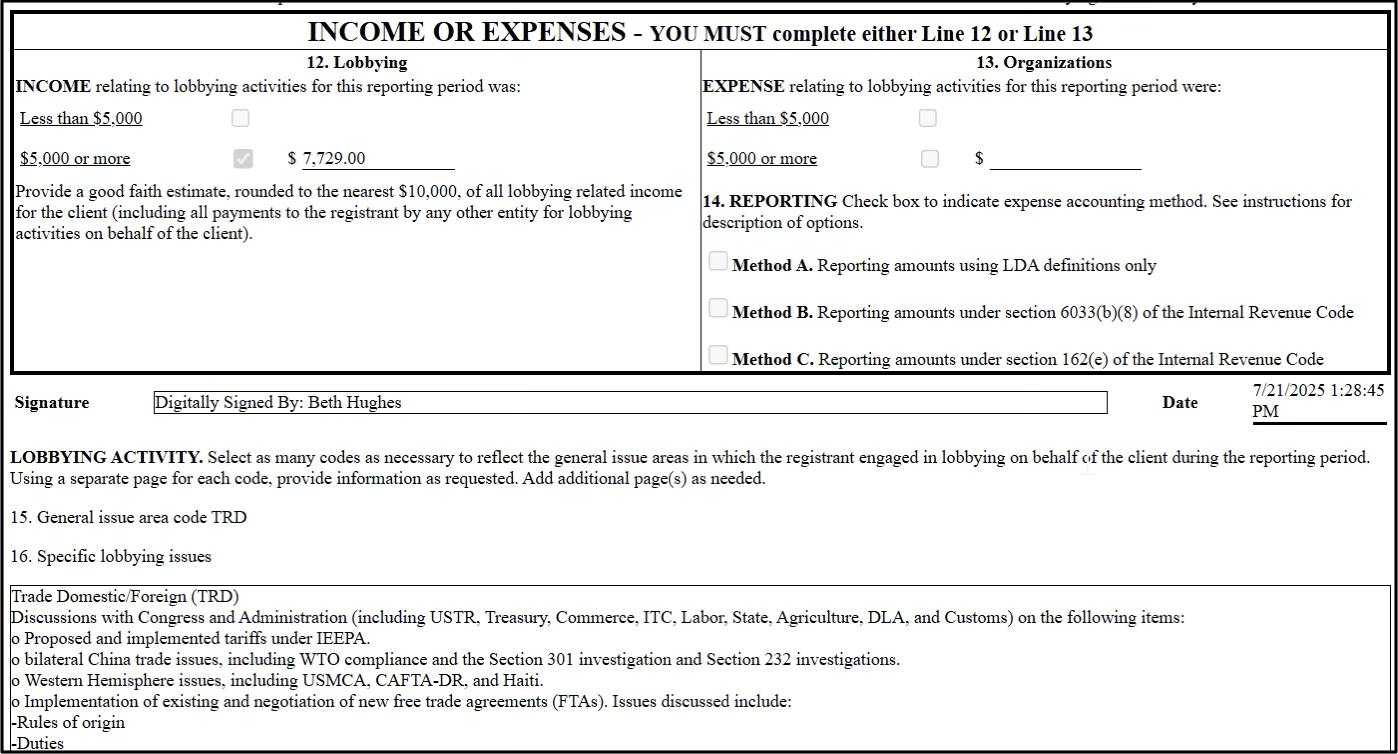
Since the number of reports varies across years, and lobbying activity may be distributed unevenly throughout the year, we aggregated disclosures by year to ensure greater consistency, combining issue lists reported across all filings for each client-registrant pair and excluding zero-activity and termination reports. As a result, the unit of observation in the dataset is the client-registrant pair per year, showing whether each pair was active in a given year and what issues were lobbied. Despite these limitations, the dataset allows us to draw meaningful conclusions around the most-frequent issues and clients.
Lobbying Clients
In the observed period, disclosures in which Russia is mentioned in the issue description but the client has no Russian affiliation—labeled “Russia mentioned” in Figure 3—consistently and substantially outnumber those filed by Russian entities. The total number of such disclosures reaches 1,702 versus just 188 filed by clients with direct or indirect Russian ties, and the gap between the two widens considerably over time from 2005 onward.
Figure 3. Annual LDA Disclosures Mentioning Russia, by Client Type
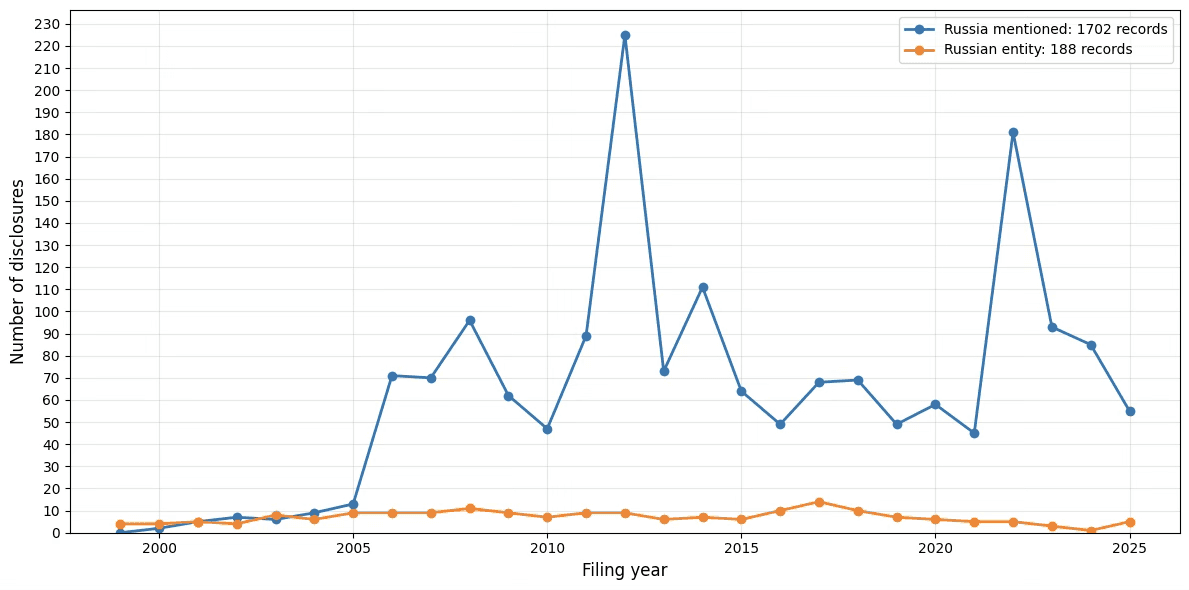
Among the 188 disclosures filed by Russian entities, 75 were submitted by clients that listed a Russian entity among their affiliated entities or foreign organizations holding an ownership stake in the registered client; 63 were filed by clients that identified Russia directly as their country of origin; and 56 disclosures came from clients without formal Russian affiliation but have been identified by the authors as having Russian ties.
The lobbying activity of Russian-affiliated entities remains relatively stable throughout the entire period. By contrast, mentions of Russia by non-Russian clients exhibit clear spikes corresponding to specific political events, such as Russia's WTO accession negotiations and waves of sanctions following the annexation of Crimea in 2014 and the full-scale invasion of Ukraine in 2022. These events triggered intensified lobbying around legislation changes and their implementation—this is visible in disclosures filed by U.S. and other non-Russian clients but largely absent among Russian-affiliated entities. Clients with Russian affiliation respond without broad mobilization of additional lobbyists in response to the political events: rather than a surge in the number of active filers, the same small set of clients continues lobbying on the same issues, with little change in the overall volume of activity.
Among the 1,702 disclosures filed by clients with no formal Russian affiliation, 570 distinct clients mentioned Russia in their issue descriptions. By contrast, the total number of unique legal entities appearing as Russian-registered clients, foreign entities with ownership or control, and affiliated organizations amounts to just 59, though the same entities frequently appear in more than one category. Moreover, in practice, many of these formally distinct entities represent the same underlying principal: For instance, Sberbank CIB USA Inc. lists at least four Russian organizations among its foreign entities—Sberbank of Russia, LLC SB Finance Holding, LLC CIB Holding, and LLC Bylinnye Bogatyri—while Telekompanie NTV lists both Media Most and Gazprom Media as its foreign entities.
Table 1. Russian-affiliated lobbying clients in LDA filings by category
Category | Total number | Top clients by disclosure count |
Russian-registered clients | 26 | Alfa-Bank, GML, En+ Group IPJSC, Gazprombank; Alexander Skorobogatko, Alexander Ponomarenko |
Foreign companies listing Russian foreign entities or affiliated Russian organizations | 24 | Nord Stream 2 AG, Sberbank CIB USA Inc., ILS International Launch Services Inc., Norimet Ltd. |
Russian foreign entities with state ownership or control | 35 | Gazprom, Russian Federation, Sberbank, Khrunichev State Research and Production Space Center; Oleg Deripaska |
Russian-affiliated organizations | 1 | Novatek |
Clients with indirect Russian ties | 14 | Itera International Energy Corporation, GML/Menatep, Severstal (including Severstal Sparrows Point LLC), Yandex N.V.; Boris Mints |
In several cases, the same commercial interest appears in the LDA record through both Russian-registered and foreign legal entities. For some clients, the reasons for using multiple legal vehicles are not immediately apparent from the filings. Nornickel— one of the world's largest producers of nickel and palladium—lobbied through both its Russian entity and the UK-registered Norimet Ltd., while Mobile Telesystems (MTS)—a Russian mobile operator—appears through its Russian entities, as well as a Bermuda-registered subsidiary lobbying the same issues.
In the case of Gazprom, the division of labor is clearer. Sanctions-related issues were handled by the Russian-registered Gazprombank GPB OJSC, while lobbying around the Nord Stream 2 pipeline between Russia and Germany was conducted by Nord Stream 2 AG, a Swiss-registered company in which Gazprom holds a 50% stake, alongside European energy partners including Shell, Engie, Wintershall, E.ON, and OMV. This reflects a practical logic: Matters related to an active international infrastructure project were not handled by a Russian entity subject to sanctions.
The Yukos case involves the largest number of distinct legal entities, including a Russian-registered client that was involved in lobbying until 2011. Recall that Yukos, once Russia's largest oil company, was dismantled by the Russian state in the mid-2000s through a series of tax claims and asset seizures; its former shareholders subsequently pursued legal action across multiple jurisdictions simultaneously. The presence of entities registered in Gibraltar, the United Kingdom, and Russia in the LDA record reflects this. A distinct set of actors appeared separately in the LDA record on behalf of Yukos's foreign shareholders—among them GML Limited, Group Menatep, and Yukos International UK BV—lobbying in connection with international arbitration claims against the Russian state, efforts framed in terms of the rule of law and shareholder rights.
In 2022, the number of disclosures filed by Russian-affiliated clients does not drop off. Among the active filers that year were Sberbank CIB USA Inc. and Nord Stream 2 AG, both of which filed for the last time: The pipeline was destroyed in September 2022, and U.S. sanctions introduced that year effectively precluded any further engagement by Sberbank with U.S. institutions.
Russian-affiliated companies that continued to appear in subsequent filings were concentrated in the energy sector, including Arctic LNG 2, a liquefied natural gas project operated by Novatek that came under U.S. sanctions in 2023, and UOGPR, which appeared in 2025. Meanwhile, En+ Group, a holding company with major Russian energy and aluminum assets, has maintained a continuous lobbying presence throughout the post-2022 period.
Beyond formally Russian-affiliated entities, a separate group of filers consists of companies and individuals that once had Russian ties but have publicly severed them since the full-scale invasion. Among them are Yandex, which rebranded as Nebius Group, Mikhail Kokorich, who renounced his Russian citizenship, and GML, whose Russian legal entity had long ceased to operate.
Key Topics
Trade Relations and Market Access
One of the most common issues across all Russia-related disclosures is trade relations between the United States and Russia, specifically lobbying around Russia's accession to the WTO and the granting of U.S. Permanent Normal Trade Relations (PNTR) status. In total, these issues account for 456 disclosures filed electronically between 2001 and 2025.
Russia's path to WTO membership was exceptionally long. It began in 1993, when Russia applied to join the General Agreement on Tariffs and Trade (GATT), the predecessor to the WTO, while WTO negotiations dragged on for almost two decades. A milestone came in November 2006, when Moscow and Washington signed a bilateral protocol concluding negotiations between the two countries, though full membership still required the completion of talks with the other WTO members. Russia formally joined the organization only on August 22, 2012.
Under WTO rules, all member states must extend unconditional most-favored-nation treatment to one another, which in U.S. law corresponds to PNTR status—and granting it to Russia required a separate act of Congress. Russia had long been blocked from PNTR status under the Jackson-Vanik amendment, a provision of the Trade Act of 1974 that had never been repealed despite the end of the Cold War. As a result, whereas European and Asian exporters immediately benefited from Russia's WTO commitments of lower tariffs and market access, U.S. firms could not fully do so until the Congress acted.
The legislation that ultimately resolved this impasse was difficult politically, so H.R. 6156, signed into law on December 14, 2012,[^14] granted Russia PNTR status and repealed the Jackson-Vanik amendment with respect to Russia, but simultaneously included the Sergei Magnitsky Rule of Law Accountability Act, imposing sanctions on Russian officials deemed responsible for the death of Russian tax lawyer Sergei Magnitsky in a Moscow prison in 2009.
The decisive steps made toward normalizing trade relations between Russia and the United States starting in 2006 coincide with the peaks in Russia-related trade and WTO disclosures, as seen in Figure 4.
Figure 4. Annual LDA Disclosures on Trade
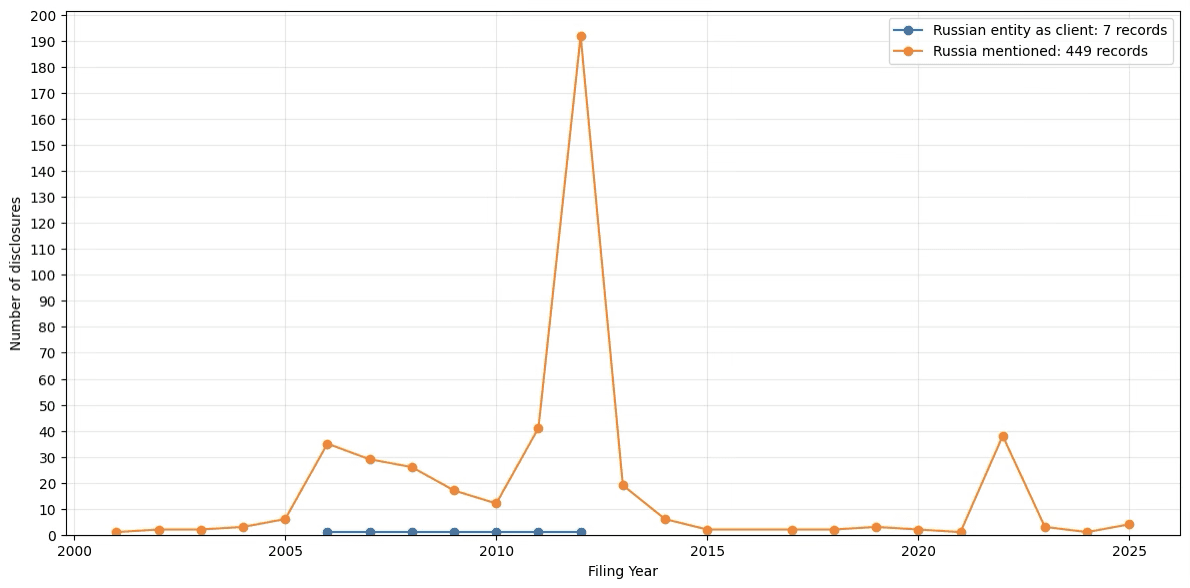
U.S. companies began engaging actively from 2006, when U.S.-Russia negotiations entered a decisive phase, until Russia was granted PNTR status. The lobbying coalition was broad. Not all filers were lobbying in favor of unconditional accession: Content producers such as Universal Music Group appeared among the filers, likely reflecting a demand for intellectual property protections as a condition of Russia's membership. The majority, however, represented companies seeking to expand commercial ties with Russia—among the most prominent being the National Pork Producers Council, Boeing, Chevron, and the U.S.-Russia Business Council, all of which remained engaged through 2012.
The secondary visible peak, in 2022, reflects lobbying around the suspension of normal trade relations with Russia and Belarus—introduced in response to Russia's full-scale invasion of Ukraine—in H.R. 7108[^15]. Among those lobbying on this issue were organizations explicitly supporting the suspension, such as the Foundation for Defense of Democracies (FDD), as well as companies with existing commercial ties to Russia, like Dell and Procter & Gamble, which were monitoring new trade restrictions to shield their operations. Notably, of the two companies cited above, Dell ceased direct sales to Russia[^16], while Procter & Gamble continued to operate in the country, albeit with a reduced product range[^17].
A telling example of the shift in lobbying posture following Russia's full-scale invasion of Ukraine in 2022 is the U.S. Chamber of Commerce, whose lobbying activity on Russia-related trade issues spans the entire period under examination. Before 2012, the Chamber lobbied actively in favor of Russia's WTO accession and the granting of PNTR status. By 2025, its filings on Russia deal with an entirely different set of concerns: implementation of U.S. sanctions on Russia, compliance with those sanctions, and the associated legal risks for U.S. companies operating in or with Russia.
As we see from the LDA data, on trade relations and market access—one of the most consequential issues directly affecting Russia's international economic standing—it was U.S. commercial actors—not Russian ones—that drove the lobbying activity in Washington. The U.S.-Russia Business Council, even though it does include some Russian member companies, was a vehicle predominantly for U.S. business interests seeking to expand ties with Russia. On the Russian side, the only entity to engage explicitly on these issues was Alfa-Bank, which facilitated meetings and discussions on U.S.-Russia relations and WTO negotiations from before the 2006 bilateral protocol through Russia's formal accession to the WTO in 2012.
Sanctions
Sanctions represent the second most prevalent topic mentioned in the lobbying issue description field across Russia-related LDA disclosures, partially overlapping with the bilateral trade relationship topic discussed above. As Figure 5 shows, the number of sanctions-related filings tracks closely with the key moments in U.S. sanctions policy toward Russia.
The first notable rise takes place around 2014, following Russia's annexation of Crimea and the introduction of the first rounds of executive-level sanctions targeting individuals and entities accused of undermining the sovereignty and territorial integrity of Ukraine, as well as sectoral sanctions aimed at increasing the diplomatic and financial costs of Russia's aggression against Ukraine[^18]. In the following years, additional sanctions were introduced in response to Russian cyber warfare: In 2015, the Obama administration established a new sanctions authority around malicious cyber activity, before expanding it in December 2016 to cover interference in elections and sanctioning Russian intelligence agencies like the GRU and FSB, along with several individuals and organizations involved in cyber operations during the 2016 presidential election[^19].
Figure 5. Annual LDA Disclosures on Sanctions Issues
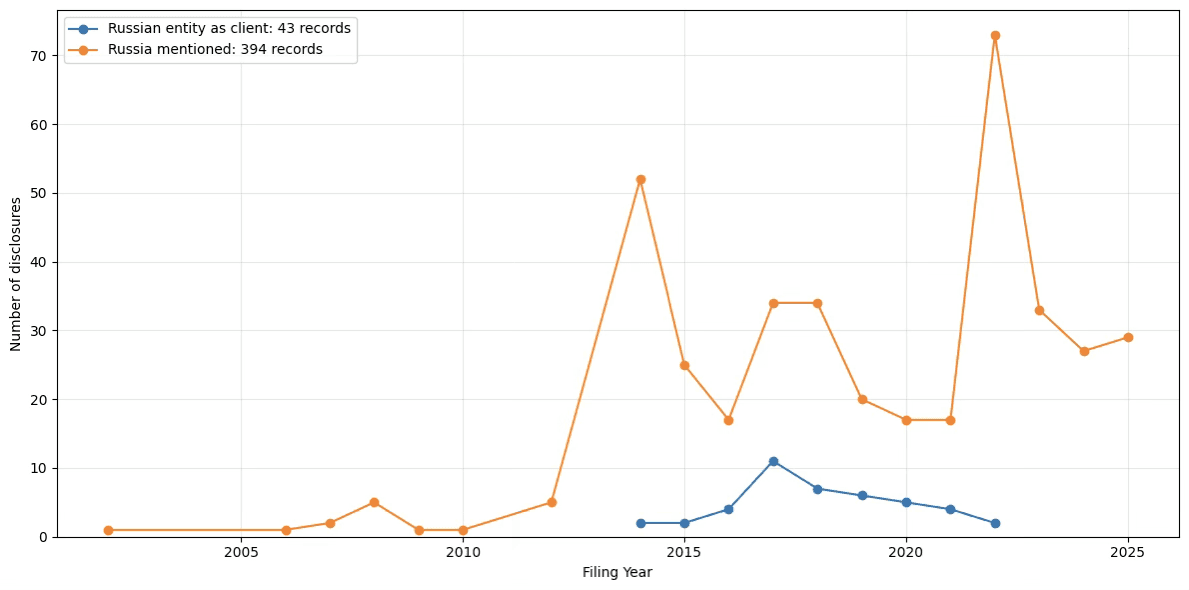
Sanctions-related lobbying picks up further in 2017 and 2018, driven largely by the passage and implementation of the Countering America’s Adversaries Through Sanctions Act (CAATSA). CAATSA codified and expanded existing sanctions against Russia across a broad range of sectors and activities, including oil and gas export pipelines, state-owned and state-affiliated financial institutions, and the defense sector. It also imposed penalties related to cyberattacks, human rights abuses, and arms transfers to Syria. It introduced a congressional review mechanism requiring the president to notify Congress at least 30 days before lifting or easing any sanctions, thereby giving Congress the ability to block a potential unilateral reversal by a future administration. CAATSA also required Treasury to prepare a report identifying senior Russian political figures, oligarchs, and parastatal entities—the so-called “Kremlin list,” eventually delivered to Congress in January 2018, naming 210 individuals but not itself imposing sanctions[^20]—which laid the groundwork for a significant expansion of personal sanctions in April 2018, when OFAC designated seven oligarchs and 12 companies owned or controlled by them, as well as 17 senior Russian government officials[^21].
The peak comes in 2022, coinciding with the sweeping sanctions packages enacted in response to Russia's full-scale invasion of Ukraine. These included full blocking sanctions on Russia's largest banks—among them Sberbank and Alfa-Bank—a ban on new investment in Russia; a ban on imports of Russian oil, gas, coal, gold, aluminum, copper, and nickel; secondary sanctions targeting foreign financial institutions servicing Russia's military-industrial complex; sanctions against individuals connected to the start of the war and subsequently to the death of Alexei Navalny; and phased restrictions on imports of enriched uranium from Russia. of the number of disclosures mentioning sanctions has remained elevated since 2022, reflecting the ongoing and iterative nature of sanctions legislation in the years that followed, as Congress continued to debate the scope of restrictions, enforcement mechanisms, and the legal exposure of U.S. companies to the sanctions regime.
Unlike the trade and WTO topic, where Russian entities were almost entirely absent, the sanctions issue attracts a modest but steady presence of Russian-affiliated clients—with 43 records over the full period. Among those subject to the sectoral sanctions introduced in 2014 under Executive Orders 13660–13662 and the 2014 Ukraine Freedom Support Act are Sberbank (Sberbank CIB USA Inc.), Gazprombank (GPB OJSC), and Novatek (together with the Yamal LNG project, in which it holds a majority stake), all of which faced restrictions on new debt and equity transactions. Gazprombank appeared in LDA filings from 2014 to 2016; Novatek and Yamal LNG from 2014 to 2017; and Sberbank from 2016 to 2022. The disclosed issue descriptions suggest that their lobbying was aimed primarily at understanding and navigating the sanctions regime—monitoring developments, assessing implications, and, in the case of Sberbank, explicitly declaring that it was “assessing possible ways to address sanctions relief.”
Another group of lobbying clients emerged after the 2017–2018 CAATSA sanctions and the publication of the so-called Kremlin list in January 2018, which included, among others, Oleg Deripaska, Alexander Skorobogatko, and Alexander Ponomarenko. Skorobogatko and Ponomarenko hired U.S. lobbyists shortly after the list came out in 2018, anticipating that inclusion might lead to personal designations—as had happened to Deripaska in April 2018—but in their case personal sanctions were not imposed until March 2022. En+ Group, the company owned and controlled by Deripaska, appeared in LDA filings from 2021 onward, addressing sanctions-related issues as part of a broader agenda around aluminum imports.
Other companies began investing in efforts to forestall or navigate sanctions. They include Nord Stream 2 AG, which appeared in LDA filings from 2017, anticipating the sanctions that were ultimately imposed in December 2019. IPSCO Tubulars Inc. d/b/a TMK IPSCO—the U.S. subsidiary of Russian pipe maker TMK—lobbied on sanctions-related issues from 2017 to 2019, disclosing concerns around CAATSA implementation and the 2018 Defending U.S. Security from Kremlin Aggression Act (DASKA), alongside broader steel and pipe industry matters. As an U.S. company owned by a Russian parent operating in the oil and gas supply chain, TMK IPSCO was directly in the firing line of sanctions.
Nonetheless, the overwhelming majority of clients lobbying sanctions-related issues remain U.S. companies—190 in total. Determining their position on them is not straightforward. MasterCard, the most active filer, in several disclosures lists only “Russia trade sanctions” or “U.S. sanctions on Russia and Belarus” as the issue description. The Foundation for Defense of Democracies (FDD), another frequent filer, similarly uses basic descriptions such as “Russia sanctions” in many disclosures, although in a few cases it provides more context—for instance, “lobbying for the designation of Russia as a state sponsor of terrorism.” To better understand the range of interests at play, note that 52 of the 190 U.S. clients had previously lobbied on Russia's WTO accession, either independently or as members of the U.S.-Russia Business Council—indicating that for a significant share of filers, the main goal is to expand the U.S.-Russia commercial relationship. For companies with established commercial interests in Russia, sanctions created legal and operational uncertainty that needed to be navigated, and lobbying was one tool for doing that.
Figure 6. Annual LDA Disclosures on Sanctions Issues Based on USRBC Membership
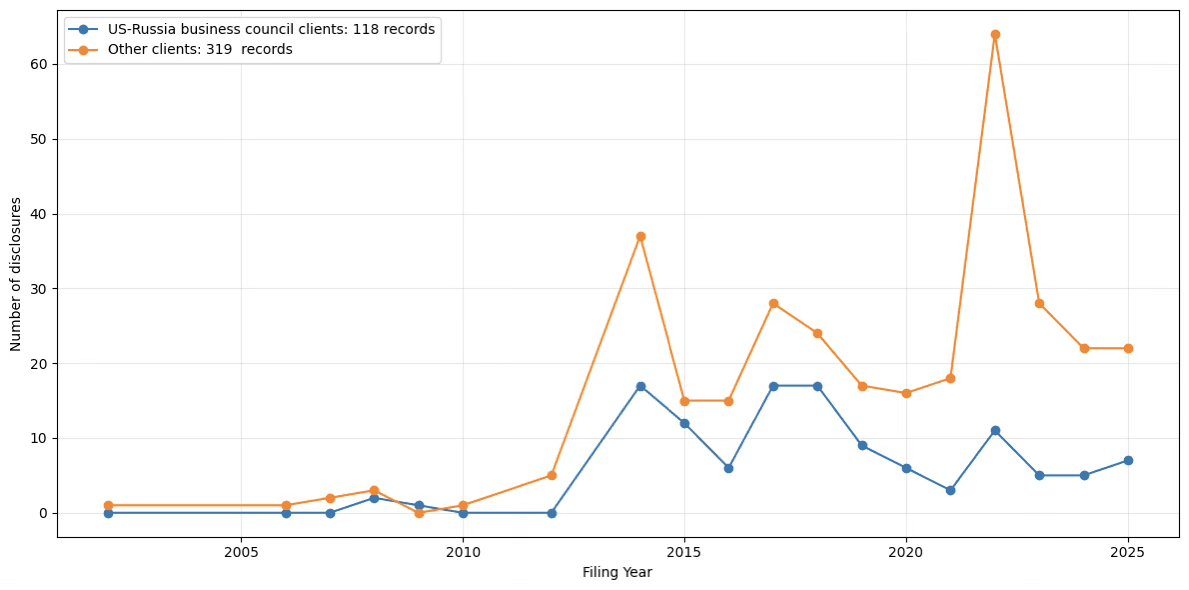
Figure 6 breaks down sanctions-related lobbying by separating clients who were members of USRBC from all other filers. Both lines rise sharply around major sanctions events.
From 2022 onward, however, the picture shifts markedly. The share of activity attributable to USRBC members drops off, and the USRBC itself largely ceased all its public activity. In its place a different set of actors came to dominate sanctions-related lobbying. Whereas the most active filers before 2022 had been commercial actors such as MasterCard, the U.S. Chamber of Commerce, and Visa—primarily monitoring sanctions to understand their implications for business—the post-2022 period saw the emergence of lobbying groups with explicitly political agendas. Among the most active were Razom, a Ukrainian-U.S. nonprofit lobbying for tougher sanctions against Russia, for Russia's designation as a state sponsor of terrorism, and for the recognition of Russian actions in Ukraine in 2022 as genocide, the FDD, which has long advocated a more confrontational sanctions posture toward Russia.
Nuclear Fuel
This section examines one of the most frequent specific lobbying topics in the dataset: nuclear fuel and enriched uranium imports to the United States. The issue has generated sustained and often competing lobbying activity: on the one side are U.S. uranium producers seeking to protect the domestic market from cheap Russian imports; on the other side are nuclear utilities with a direct interest in maintaining access to affordable Russian fuel. This tension runs through the entire period considered and shapes much of the legislative activity discussed below.
The origins of these imports lie in the Soviet collapse. As part of broader disarmament efforts following the end of the Cold War, the United States and Russia sought a practical mechanism for disposing of Russia's vast stockpiles of weapons-grade highly enriched uranium (HEU). The solution took shape between 1991 and 1993, when negotiations produced the Megatons to Megawatts Program, formally known as the HEU Agreement, signed in 1993. Under the program, Russian weapons-grade uranium was to be down-blended into low-enriched uranium (LEU) suitable for use as fuel in commercial nuclear reactors and sold to the United States over a 20-year period, from 1993 to 2013.
The terms under which Russian LEU could enter the U.S. market immediately became a point of friction. As the Soviet Union collapsed and vast stockpiles of weapons-grade uranium became available for conversion and export, U.S. domestic producers grew concerned that Russian LEU would flood the market. In December 1991, the Department of Commerce initiated a formal antidumping investigation under Section 732 of the 1930 Tariff Act to determine whether Soviet uranium imports were being sold in the United States at less than their fair value, with the U.S. International Trade Commission confirming injury in its preliminary determination. Rather than allowing the investigation to run its course and potentially result in punitive duties, Washington and Moscow—the latter having legally inherited the Soviet nuclear arsenal—reached a compromise: the Russian Suspension Agreement, signed in 1992, under which Russia agreed to limit its uranium exports in exchange for the suspension of the investigation. This arrangement governed the broader terms of Russian uranium imports throughout the period covered by the HEU Agreement, and well beyond it.
In 1994, United States Enrichment Corporation (USEC; later rebranded Centrus Energy) and TENEX, a subsidiary of Rosatom responsible for uranium exports, signed a commercial agreement formalizing their respective roles as executive agents for the HEU Agreement on the U.S. and Russian sides. Both USEC/Centrus and TENEX appear as lobbyists, as does U.S.-registered Uranium One Inc.—a company in which Atomredmetzoloto (ARMZ), a uranium mining subsidiary of Rosatom, held a 51% stake, meaning it is effectively part of the Russian state nuclear complex. Figure 7 illustrates a familiar asymmetry in disclosures filed: Russian-affiliated entities account for only 6 over the entire period, while U.S. clients generated 131.
In 2009, Exelon Business Services LLC, one of the largest nuclear utilities in the United States, signed a long-term supply contract with TENEX for uranium running from 2014 to 2020. Unlike the HEU Agreement, which drew on Russia's stockpiles of weapons-grade uranium and was scheduled to expire in 2013 once those stocks were fully converted to LEU, this Exelon-TENEX contract covered commercial enrichment services from Russian civilian facilities. The deal took years to materialize: From 2006 onward, Exelon had been actively lobbying on the terms of both the Russian Suspension Agreement and the HEU Agreement, seeking to ensure continued access to Russian reactor fuel on favorable terms once the original intergovernmental program came to an end.
Figure 7. Annual LDA Disclosures on Nuclear Fuel
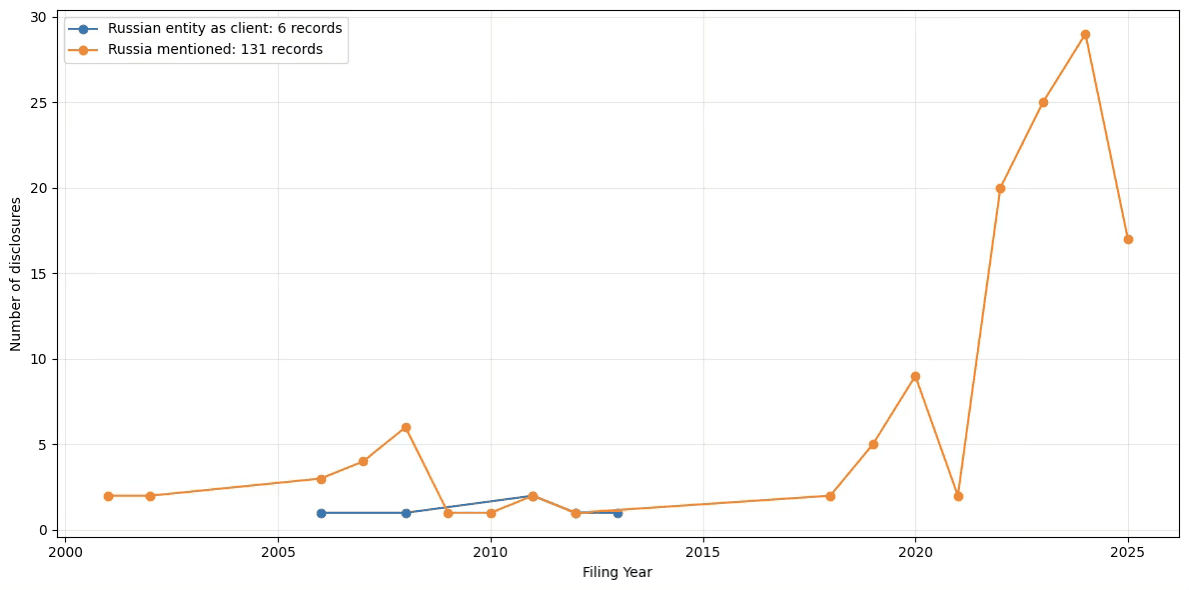
A second pickup in lobbying activity is visible around 2020, driven by the approaching expiration of the Russian Suspension Agreement on December 31 of that year. Domestic uranium producers (e.g., Energy Fuels Resources, Uranium Energy Corporation, and Uranium Producers of America) feared that without renewal, the lapse of the agreement's export limits could expose the U.S. market to unrestricted Russian imports, undercutting domestic producers. Nuclear utilities dependent on Russian fuel (e.g., Exelon, Entergy Services, and Xcel Energy), by contrast, worried that expiration would trigger the resumption of the suspended antidumping investigation, potentially disrupting or halting supplies altogether pending its outcome. Notably, Russian-affiliated entities (including TENEX) were not participating in the lobbying[^22]. The result was a compromise: in October 2020, the Department of Commerce and Rosatom signed an amendment extending the Russian Suspension Agreement through 2040 and entailing a gradual reduction in Russia's share of the U.S. enrichment market from approximately 20% to an average of 17%, with a ceiling of 15% from 2028 onward.
The most intensive lobbying activity on this issue is seen after 2022, driven by intensifying legislative efforts to restrict Russian uranium imports in the wake of Russia’s full-scale invasion of Ukraine. These efforts culminated in the passage of the Prohibiting Russian Uranium Imports Act (H.R. 1042), signed into law in May 2024, which banned the importation of unirradiated LEU produced in Russia or by Russian entities, with temporary exemptions available through January 2028 for operators unable to secure alternative supplies. Domestic uranium producers and their representative associations—among them the Uranium Producers of America and National Mining Association, as well as individual companies such as Cameco, Energy Fuels Resources, and Uranium Energy Corporation—lobbied consistently for a ban on Russian uranium imports and other measures to strengthen the domestic fuel cycle[^23]. On the other side, nuclear utilities and their associations—including the Nuclear Energy Institute, Entergy Services, Constellation Energy, Xcel Energy, and Exelon—actively lobbied to preserve access to Russian fuel. As Reuters reported in March 2022, the Nuclear Energy Institute was pushing the White House to ensure that uranium would not be caught up in any future energy-related sanctions[^24].
Conclusion
Examining LDA filings provides a fuller picture of Russia-related lobbying than FARA data does alone, capturing the full range of issues lobbied and commercial engagement—both in Russia's interests and against them. The function of lobbying Russian state interests is performed partly by state-affiliated companies such as Gazprom and Sberbank. It has also involved firms that, though without direct state ownership, operate in line with state priorities, including Alfa-Bank, Novatek, and En+ Group. In practice, the line between commercial and state interests in these cases is often blurred. These companies have typically lobbied to preserve opportunities for cooperation with the United States—to maintain trade, investment, and joint projects. This has meant pushing for political progress in WTO accession negotiations and later for easing or limiting sanctions pressure.
The data suggests that the biggest role in building commercial ties, however, is played not by Russian commercial actors—whether state-owned or private—but by U.S. ones. Some were interested in Russia as a market, embodied by the work of the USRBC. Others were interested in Russian raw materials and commodities, best reflected in the case of nuclear fuel. This U.S. dominance is visible in the responsiveness of U.S. commercial actors to policy developments and events: Every significant change in Russia's status as a trading partner—WTO accession negotiations, the granting of PNTR, the introduction of sanctions, the suspension of normal trade relations—has triggered a sharp increase in lobbying activity by U.S. firms. Russian commercial actors, by contrast, have showed no such responsiveness, maintaining a steady yet limited presence.
[^1]: Craig Holman and William Luneburg, "Lobbying and Transparency: A Comparative Analysis of Regulatory Reform," Interest Groups & Advocacy, no. 1 (May 2012): 75–104, https://doi.org/10.1057/iga.2012.4.
[^2]: Foreign Agents Registration Act, Public Law 75-583, 52 Stat. 631 (1938).
[^3]: Lobbying Disclosure Act of 1995, Public Law 104-65, 109 Stat. 691 (December 19, 1995).
[^4]: Jacob R. Straus, Lobbying Registration and Disclosure: The Role of the Clerk of the House and the Secretary of the Senate, CRS Report R44292 (Washington, DC: Congressional Research Service, December 1, 2015), https://www.congress.gov/crs-product/R44292.
[^5]: Hailey Fuchs, "How Russian Entities Are Retaining Much of Their D.C. Lobbying Influence," Politico, March 22, 2022, https://www.politico.com/news/2022/03/22/russian-entities-lobbying-disclosure-00019221.
[^6]: In practice, Russia's presence in FARA filings has been remarkably limited: over the entire period of FARA existence since 1942 till 2025 only 147 Russian foreign agents were registered, of whom 5 remain active in the beginning of 2026.
[^7]: Senate Office of Public Records cannot vouch for the data or analyses derived from these data after the data have been retrieved from LDA.gov
[^8]: Honest Leadership and Open Government Act of 2007, Public Law 110-81, 121 Stat. 735 (September 14, 2007).
[^9]: Registration is required where total income from lobbying activities on behalf of a given client exceeds $5,000 per semiannual period (in the case of a lobbying firm), or where total lobbying expenditures exceed $20,000 per semiannual period (in the case of an organization lobbying on its own behalf).
[^10]: See, for example, the lobbying registration for Severstal North America (December 14, 2011), where no specific issues were listed, https://lda.gov/filings/public/filing/310922ac-cd4b-4adc-81f2-2d7b79a33a6d.
[^11]: See, for example, the Q3 2025 lobbying disclosure report for Veon Ltd (July 1–September 30, 2025, filed October 20, 2025), where issues are described very vaguely,
https://lda.gov/filings/public/filing/5bbeb37d-f39f-44c6-bdf5-df1ff82afdc0.
[^12]: All lobbying disclosure data are drawn from LDA filings available through the U.S. Senate Lobbying Disclosure Act API, https://lda.senate.gov/api/.
[^13]: See, for example, the second-quarter-2025 lobbying disclosure report for Travel Goods Association (April 1–June 30, 2025, filed July 21, 2025), where a single sum for income and expenses was reported across a wide range of lobbying issues http://lda.gov/filings/public/filing/636555cd-d327-433f-ac5a-0e0260857f93.
[^14]: Russia and Moldova Jackson–Vanik Repeal and Sergei Magnitsky Rule of Law Accountability Act of 2012, H.R. 6156, Public Law 112-208, 126 Stat. 1496 (December 14, 2012).
[^15]: Suspending Normal Trade Relations with Russia and Belarus Act, H.R. 7108, 117th Cong. (2022), signed into law April 8, 2022, Public Law 117-110.
[^16]: “Dell Ceases All Russian Operations after August Offices Closure,” Reuters, August 27, 2022, https://www.reuters.com/technology/dell-ceases-all-russian-operations-after-august-offices-closure-2022-08-27.
[^17]: “For Fear or Money, Consumer Giants Are Staying in Russia,” Bloomberg, February 12, 2023, accessed March 23, 2026.
[^18]: Executive Order 13660, “Blocking Property of Certain Persons Contributing to the Situation in Ukraine,” 79 Fed. Reg. 13493 (March 6, 2014); Executive Order 13661, “Blocking Property of Additional Persons Contributing to the Situation in Ukraine,” 79 Fed. Reg. 15535 (March 16, 2014); Executive Order 13662, “Blocking Property of Additional Persons Contributing to the Situation in Ukraine,” 79 Fed. Reg. 16169 (March 20, 2014).
[^19]: Executive Order 13694, “Blocking the Property of Certain Persons Engaging in Significant Malicious Cyber-Enabled Activities,” 80 Fed. Reg. 18077 (April 1, 2015); Executive Order 13757, “Taking Additional Steps to Address the National Emergency With Respect to Significant Malicious Cyber-Enabled Activities,” 82 Fed. Reg. 1 (January 3, 2017).
[^20]: U.S. Department of the Treasury, “Treasury Designates Russian Oligarchs, Officials, and Entities in Response to Worldwide Malign Activity,” Press Release SM-0338, April 6, 2018, https://home.treasury.gov/news/press-releases/sm0338.
[^21]: U.S. Department of the Treasury, “Treasury Designates Russian Oligarchs, Officials, and Entities in Response to Worldwide Malign Activity,” Press Release SM-0338, April 6, 2018, https://home.treasury.gov/news/press-releases/sm0338.
[^22]: Tenam Corporation, the United States representative of TENEX, was registered as a lobbying client by The Network Companies LLC in 2019, with the registrant identifying it as the U.S. representative of “TENEX, a leading global supplier of nuclear fuel cycle products.” A termination report filed the same year recorded zero lobbying activity.
[^23]: S. 3856 / H.R. 7222, 117th Cong. (2021–2022); S. 763, Reduce Russian Uranium Imports Act, and H.R. 1042, Prohibiting Russian Uranium Imports Act, 118th Cong. (2023–2024); H.R. 209, Permitting for Mining Needs Act, 118th Cong. (2023–2024); Inflation Reduction Act, Public Law 117-169, 136 Stat. 1818 (August 16, 2022), HALEU provisions; Nuclear Fuel Security Act, enacted as Division C of the National Defense Authorization Act for Fiscal Year 2024, Public Law 118-31, 137 Stat. 136 (December 22, 2023).
[^24]: Ernest Scheyder and Trevor Hunnicutt, “Exclusive: U.S. Utilities Push White House Not to Sanction Russian Uranium,” Reuters, March 2, 2022.